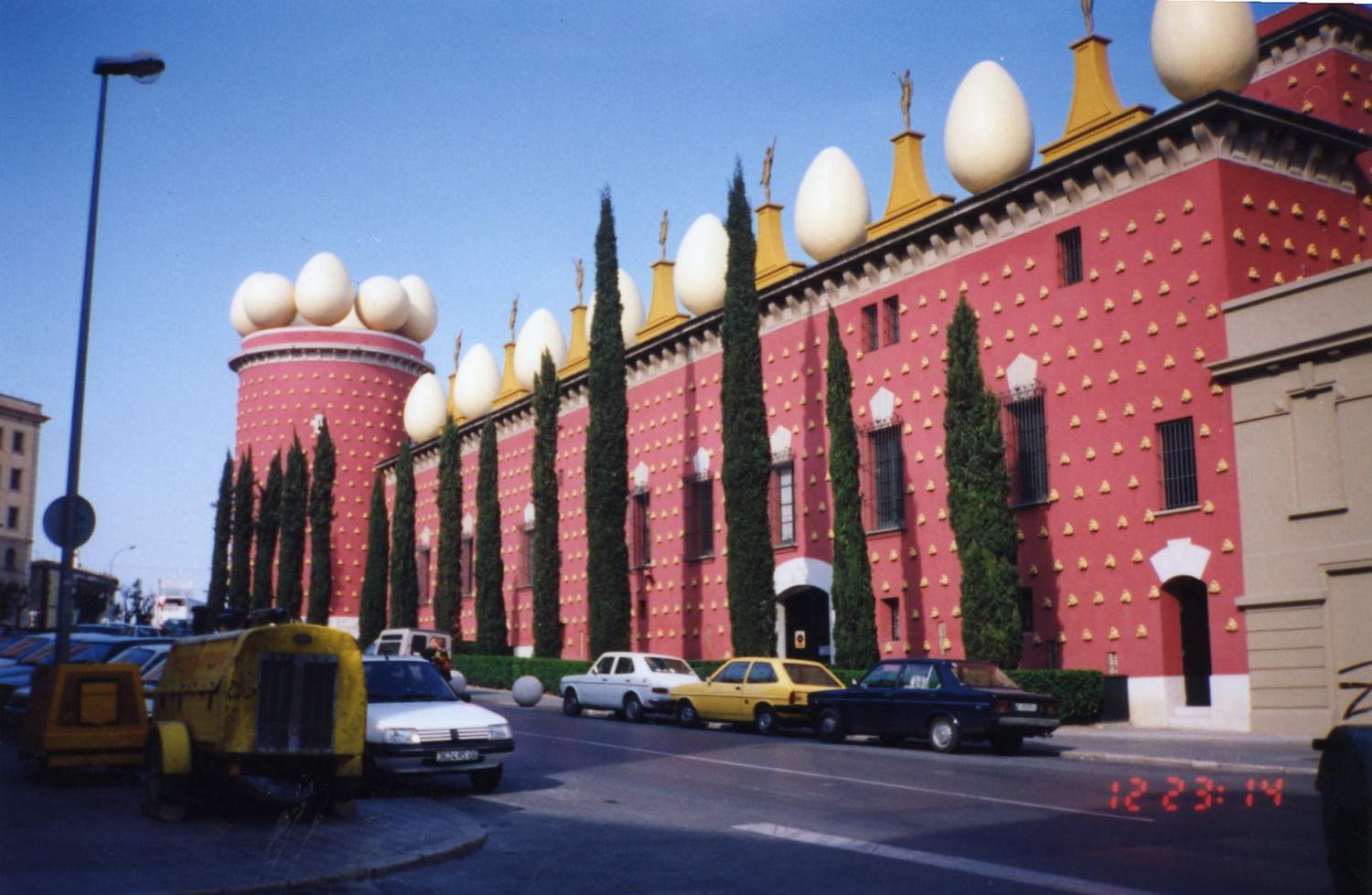


The History of Dalí Theatre and Museum
The Dalí Theatre and Museum is located in Figueres, Spain. Its origins are tied to the ruins of the old Figueres Municipal Theatre, a structure that had been burned during the Spanish Civil War. For years, the site remained in a state of ruin, a hollow shell of its former self. In 1960, a decision was made by Salvador Dalí and the mayor of Figueres to rebuild this space, transforming the damaged landmark into a dedicated museum for the artist's work.
Construction on this transformation began in 1968. The project sought to repurpose the historical site, eventually leading to the establishment of the museum in 1974. Salvador Dalí maintained a deep connection to this location, living in Figueres from 1984 to 1989. The building itself remains a physical part of his personal history, built upon the very ground where he once held his first public exhibitions as a young man.
The Architecture of a Surrealist Labyrinth
The structure is a monumental presence in Figueres, Spain, acting as the artist's final creation. It occupies the site of a converted, burned-out derelict theatre, where the original purpose of the building has been subsumed by a sprawling, surrealist labyrinth. This design seeks to disorient the rational mind through a complex arrangement of spaces. The architects, Joaquim de Ros i Ramis and Alexandre Bonaterra, worked to transform the ruins into this intentional, psychological environment. The layout extends beyond the primary walls to include buildings and courtyards adjacent to the old theatre.
A striking assemblage of shapes defines the exterior, culminating in a magnificent geodesic dome. This glass structure crowns the former stage of the theatre, allowing light to penetrate the interior. Where the audience once sat, the space has been transformed into a courtyard open to the sky. This openness provides a sharp contrast to the enclosed, dreamlike rooms found within the labyrinth. The architecture does not merely house art; it functions as a physical manifestation of the subconscious, where the boundaries between a building and a dream become porous.
The Extensive Collection of Salvador Dalí
The museum holds the single largest and most diverse collection of works by Salvador Dalí. At its core lies the artist's personal collection, a body of work that spans every decade of his creative life. These paintings exist alongside sculptures, three-dimensional collages, and mechanical devices that challenge the boundaries of traditional form. The presence of these objects creates a physical record of a life lived through art.
Beyond the canvas, the collection expands into the intricate and the ephemeral. Intricate drawings and prints are held here, as are jewelry designs and holographic creations. This variety reflects a relentless pursuit of new mediums. While the focus remains on Dalí, the museum also houses a small selection of works by other artists, including El Greco and Marcel Duchamp, as well as pieces by John de Andrea.
- Gala Contemplating the Mediterranean Sea Which at Eighteen Metres Becomes the Portrait of Abraham Lincoln, 1976
- Cubist Composition - Portrait of a Seated Person Holding a Letter, 1923
Masterpieces and Iconic Works
The presence of the works within these walls reveals the evolution of a singular vision. Early experiments are visible in pieces such as The Smiling Venus (1921) and Tea 'sur l'herbe' (1921). These works sit alongside Cubist Composition - Portrait of a Seated Person Holding a Letter, which dates to about 1923. Such pieces provide a foundation for the more complex, transformative objects found later in the collection. One encounters Gala Contemplating the Mediterranean Sea Which at Eighteen Metres Becomes the Portrait of Abraham Lincoln, a large-scale work from about 1976 that demands a specific physical relationship with the viewer.
The boundary between functional objects and surrealist sculpture often dissolves here. A three-dimensional anamorphic living-room installation features the Mae West Lips Sofa, a piece of functional art that changes form depending on the observer's position. This preoccupation with the unexpected extends to a Dalí installation housed inside a full-sized car, a work inspired by Rainy Taxi (1938). Even the architecture contributes to this sense of the uncanny, with a glass geodesic dome cupola crowning the stage of the old theatre, allowing light to interact with the objects below.
- The Smiling Venus (1921)
- Tea 'sur l'herbe' (1921)
- Cubist Composition - Portrait of a Seated Person Holding a Letter (about 1923)
- Gala Contemplating the Mediterranean Sea Which at Eighteen Metres Becomes the Portrait of Abraham Lincoln (about 1976)


