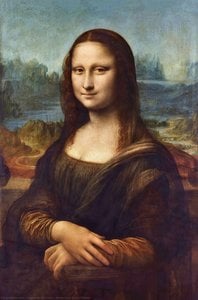
I got to the Louvre at nine in the morning, which everyone tells you is the smart move, and I stood in a room the size of a high-school gymnasium with four hundred other people holding their phones over their heads like they were catching a bouquet, and when I finally got to the front of the scrum, the Mona Lisa was smaller than my laptop screen. That's it. That's the whole confession. I had pictured something the size of a garage door, glowing, maybe humming a little, and instead I got a 30-by-21-inch (76.2 by 53.3 cm) walnut panel behind bulletproof glass and a rope line, lit like a hostage video, and my first honest thought — not my later, cleaned-up, wrote-an-article-about-it thought, but my actual first thought — was oh. Just: oh. Flat, a little embarrassed, the way you feel when you finally meet someone famous and they turn out to have a regular, forgettable handshake.
Here's what I didn't understand yet, standing there disappointed: nobody in that room was checking whether it was the best painting in the building. Two floors up, unbothered, hangs a Vermeer, and I promise you it will out-paint the Mona Lisa on pure craft any day of the week, and nobody's elbowing anybody to see it. The crowd wasn't voting on quality. The crowd was there because this is the most copied face in the history of the species, and standing in front of the original is the one experience the copies can't give you, and that scarcity is the whole show. Eighty percent of the Louvre's nine million annual visitors make the pilgrimage to that one room. Eighty percent. That's not connoisseurship, that's a stadium wave.
Fame and "most copied" are not the same list, and once you see the gap you can't unsee it
Every "greatest paintings of all time" listicle on earth is really answering one question — which paintings does the culture agree are important — and calling it done. That's a fame ranking. It's built out of art history seminars and museum wall text and, increasingly, whatever ranks well on Google. It rewards seriousness. It rewards paintings you're supposed to have an opinion about.
"Most copied" measures something completely different and much more honest: how many times has a human being, somewhere, tried to make this image exist again. Hand-painted knockoffs, giclée prints, tattoo-parlor flash sheets, coffee mugs, a kid's art-class assignment, Warhol running it through a silkscreen forty times because he could. That's not reverence. That's appetite. And appetite runs on rules fame doesn't care about — is the composition simple enough to survive being shrunk onto a phone case, is the color scheme loud enough to read from across a room, and, the one nobody puts on the wall text, is the artist dead long enough that copying it is legal. A masterpiece that's still in copyright might be the most admired painting on the planet and still lose to a public-domain landscape nobody can name, because one of them you can print for money and the other one gets you a letter from a lawyer. Fame is permanent. Copyright expires on a clock. Those two rankings only agree at the very top, and even there, barely.
Look at the paint. Just look at it.
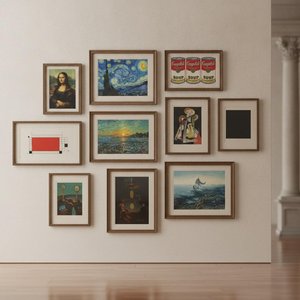
Stand close enough to The Starry Night — you can, at MoMA, closer than the guards probably want — and the first thing you notice is that it isn't flat. It's not a picture of a night sky. It's a relief map of one. Van Gogh didn't brush the paint on so much as build it, ridge by ridge, straight from the tube half the time, and you can see exactly where his hand slowed down and where it didn't. The cypress tree on the left is black as a burnt matchstick, twisting up out of the frame like smoke that decided to become solid, and around it the sky is doing something no calm person's hand does — it's dragged and looped and scraped into fat spiraling ropes of cobalt and Prussian blue, whorl folding into whorl, so thick in places the brush must have skidded and caught and skidded again, leaving little combed furrows you can count with your fingernail if a guard isn't looking. The stars aren't dots. They're small hot suns, white and lemon-yellow, each one wearing a corona painted in a ring of quick, stabbing strokes, like he attacked the canvas eleven separate times just to get one star to glow. Down at the bottom, almost an afterthought, a sleepy little village sits under all of that violence — dark blue roofs, one crooked church spire, a few warm orange windows — completely still, completely oblivious, while the entire sky above it churns like a pot somebody forgot to turn down. It is a quiet town under a nervous breakdown. It's the best description of what insomnia actually feels like that anyone has ever gotten onto a rectangle, and it cost him nothing to make and it's public domain, so you can own a piece of cloth with that same image on it for eighty bucks. That gap — between what it took to make and what it costs to have — is the whole engine of this article.
This has been going on for five hundred years, and the Louvre still runs it like a union
People act like reproduction culture started with the postcard rack. It didn't. Leonardo's own workshop turned out a second Mona Lisa while he was alive to watch — the Prado's version is now understood to be a studio copy painted in the same room, at the same time, by a student sitting a few feet from the master, which means the "original" was never even a lonely object, it had company from day one. The Louvre has run a formal copyists' bureau since 1793 — since the French Revolution, since before the metric system — where somewhere between ninety and two hundred and fifty painters a year get an official permit, an easel, and three months to sit in the galleries copying whatever they want off the wall in full view of the tourists. And when a painting can't be copied fast because it physically can't move — Leonardo's Last Supper is painted straight onto a refectory wall in Milan, not on a panel, so it stays put forever — the museum rations access instead: about 1,300 tickets a day, fifteen-minute slots, thirty-five people at a time, booked out weeks in advance like a table at a restaurant that doesn't need the money. Scarcity is not a side effect of fame. Scarcity manufactures fame. The harder a painting is to see, the harder people work to make a version they can keep.
The verdict: here are the twenty, ranked, with the receipts
I'm not hedging this. This is the list.
Number one is boring and correct. Number two is the one that made me change my mind about who actually deserves to be number one, and I stand by leaving it where it is anyway — the Mona Lisa wins on sheer historical head start, four hundred years of copying before anyone else even entered the race, and head starts like that don't get caught. Everything from twelve onward is doing something the top eleven aren't: it's still fighting a copyright clock, which means half this list you're legally free to copy tonight and half of it you're not — check the "in copyright" column above title by title before you commission a copy, since the ranking alone won't tell you which side of that line a given piece falls on.
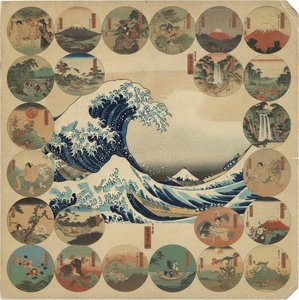
Notice, too, what snuck onto a "paintings" list without technically being a painting — a woodblock print at five, a ceiling fresco at eleven. I left them in on purpose. A ranking that quietly filters out anything inconvenient isn't a ranking, it's a brochure.
One more thing worth being straight about: our own commission data — eighteen years of actual hand-painted orders, one narrower medium — puts The Starry Night first and the Mona Lisa second, not the other way round. That's not a mistake. Those figures count what people paid a studio to paint since 2008. This ranking counts five hundred years of every format there is. Different question, different answer, both honest.
Three questions you're probably asking yourself
Okay, but what's actually the single most copied painting, no caveats?
The Mona Lisa. Not close, historically. Copying started in Leonardo's own studio before he'd even finished it, it's been public domain forever, and it's had five hundred years and zero legal obstruction to build a lead nothing else on this list can touch.
If it's public domain, why does the Louvre act like I'm trying to steal it?
Because the painting being free and the room being crowded are two different problems. Copyright expired centuries ago. Physics didn't. One four-hundred-square-foot room, nine million visitors a year, eighty percent of them wanting the same eight feet of floor — that's a traffic problem wearing a copyright costume.
Why is a 1962 comic-book-looking soup can not on this list and a 500-year-old Flemish altarpiece is?
Because this list ranks physical paintings people can and do own copies of, and the closer something is to still being owned by somebody's estate, the shorter and more legally complicated that list of copies gets. Warhol's on here at sixteen precisely because he's the exception that proves it — famous, heavily copied, and still, right now, not free.
Related on Most-Famous-Paintings.com
- Own the number one, cheaper than you'd think: order a Mona Lisa reproduction.
- The Starry Night's impasto is the whole argument for paint over print — see it in the catalogue.
- Browse Klimt's full catalogue if The Kiss's gold leaf is more your wall than a night sky.
Sources
- The Story behind the Most Reproduced Artwork of All Time — Artsy
- Mona Lisa (Prado) — Wikipedia
- Leonardo and the copy of the Mona Lisa — Museo Nacional del Prado
- Highest insurance valuation for a painting — Guinness World Records
- The 'Mona Lisa' Is Moving to a Room of Her Own at the Louvre — Smithsonian Magazine
- The underground Mona Lisa and the trouble with tourists — The Week
- The world's 100 most visited art museums in 2025 — The Art Newspaper
- How Skilled Copyists Leave the Louvre with a Masterpiece Every Year — My Modern Met
- A stroke of genius: Meet the copyists recreating the Louvre's masterpieces — CNN
- Buy your ticket to visit Leonardo's Last Supper — YesMilano
- How to Get Last Supper Tickets in Milan — The Crowded Planet
- Klimt's The Kiss in Vienna — Visiting Vienna
- The Great Wave off Kanagawa — Wikipedia
- The Great Wave off Kanagawa — Artelino