Introduction
The 18th century in the Southern Netherlands and the surrounding territories marked a period of profound stylistic transition, where the dramatic intensity of the Baroque began to soften into the grace of the Rococo and the structured elegance of Neoclassicism. Belgian painters of this era operated at a unique cultural crossroads, blending the meticulous Flemish tradition of detail with the burgeoning international trends of French and Italian aesthetics. This era was defined by a mastery of light and a sophisticated approach to diverse genres, ranging from the grandiosity of mythological scenes to the intimate, atmospheric nuances of landscape and still life.
As the geopolitical landscape of Europe shifted, these artists became essential conduits of visual language, capturing the opulence of aristocratic life while simultaneously exploring the natural world with newfound scientific curiosity. Their ability to balance technical precision with emotional resonance ensures that their works remain vital today, offering a window into the changing social hierarchies and the evolving perception of beauty in the pre-industrial age. By examining their contributions, we gain a deeper understanding of how the foundations of modern European art were laid through a synthesis of regional heritage and continental innovation.
The following selection highlights ten significant figures who defined this period, showcasing the breadth of talent that emerged from this vibrant artistic landscape.
Peter Tillemans
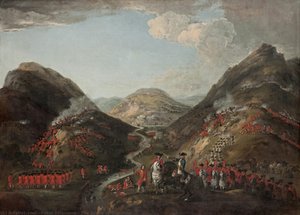 The Battle of Glenshiel - Peter Tillemans
Born in Antwerp around 1684, Peter Tillemans represents a vital link between the Flemish tradition and the evolution of the English sporting school. As a painter born in Belgium who rose to prominence in the early 1700s, his career exemplifies the international movement of talent from the Low Countries to the burgeoning art scene of London. Trained in the rich, atmospheric techniques of his homeland and sharing stylistic connections with his brother-in-law, the celebrated Pieter Casteels, Tillemans brought a meticulous, Flemish sense of precision to the depiction of movement and landscape.
His work is defined by a unique ability to fuse topographical accuracy with the visceral energy of equestrian life. In his notable work, The Battle of Glenshiel (1719), he captures the intensity of the Jacobite rising with remarkable detail. The painting serves as both a historical record and a masterclass in kinetic energy, as red-coated soldiers and cavalry navigate the rugged, mountainous terrain of Scotland. Through his command of light and shadow, Tillemans transformed the rigid requirements of topographical art into dramatic, breathing narratives of the natural and military world.
Joseph Benoit Suvée
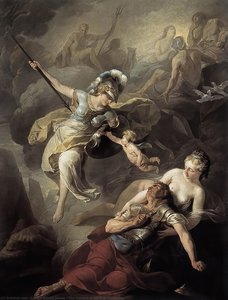 The Combat of Mars and Minerva - Joseph Benoit Suvée
In his 1771 masterpiece, The Combat of Mars and Minerva, the dramatic tension of classical mythology is captured through a sophisticated command of movement and light. This oil on canvas, which earned Suvée the prestigious Prix de Rome, showcases a scene of divine confrontation where anatomical precision meets the structured idealism of the Neoclassical movement. The composition utilizes a controlled interplay of shadow and light to define the heavy folds of drapery and the muscularity of the figures, creating a sense of profound depth and theatricality.
Born in Bruges in 1743, Joseph Benoit Suvée stands as a vital representative of 18th century Belgian painters, having transitioned from his Flemish roots to the heart of the French academic tradition. His work marks a significant departure from the lightheartedness of the Rococo, favoring instead the moral gravity and rigorous discipline of historical narratives. Suvée’s signature style is defined by an ability to breathe life into the legends of Greece and Rome, using a palette that emphasizes the tactile quality of skin and fabric. Through his mastery of composition, he transformed mythological and historical scenes into epic stages for human emotion and academic excellence.
Pieter van Bloemen
 Horseman at Rest - Pieter van Bloemen
Pieter van Bloemen stands as a vital link between the late Flemish Baroque and the evolving tastes of the 18th century. Born in Antwerp, his career spanned the transition into the 1700s, a period where his mastery of animalier subjects and Italianate landscapes became highly sought after. His identity as a Belgian painter is rooted in his Antwerp training under Simon Johannes van Douw and his eventual status as a master of the Guild of Saint Luke, a foundation that allowed him to flourish during the early decades of the 18th century.
His representative work, Horseman at Rest (1705), exemplifies the sophisticated style he refined during his extensive travels through Italy and his membership in the Bentvueghels in Rome. The painting captures a moment of quietude within a rugged, untamed landscape, utilizing a muted, earthy palette to ground the scene in realism. Through meticulous brushwork, he renders the textures of animal hair and heavy fabrics, creating a palpable sense of atmosphere. The composition, characterized by a soft, overcast light, showcases his ability to blend dynamic equestrian scenes with the tranquil, atmospheric depth of the Roman Campagna.
Joseph Van Aken
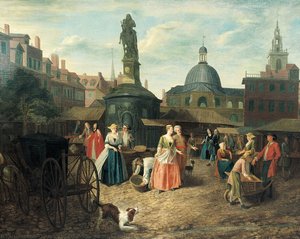 The Old Stocks Market - Joseph Van Aken
In The Old Stocks Market, Joseph Van Aken captures a bustling slice of 18th-century London, featuring the equestrian statue of Charles II and the distinctive dome of St Stephen Walbrook. This vibrant scene, characterized by its rich espresso tones and lively civic atmosphere, showcases the artist's ability to blend architectural precision with the spontaneous energy of a city market.
Born in Antwerp around 1699, Van Aken represents the significant migration of Belgian talent to the English capital during the 1700s. His journey from the traditions of the Antwerp School to the burgeoning art scene of Georgian London defines his place among 18th-century Belgian painters. Though he likely developed his skills through an autodidactic approach rather than a formal apprenticeship, his mastery of the Flemish Baroque style is unmistakable. He became particularly celebrated for his sophisticated drapery paintings, using meticulous brushwork to render the texture and weight of fine fabrics with profound realism. Whether depicting intimate conversation pieces or expansive urban landscapes, his work is marked by a subtle psychological depth and a command of light that elevated the genre of decorative painting during this era.
Victor Honoré Janssens
 Landscape with Sacrifice to Diana - Victor Honoré Janssens
A master of dramatic narrative, Victor Honoré Janssens represents the transition of Flemish artistry into the early 18th century. Born in Brussels and trained under Lancelot Volders within the esteemed Guild of Saint Luke, his career spanned the most prestigious courts of Europe, from Germany to Italy. His inclusion in the canon of 18th-century Belgian painters is defined by his ability to blend the intense Baroque energy of his training with the refined, classical grace required by the aristocratic patrons of Vienna and London. His work often bridged the gap between grand historical painting and the intricate demands of tapestry design.
In his evocative work, Landscape with Sacrifice to Diana (c. 1704), Janssens demonstrates his mastery of mythological storytelling. The canvas depicts a crowded, solemn assembly of men, women, and children gathered around an altar to perform a sacred rite. As smoke rises toward the heavens, the viewer's eye is drawn upward to a prominent statue of the goddess Diana, who watches over the ritual from a pedestal. Through a layered landscape that stretches toward a mountainous horizon, Janssens uses theatrical light and complex composition to merge the mortal realm with the divine, a hallmark of his sophisticated Flemish style.
Leonard Defrance
 Women Fighting - Leonard Defrance
Born in Liège in 1735, Leonard Defrance stands as a quintessential figure among 18th century Belgian painters, embodying the era's transition from traditional apprenticeship to the grander European Neoclassical sensibility. His artistic foundation was laid during a rigorous seven-year apprenticeship under Jean-Baptiste Coclers, but it was his intrepid journey to Rome in 1753 that truly expanded his vision. By traveling on foot through the Italian peninsula, Defrance absorbed the dramatic compositions of the Baroque and the structural clarity of the Renaissance, elements that would later define his multifaceted career in Liège.
His versatility allowed him to master landscapes and still lifes, yet his ability to capture human drama is perhaps most evident in his 1775 work, Women Fighting. This piece exemplifies the shift in 18th-century Belgian art away from distant allegories toward the tension of domestic life. Through a muted palette of ochre and deep browns, Defrance utilizes light and shadow to heighten the chaos of the struggle. The painting showcases his technical precision, particularly in the rendering of heavy silk drapery and the stark, saturated red of a canopy bed, creating a sense of movement that disrupts the architectural stillness of the room.
Pieter Jozef Verhaghen
 Jesus in Emmaus - Pieter Jozef Verhaghen
A significant figure among 18th century Belgian painters, Pieter Jozef Verhaghen (1728–1811) bridged the gap between the grand traditions of the past and the evolving sensibilities of his era. Born in Belgium, his artistic identity was deeply rooted in the Flemish tradition, particularly the dramatic and fleshy style of Rubens. His career was marked by a profound connection to both his homeland and Italy, where his work reflected a sophisticated understanding of light and composition.
Verhaghen’s mastery is perhaps most evident in his religious commissions, where he utilized a dramatic chiaroscuro to elevate spiritual narratives. In his representative work, Jesus in Emmaus (1772), he captures a moment of profound revelation through the interplay of light and shadow. The scene, centered on the breaking of bread, uses a palette of deep reds, ochres, and earthy tones to create an intimate, tangible atmosphere. Through precise brushwork and a command of texture, he transforms a quiet meal into a powerful spiritual encounter, ensuring his place as a vital voice in the 18th-century Belgian artistic landscape.
Simon Du Bois
 Aernout van Citters (1661-1718), Son of Aernout van Citters and Christina de Brauw, Simon Dubois, 1690 - 1708 - Simon Du Bois
Simon Du Bois represents a vital link in the evolution of Flemish artistry, bridging the intense traditions of the 17th century with the refined sensibilities that would define the 18th century Belgian painters. Born in Antwerp, his early training under Jan van Berchem and Philips Wouwermans instilled in him a profound mastery of movement and animal subjects. However, his artistic trajectory was fundamentally altered by his travels to Venice and Rome, where he embraced an Italianate style characterized by theatrical compositions and dramatic lighting.
His ability to blend psychological realism with intense visual drama allowed him to transition from rendering dynamic cavalry charges to becoming a sought-after portraitist for the European aristocracy. This versatility is exemplified in his work Aernout van Citters (1661-1718), Son of Aernout van Citters and Christina de Brauw, Simon Dubois, 1690 - 1708, a portrait that showcases his skill in capturing both individual character and the complex heraldic traditions of the era. By mastering both the grand biblical scene and the intimate courtly portrait, Du Bois helped establish the sophisticated aesthetic foundations that subsequent generations of Belgian artists would build upon during the 1700s.
Gaspar Peeter Verbruggen the Younger
 Portrait of Maria Luisa of Savoy in the Frame Decorated with Flowers - Gaspar Peeter Verbruggen the Younger
Gaspar Peeter Verbruggen the Younger stands as a pivotal figure in the transition of Flemish still life traditions into the early 18th century. Born in Antwerp in 1664, his career spanned the turn of the century, bridging the opulent Baroque sensibilities of the 17th century with the refined decorative tastes of the 1700s. As a master of floral and fruit arrangements, his work exemplifies the high level of botanical artistry produced in the Belgian territories during this era. His technical precocity was evident early on, having entered the Antwerp Guild of Saint Luke at the age of thirteen.
His ability to blend intense botanical realism with grand, ornamental compositions is masterfully displayed in his 1704 work, Portrait of Maria Luisa of Savoy in the Frame Decorated with Flowers. In this monumental oil on canvas, Verbruggen utilizes a lush, dense border of roses, lilies, and carnations to frame the bust of the Queen consort of Spain. The composition creates a dramatic interplay between the dark, receding background and the vibrant, tactile textures of the floral garland, showcasing the sophisticated decorative style that defined his legacy as a premier Belgian painter of the early 18th century."
Philipp Ferdinand de Hamilton
 White Spotted Deer and a Porcupine - Philipp Ferdinand de Hamilton
Born in Brussels, Philipp Ferdinand de Hamilton represents the sophisticated intersection of Flemish technical tradition and the aristocratic elegance of the 18th century. As a painter born in Belgium who achieved international prominence, his career was defined by a remarkable period of stability; from 1705 until his death in 1750, he served as a court painter in Vienna. This prestigious tenure allowed him to evolve from the quietude of traditional still life into a more dynamic, narrative style that catered to the social status of the Austrian elite.
His work, exemplified by the 1724 masterpiece White Spotted Deer and a Porcupine, demonstrates an almost clinical, anatomical precision. Inheriting a deep understanding of texture from his father, the still-life painter James de Hamilton, Philipp Ferdinand moved beyond mere decoration to capture the visceral reality of the natural world. In this specific composition, the artist masterfully manipulates light and shadow to define contrasting organic surfaces, from the soft, creamy coats of the deer to the sharp, radiating quills of the porcupine. His ability to transform the spoils of the hunt into structured, formal compositions marks him as a vital figure in the evolution of 18th-century European art.
Conclusion
The 18th century was a transformative era for Belgian art, characterized by a sophisticated transition from the heavy grandeur of the Baroque toward the delicate elegance of the Rococo and the structured clarity of Neoclassicism. From the intricate landscapes of Pieter van Bloemen to the refined portraiture and pastoral scenes that defined the period, these artists collectively captured the shifting aesthetics of a changing Europe. Whether through the dramatic light of a landscape or the meticulous detail of a still life, each master contributed a unique layer to the visual heritage of the region, ensuring that the artistic dialogue of the 1700s remains vibrant and essential.
For those looking to bring this historical elegance into a modern setting, Mus3ums.com offers a way to honor these masters through our bespoke services. You can explore our full collection to find these timeless works or commission a custom piece that reimagines your own memories in a classical style. We invite you to transform your living space by living with these masterpieces through our museum-quality, hand-painted oil reproductions, each meticulously crafted by expert artists to preserve the soul and texture of the original era.