
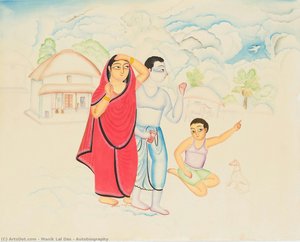
Introduction
The landscape of contemporary art in the subcontinent has undergone a profound metamorphosis during the 21st century, driven by a generation of artists who navigate the tension between ancient heritage and a rapidly globalizing reality. These painters from India are united by a unique ability to synthesize traditional iconography with modern sensibilities, creating a visual language that is as much about the digital age as it is about ancestral memory. Their work often explores the complexities of identity, the shifting urban environments of modern India, and the enduring spiritual echoes that persist amidst technological advancement.
Historically, this group represents a departure from the rigid boundaries of mid-century modernism, moving toward a more fluid, eclectic approach to medium and subject. While previous generations sought to define a national aesthetic, the artists of this century are more concerned with the individual's place within a globalized world, utilizing everything from expressive abstraction to meticulous figurative realism. This evolution reflects a culture that is simultaneously deeply rooted in its past and aggressively looking toward the future.
Today, these creators matter because they provide a vital window into the soul of a nation in transition. Their canvases capture the pulse of a society that is redefining its traditions, making their work essential for anyone seeking to understand the intersection of culture and modernity. In the following sections, we examine ten significant figures—including Zarina, Manik Lal Das, and Devender Pal Singh—whose diverse styles and profound visions define the current era of Indian artistic expression.
Zarina
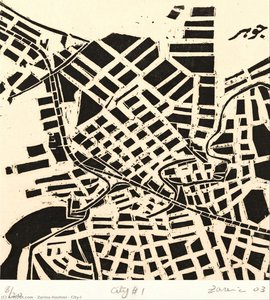 City-I - Zarina
A pioneer of minimalist abstraction, Zarina remains a defining figure among 21st century Indian painters due to her profound ability to translate the complexities of human identity into geometric clarity. Her work, which continued to resonate deeply through the early decades of this century, serves as a visual bridge between her Indian heritage and the global experience of migration. By stripping art down to its essential forms, she transformed the personal trauma of displacement into a universal language of memory and belonging.
In her evocative 2003 work, City-I, this mastery of minimalist printmaking is on full display. The piece functions as a cartography of the psyche, utilizing a stark, high-contrast interplay of light and shadow to navigate the urban landscape. Through the rhythmic placement of city streets and the transient motion of a train, Zarina captures the tension between permanent architecture and the fleeting nature of human movement. Her use of texture and void allows the viewer to experience the city not merely as a physical location, but as a psychological space where history and memory intersect. It is this ability to infuse minimalist geometry with deep, spiritual resonance that secures her legacy in contemporary art history.
Manik Lal Das
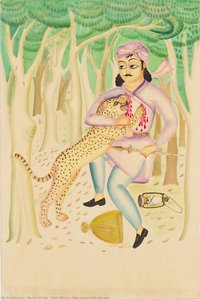
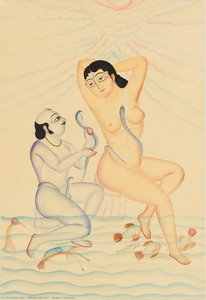 Snake charmer - Manik Lal Das
A prominent figure in the landscape of 21st century Indian painters, Manik Lal Das—often known as Kalam Patua—has dedicated his career to the vital revival of Kalighat painting. Born in 1962 in Krishnanagar, India, he was raised within the traditional Patua community of scroll painters and storytellers. This deep-rooted heritage allows him to bridge the gap between ancient narrative traditions and the contemporary era, ensuring that the expressive, bold aesthetics of Bengal's folk art remain a living, breathing medium in the modern age.
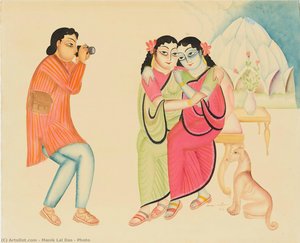
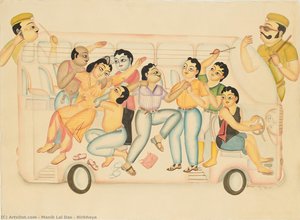
His work is characterized by vibrant watercolors and a stylistic freedom that prioritizes emotional resonance and social commentary over rigid realism. Das’s ability to translate everyday life and personal history into stylized, luminous compositions has earned his work recognition in prestigious institutions such as the Gallery of Modern Art. His representative work, Snake Charmer, serves as a masterful distillation of Bengali folklore, blending mythological themes with a contemporary sensibility. Through his "autobiography" series and depictions of modern urban life, Das secures his place as a crucial voice in 21st-century Indian art, transforming traditional scroll-painting conventions into sophisticated works of contemporary visual storytelling.
Devender Pal Singh
A hallmark of Devender Pal Singh’s oeuvre is the profound ability to reconstruct the historical narratives of Punjab through a lens of dramatic contemporary realism. His work is instantly recognizable by its commanding compositions and a sophisticated mastery of light and shadow that breathes life into the figures of Sikh history. Born in Amritsar in 1947, Singh’s artistic lineage is deeply rooted in his heritage, having been influenced by his father, Sewak Singh, and refined through formal studies in Mumbai, Ludhiana, and Chandigarh. As a prominent figure among 21st century Indian painters, his continued production and the global resonance of his themes ensure his place in the modern era of South Asian art.
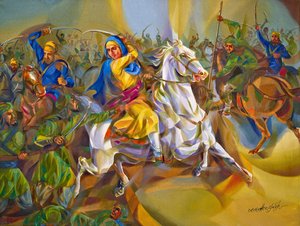
In his representative work, Mata Bhag Kaur, Singh captures a moment of intense conviction. The painting depicts a warrior woman atop a stark white horse, cutting through a sea of men with a quiet, gravitational leadership. Through meticulous oil techniques, he emphasizes the tension in her posture and the dignity of her presence, transforming a fragment of the year 1705 into a timeless study of strength and spiritual resolve.
Vibhor Yadav
 Dream for her Daughter - Vibhor Yadav
Born in Noida in 1991, Vibhor Yadav represents the evolving visual language of the 21st century Indian art scene. While his medium is the lens rather than the brush, his presence in this contemporary era is defined by a profound shift toward documentary photography that functions with the narrative depth of classical portraiture. His work belongs to this century's movement of social and cultural documentation, utilizing the camera to capture the raw essence of the human experience in a rapidly changing world.
Yadav’s practice is characterized by a sensitive artistic eye and a dedication to illuminating social realities. His representative work, "Dream for her Daughter" (2021), serves as a poignant example of his ability to transform the mundane into the monumental. In this piece, he captures an intimate moment within the Maasai community in Tanzania, using high-contrast lighting to emphasize the tactile, weathered textures of mud-brick architecture. Through the interplay of heavy shadows and earthy tones, Yadav explores universal themes of paternal love and ancestral continuity, bridging the gap between specific cultural narratives and the global human condition.
Gaurang Kumar Shah
 Dhruva Narayan On The Loom - Gaurang Kumar Shah
Gaurang Kumar Shah stands as a vital figure among 21st century Indian painters due to his unique ability to bridge the gap between ancient handloom traditions and contemporary visual storytelling. Born in Hyderabad, Shah has spent his career revitalizing the textile heritage of India, transforming the loom into a medium for profound narrative art. His work is a testament to the 21st-century movement of preserving grassroots craftsmanship through a modern, sophisticated lens, supporting thousands of weavers while elevating traditional techniques like Jamdani to the status of fine art.
His representative work, Dhruva Narayan On The Loom (2018), exemplifies this mastery. The piece serves as a meditative exploration of Hindu mythology, utilizing the tactile nature of hand-woven fabric to create a sense of spiritual permanence. In this work, the subject is depicted in a state of serene repose, enveloped in evocative blues that suggest the infinite. By layering vibrant pigments onto the textured surface of the textile, Shah achieves a luminous interplay of light and shadow that a flat canvas cannot replicate. Through this intersection of myth and material, he captures the eternal essence of the steadfast Dhruva, making him a defining voice in the modern Indian artistic landscape.
Pradyumna Kumar Mahanandia
 Bararsingha - The balance of Life - Pradyumna Kumar Mahanandia
Pradyumna Kumar Mahanandia represents the profound evolution of Indian contemporary art, bridging ancestral traditions with a modern, global perspective. As a prominent figure among 21st century Indian painters, his work is defined by a seamless integration of traditional Odia and Mithila art forms with a sophisticated, contemporary sensibility. His practice is characterized by a meticulous attention to line and a vibrant, layered approach to color that breathes life into complex, symbolic compositions.
A viewer can instantly recognize Mahanandia’s mastery through his rhythmic, organic linework and his ability to imbue natural subjects with spiritual depth. His representative work, “Bararsingha – The Balance of Life” (2014), exemplifies this aesthetic. In this piece, he utilizes the intricate patterns of the Mithila tradition to depict two deer intertwined beneath a sheltering tree, creating a visual meditation on harmony and interconnectedness. His technique often involves delicate, repetitive geometric shapes and fine, flowing contours that suggest movement and grace. Whether exploring the life-giving essence of the mango tree or the delicate symbology of fauna, Mahanandia’s art remains a testament to resilience and the enduring power of cultural heritage in the modern era.
Anwar Chitrakar
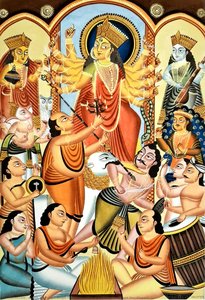 Single Panel Patachitra of Goddess Durga and Worshippers - Anwar Chitrakar
Anwar Chitrakar represents a vital link in the evolution of 21st century Indian painters, serving as a contemporary custodian of the ancient visual languages of West Bengal. Born in 1980 in the Pingla region, Chitrakar’s artistic foundation was laid not in a formal academy, but through a direct lineage of tradition. As a member of the Patua community, he was trained under the guidance of his father, the celebrated Amar Chitrakar, inheriting the sacred art of Pattachitra—the traditional scroll painting of Bengal.
His place among the prominent artists of this century is defined by his ability to bridge historical folk traditions with a modern sensibility. He masterfully employs the Kalighat style, utilizing bold, sweeping outlines and a symbolic economy of form to capture the essence of his subjects. This technique, characterized by expressive color palettes and fluid strokes, allows him to translate 19th-century aesthetics into a vibrant contemporary context. His 2019 work, Single Panel Patachitra of Goddess Durga and Worshippers, exemplifies this mastery. Through the use of vibrant hues and rhythmic compositions, the piece transforms religious iconography into a profound narrative of devotion, ensuring that the ancient pulse of Bengali storytelling remains a living, breathing force in the 21st century.
Pushpa Kumari Kohli
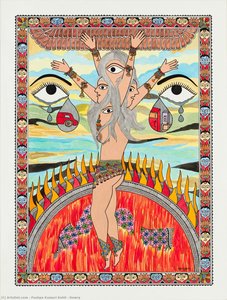 Dowry - Pushpa Kumari Kohli
Pushpa Kumari Kohli stands as a vital figure among 21st century Indian painters, bridging the ancient rhythms of Mithila tradition with the urgent social dialogues of the modern era. Born in 1969 in India, her practice is a profound continuation of the Madhubani art form, a legacy inherited from her maternal grandmother. By translating domestic, ancestral customs into the contemporary fine art landscape, Kohli ensures that the spiritual and communal essence of Bihar remains a living, evolving language in the 21st century.
Her technique is an alchemy of nature, utilizing organic pigments like turmeric yellow, indigo blue, and red ochre applied with tamarind paste onto coarse cotton paper. This meticulous process creates a tactile depth that defies the flat nature of modern digital prints. In her representative work, Dowry (2015), she masterfully employs traditional iconography—such as stylized figures and intricate geometric patterns—to deliver a poignant feminist commentary. By juxtaposing sacred symbols with modern elements, Kohli transforms the celebratory aesthetics of folk art into a powerful meditation on women's rights and the complexities of contemporary Indian society.
Venkat Shyam
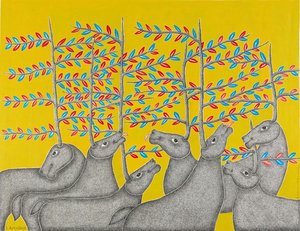 Under the tree - Venkat Shyam
A prominent figure in the landscape of 21st century Indian painters, Venkat Raman Singh Shyam carries the ancestral legacy of the Pardhan Gond community into the contemporary era. His artistic journey is defined by a transition from humble beginnings in Madhya Pradesh to becoming a leading practitioner of the Jangarh Kalam style. Having apprenticed under his uncle, the celebrated Jangarh Singh Shyam, Venkat has evolved this traditional movement, blending inherited Gond conventions with a modern sensibility that addresses both personal experience and social narratives.
His work is characterized by a masterful use of delicate, precise linework that creates a sense of rhythmic movement and depth. In his 2015 masterpiece, Under the Tree, this technique is vividly displayed. The piece serves as a profound immersion into Gond cosmology, utilizing a vibrant palette of ochre yellows and deep greens to depict the spiritual significance of the natural world. Through his ability to synthesize traditional motifs with contemporary themes, Venkat Shyam has secured his place as a vital voice in modern Indian art, transforming ancient storytelling into a sophisticated visual language for the 21st century.
Dilip Kumar Chandra
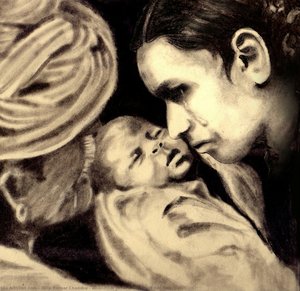 Anandibai Joshee - Birth of Her Son - Dilip Kumar Chandra
Dilip Kumar Chandra (1936–2018) remains a profound voice in the lineage of Indian art, bridging the gap between traditional Bengali folklore and the sensibilities of the modern era. His work is characterized by a remarkable commitment to restraint, often eschewing the flamboyant color palettes of his contemporaries in favor of a disciplined, monochromatic precision. This mastery of line and shadow allows him to distill complex historical narratives into moments of profound stillness, a technique that continues to influence the aesthetic direction of 21st century Indian painters who seek to balance cultural heritage with contemporary minimalism.
His representative work, Anandibai Joshee - Birth of Her Son, created in 2018, serves as a testament to his ability to capture the weight of history through a minimalist lens. In this evocative drawing, Chandra utilizes subtle tonal variations to define the contours of a mother cradling her newborn. By stripping away the noise of the world, he focuses entirely on the dignity of the human condition and the psychological depth of the subject. This focus on the essential essence of life ensures his place among the significant artists defining the visual language of India in the 21st century.
Conclusion
The evolution of contemporary Indian art in the 21st century is defined by a profound dialogue between ancestral heritage and modern abstraction. From the intricate, meditative compositions of Zarina to the vibrant, textured landscapes of Manik Lal Das, these artists have collectively expanded the visual vocabulary of the subcontinent. Whether through the bold strokes of Devender Pal Singh or the nuanced, evocative storytelling found in the works of Pushpa Kumari Kohli and Venkat Shyam, this generation of painters has successfully bridged the gap between traditional motifs and the globalized aesthetic of the new millennium. Each artist contributes a unique layer to this cultural tapestry, ensuring that the legacy of Indian expression remains dynamic and ever-evolving.
At Mus3ums.com, we invite you to bring this vibrant legacy into your own living space. You can explore our full collection to find pieces that resonate with your personal aesthetic. Our master artists specialize in creating museum-quality, hand-painted oil reproductions that capture the soul, texture, and depth of these significant works, allowing you to live with the beauty of 21st-century Indian mastery every day.


