The Quiet Shift in the Flemish Landscape
In the early sixteenth century, the focus of Netherlandish painting began to drift away from the tight, meticulous details of the previous generation. Joachim Patenier, born around 1480 in Dinant or Bouvignes, was at the center of this change. While his predecessors like Jan van Eyck and Rogier van der Weyden focused on the sharp precision of textures and figures, Patenier looked toward the horizon. He was a man who lived and worked in Antwerp, eventually becoming a member of the city's Guild of Saint Luke in 1515. His work suggests a mind preoccupied with the way light and air change the appearance of distant mountains and winding paths.
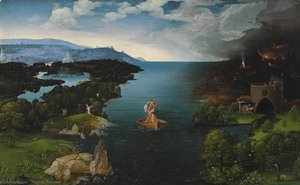
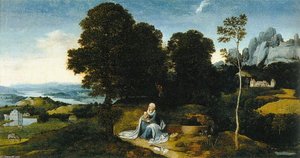
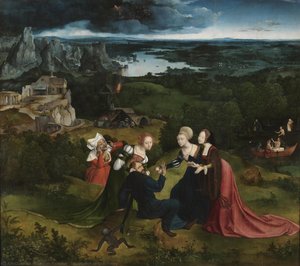
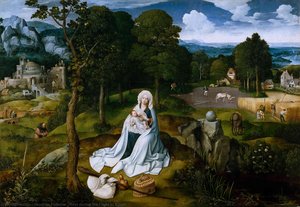
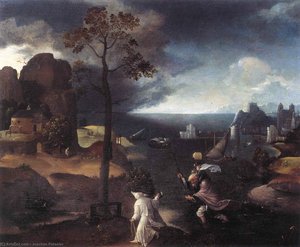
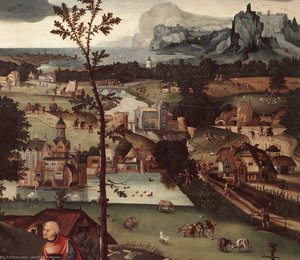
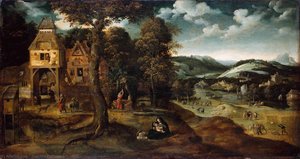
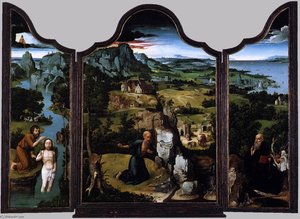
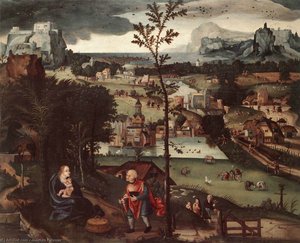
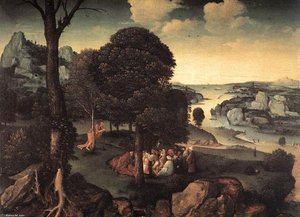
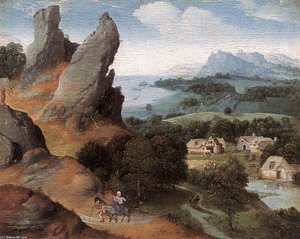
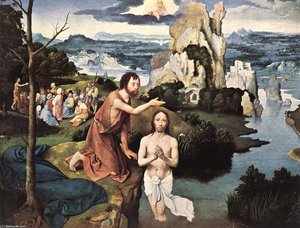
He did not merely use nature as a backdrop for religious stories. Instead, the landscape became the primary subject. In his hands, the natural world took on a sense of scale that felt both vast and intimate. He moved away from the crowded compositions of the past, opting instead for wide, panoramic views. This approach helped create what would later be known as the world landscape style, where the eye is led through layers of terrain, from the dark, textured foreground to the pale, hazy blue of the furthest peaks.
The Language of Light and Space
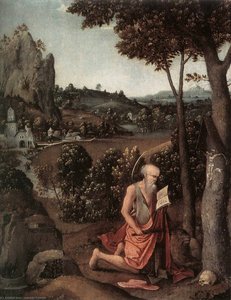
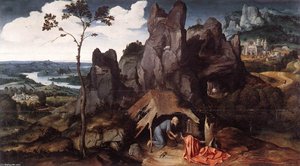
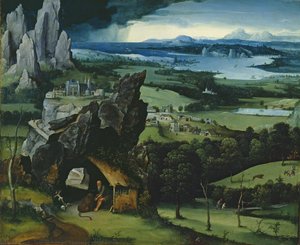
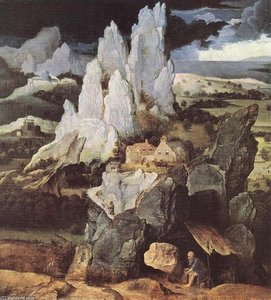
Patenier’s technique relied heavily on atmospheric perspective. By using soft gradations of color, he captured the way moisture and distance blur the edges of the world. This was a departure from the hard lines of earlier Flemish art. In works like Landscape with St Jerome, the figure of the saint is small, dwarfed by the immense, rocky terrain. The landscape is not a passive setting; it is a space of solitude and contemplation. The jagged cliffs and deep shadows create a sense of physical and spiritual weight.
His development as an artist shows a steady movement toward this expansive view. His early years were spent absorbing the traditions of the North, but his later works show a growing interest in spatial depth. He experimented with how light filters through clouds and how shadows fall across a valley. This was not about capturing a specific place, but about constructing a space that felt deep and breathable. His workshop in Antwerp was a busy place, and he often worked alongside others, such as Quentin Metsys, to bring these large-scale visions to life.
A Legacy of the Horizon
By the time of his death in Antwerp in 1524, Patenier had helped establish landscape as an independent genre. He was among the first to treat the natural world as a subject worthy of study in its own right. His influence can be seen in the way later artists approached the depiction of the earth, moving toward a more integrated relationship between the human figure and the environment. His paintings remain in collections such as the Museo del Prado in Madrid and the Louvre in Paris, where they continue to show the early steps toward modern landscape painting.
His life was marked by these shifts in perspective. He was a man of his time, connected to figures like Albrecht Dürer, yet he carved out a specific niche for himself. He looked at the world and saw more than just objects; he saw the air between them and the light that moved through it. This focus on the atmosphere changed the direction of Flemish art, moving it from the microscopic detail of the surface to the vastness of the sky.
Questions & Answers
In which historical period did Joachim Patenier work?
Joachim Patenier worked in the Renaissance period. The period situates the artist's activity in history.
Where is Joachim Patenier from?
Joachim Patenier was born in Belgium.
What are the birth city and country of Joachim Patenier?
Joachim Patenier was born in Dinan, in Belgium.