Long Distance InformationBill Woodrow · 1983
 Sculpture Bronze
- Contemporary Realism
 1983
1983 1900.0 x 1800.0 cm
 British Council
Bill Woodrow’s “Long Distance Information”: A Dialogue Between Decay and Invention
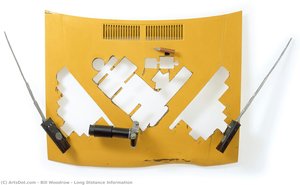
The sculpture "Long Distance Information," created by Bill Woodrow in 1983, stands as a striking testament to the burgeoning New Sculpture movement of the early eighties—a reaction against the prevailing conceptual art trends that dominated the decade. More than just an assemblage of discarded materials, it embodies Woodrow’s profound engagement with themes of recession, redundancy, anger, and waste – anxieties acutely felt during Britain's economic downturn at the time of its conception. This piece isn’t merely decorative; it compels viewers to contemplate the relationship between ruin and renewal, mirroring Freud’s exploration of the uncanny and challenging our perception of familiar objects transformed into something unsettling yet strangely beautiful.- Subject Matter & Context: Woodrow's preoccupation with everyday detritus—specifically a car bonnet—reflects a broader artistic impulse to reclaim overlooked textures and forms from the margins of society. The sculpture emerged during a period marked by significant social upheaval, mirroring the disillusionment felt after the heady optimism of the late 1960s and early 70s.
- Style & Technique: Woodrow’s approach distinguishes itself from earlier sculptural endeavors through its deliberate embrace of chance and improvisation. He skillfully manipulates found objects—a car bonnet, walkie-talkies, a long-lens camera, and a bullseye—to create an unsettling juxtaposition of textures and forms. The fractured umbrella frames serve as conduits for conveying emotion, mirroring the fragmented nature of experience itself.
- Symbolism & Surrealist Influence: Woodrow’s work draws heavily from Surrealist principles, particularly Freud's concept of “the uncanny.” The broken umbrella symbolizes vulnerability and decay, while the crow perched atop it represents aggression and disruption—a deliberate provocation against established conventions. This duality underscores the sculpture’s exploration of psychological tension.
- Material Exploration: Woodrow’s masterful use of materials – primarily steel and bronze – contributes to the sculpture's overall impact. The weathered surface of the bonnet speaks volumes about time, transformation, and the passage of experience. He expertly welds and joins disparate elements together, creating a cohesive whole from seemingly unrelated components.
- Emotional Resonance: “Long Distance Information” isn’t simply an aesthetically pleasing object; it evokes a visceral response in the viewer. The sculpture's inherent fragility communicates a sense of vulnerability alongside its assertive presence—a poignant reminder that beauty can emerge from unexpected places and that even discarded materials hold profound symbolic significance.
Discovering the transformative potential of repurposed materials, Woodrow’s work embodies a spirit of experimentation and intellectual curiosity—a legacy that continues to inspire artists today.
Bill Woodrow (1948 –)
Explore British sculptor Bill Woodrow's found-object installations & welded steel/bronze works. Known for his 1980s rise, Tate Gallery exhibits & Turner Prize nomination. Discover his unique art!
British Council (London, United Kingdom)
Experience the iconic British Council Collection in London featuring masterpieces by Lucian Freud and David Hockney through a dynamic journey of contemporary British art that invites you to explore its global legacy.
About this artwork
- Title: Long Distance Information
- Artist: Bill Woodrow
- Year: 1983
- Original dimensions: 1900.0 x 1800.0 cm
- Format: Panoramic
- Copyright status: Under copyright
- Where to see it: British Council
- Corpus context: memento mori symbolism, social critique
- Keywords: contemporary art, surrealism, sculpture
- Color hue: Ochre to Sepia
Quick Facts
- Artistic style: Assemblage
- Location: Private Collection
- Movement: New Sculpture
- Dimensions: 1900 x 1800 cm
- Artist: Bill Woodrow
- Medium: Steel bonnet
Questions & Answers
What is the overall mood of "Long Distance Information" by Bill Woodrow?
"Long Distance Information" has a calm atmosphere.
What underlying hue runs through "Long Distance Information" by Bill Woodrow?
An ochre to sepia hue runs through "Long Distance Information" by Bill Woodrow.
What national origin stands behind the Contemporary Realism of "Long Distance Information"?
"Long Distance Information" connects the Contemporary Realism movement with United Kingdom through its creator's birthplace.