
A Legacy of the Museum of Fine Arts
The Museum of Fine Arts, located in Boston, United States of America, began its existence in 1870 within the walls of the Boston Athenæum. This foundation established a presence that has grown into a significant institution, now recognized as the 20th-largest art museum in the world by public gallery area. Its scale allows for a profound encounter with history, attracting a steady stream of observers; as of 2024, it is the 83rd-most-visited art museum in the world.
The institution maintains a deep connection to academic study through its affiliation with the School of the Museum of Fine Arts at Tufts. This relationship anchors the museum within a broader landscape of learning and research. The presence of such a vast collection ensures that the Museum of Fine Arts remains a central point for those seeking to observe the physical traces of human creativity across many eras.
The Architecture of the Neoclassical Home
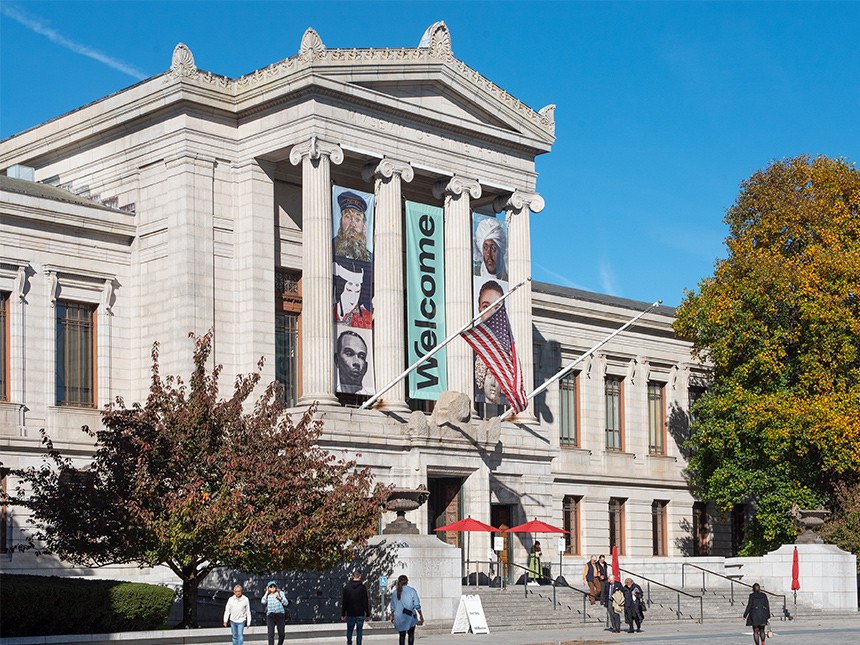
The museum’s presence on Huntington Avenue is defined by the neoclassical vision of architect Guy Lowell. Its granite façade radiates solidity and elegance, providing a heavy, grounded presence within the city. This structure replaced the original 1876 building designed by John Hubbard Sturgis and Charles Brigham. While the earlier brick Gothic Revival design established the institution's beginnings, the current home offers a different sense of permanence through its stone and classical proportions.
Inside, the rotunda acts as a central axis, its walls adorned with monumental frescoes by John Singer Sargent. These large-scale works integrate with the architectural scale, turning the physical space into a site of visual weight. The interplay of light and shadow across the rotunda's surfaces emphasizes the height and volume of the hall. It is a space where the architecture and the painted figures exist in a shared, quiet gravity.
Modernity enters the site through the Linde Family Wing for Contemporary Art. Conceived by I.M. Pei, this addition introduces a different architectural language to the campus. The soaring glass atrium creates an ethereal atmosphere, offering a sharp contrast to the heavy granite and traditional lines of the historic core. This juxtaposition of Pei's modernist design with Lowell's Beaux-Arts style creates a tension between the weight of the past and the transparency of the present.
The Vast Collection of European Masterpieces
The European galleries hold a profound presence, where the light of the Impressionist era remains tangible. Claude Monet’s work is central to this experience, particularly in the way his brushwork captures the shifting atmosphere of the natural world. One can stand before Grainstack in the Morning, Snow Effect, painted about 1890, and observe the subtle textures of a winter landscape. The collection also contains the dramatic intensity of Van Gogh’s landscapes, where the weight of the paint conveys a sense of movement and emotion. These works exist as physical records of vision and light.
Portraiture within the museum offers a study of character and social grace. The elegant portraits of Renoir and Degas provide a window into the refined aesthetics of their respective eras. Pierre-Auguste Renoir’s Dance at Bougival, from 1883, captures a specific moment of social life with a lightness of touch. Nearby, Édouard Manet’s Portrait of Victorine Meurent, from 1862, presents a direct and commanding presence. These paintings do more than represent faces; they hold the gaze of the viewer through a careful balance of form and color.
- Grainstack in the Morning, Snow Effect, about 1890 - Claude Monet
- Dance at Bougival, 1883 - Pierre-Auguste Renoir
- Portrait of Victorine Meurent, 1862 - Édouard Manet
Ancient Treasures and Global Traditions
The collection offers a profound encounter with the artifacts of ancient Egypt, where sarcophagi adorned with intricate hieroglyphs and statues embodying pharaonic power exist in quiet stillness. These objects carry the weight of millennia, inviting a close study of the rituals and mysteries of a civilization that shaped human history. Nearby, the presence of Chinese bronzes provides a study in symbolic meaning, their forms carrying the gravity of their original purpose. The museum also holds a significant selection of Korean art, adding to the breadth of its Asian holdings.
In the galleries dedicated to Japan, delicate woodblock prints reveal the subtle nuances of traditional techniques. These works allow for a slow observation of line and color. This focus on craftsmanship extends to the powerful Indian sculptures, which reflect a deep sense of spiritual devotion through their form and gesture. The museum's reach continues through its various collections of Japanese and Korean art, creating a space where the specificities of different traditions are given room to exist alongside one another.
Art of the Americas and Decorative Arts
The museum’s dedication extends to American portraiture, offering a focused look at the faces and social structures of the New World. Alongside these portraits, the collection includes decorative arts from around the globe. These objects exist as physical evidence of craftsmanship and status. Furniture pieces, in particular, speak volumes about the social standing of their previous owners through their construction and material choice.
Ceramics within the galleries showcase distinct regional styles, revealing the specificities of local production and aesthetic preference. Textiles also hold a significant presence, characterized by their use of color and pattern. These woven works provide a tactile connection to the hands that created them. The breadth of the collection allows for a quiet observation of how utility and beauty intersect across different eras and geographies.
- Paul Revere by John Singleton Copley
Masterpieces of the Permanent Collection
The presence of certain works within these walls commands a specific kind of attention. Winslow Homer’s The Fog Warning, dating from about 1885, offers a study in the tension between the sea and the elements. Nearby, the quietude of Jean-François Millet’s Harvesters Resting from 1853 provides a moment of stillness. These paintings exist as physical entities, their textures and brushstrokes revealing the hand of the artist in a way that digital reproductions cannot replicate.
Light and shadow define much of the collection's emotional weight. In 1897, John Singer Sargent produced Head of Christ, a work that utilizes light to create a sense of volume and depth. This focus on the interplay of light is echoed in the Impressionist holdings, such as Claude Monet’s Water-Lilies (43) from 1907. The brushwork in these later works captures a specific, fleeting atmosphere. Similarly, Édouard Manet’s The Execution of the Emperor Maximilian of Mexico, created in 1867, presents a stark, historical gravity through its composition and color.
- The Fog Warning, about 1885
- Head of Christ, 1897
- Water-Lilies (43), 1907
- The Execution of the Emperor Maximilian of Mexico, 1867
- Harvesters Resting, 1853
Exhibitions and Cultural Engagement
The museum functions as a site for continuous artistic discourse. Past retrospectives have examined the transformative impact of artists such as Picasso and Warhol, placing their work within the context of shifting modern movements. These large-scale presentations allow for a direct encounter with the evolution of twentieth-century visual language. Beyond these major surveys, the institution maintains a steady rhythm of temporary exhibitions, lectures, and workshops that invite closer study of specific themes and techniques.
A dynamic environment for collaboration exists through the museum's affiliation with Tufts University's School of the Museum of Fine Arts. This connection fosters a space where research and creative practice meet, supporting a deeper understanding of the objects held within the galleries. Such academic and artistic intersections ensure the institution remains a place of active inquiry rather than a static repository.
Accessibility remains a central priority, ensuring that the collections are available to all visitors. This commitment to inclusivity allows a diverse public to engage with the works on their own terms. The programming is designed to be accessible, removing barriers to the experience of art and fostering a sense of community through shared cultural engagement.
Digital Horizons and Global Reach
The museum has embraced digital platforms like Google Arts & Culture to extend its reach beyond the borders of Boston. Through virtual tours and high-resolution images, the collection becomes accessible to those who cannot physically enter the halls on Huntington Avenue. This digital presence allows for a quiet exploration of the works from any distance. It provides a way to observe the fine details of the art through a screen, bringing the presence of the objects into private spaces across the globe.
These digital tools underscore a commitment to innovation and the democratization of access. By utilizing modern technology, the institution ensures that its vast holdings remain available to a global audience. The ability to examine textures and forms through high-resolution imagery bridges the gap between the physical gallery and the remote viewer. This approach maintains a connection between the art and the public, regardless of geography.