
The History of Church of Our Lady
The Church of Our Lady, known in Dutch as Onze-Lieve-Vrouwekerk, remains a central presence in Bruges, Belgium. Established in the 13th century, the site has evolved through centuries of continuous use and expansion. The structure seen today reflects a long chronology of construction, with the building dating mainly from the 13th, 14th, and 15th centuries.
The history of the site is marked by the addition of specific spaces for the local nobility and religious devotion. In 1482, a chapel was created for Lodewijk van Gruuthuse. This addition contributed to the complex layers of the church's interior and its role as a repository for significant religious and funerary works. The church continues to function as a Roman Catholic place of worship, maintaining its long-standing connection to the city's spiritual life.
The Architecture of the Gothic Church
The exterior of the church reveals the structural logic of the Gothic style through prominent flying buttresses. These stone supports, constructed in the 1270s and 1280s, provide the necessary stability for the soaring verticality of the building. Above the city skyline, the 115.6-metre-high (379 ft) tower remains the tallest structure in Bruges. This brickwork tower dominates the view from the surrounding streets, marking the presence of the church within the urban landscape.
Inside, the nave is defined by the presence of cross-vaults and a floor of black and white tiles. The geometry of the ceiling meets the rhythmic pattern of the ground, creating a sense of order within the central space. While the primary structure follows Gothic principles, the side aisles and chancel exhibit a different aesthetic, characterized by the heavily ornamented Baroque style. This transition between the structural austerity of the nave and the decorative intensity of the aisles creates a layered historical presence.
Masterpieces of the Art Collection
Within the quietude of this church, the presence of Michelangelo's Madonna and Child commands the space. This white marble sculpture, completed in 1506, possesses a weight of close to a ton. The stone carries a profound stillness. The drapery of the Virgin's robe moves with a fluidity that recalls the tension found in the Pietà, characterized by a long, oval face and a specific rhythmic flow in the fabric.
The sculpture arrived in Bruges in 1514, having been purchased by the merchants Jan and Alexander Mouscron. It was the first work by Michelangelo to leave Italy during his lifetime. The marble, likely sourced from Carrara, retains a luminous quality even in the dim light of the chapel. It remains a central point of focus for those seeking the intersection of human form and divine grace.
- The Crucifixion, 1626 - Anthony van Dyck
- The Transfiguration of Christ (central panel), 1520 - Gerard David
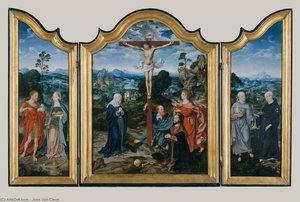
- The Crucifixion with Saints and a Donor - Joos van Cleve
Notable Works by Adriaen Isenbrant
Within the quietude of the church, the presence of Adriaen Isenbrant is felt through the monumental panel painting, Our Lady of the Seven Sorrows. Completed around 1535, this work reflects the burgeoning Renaissance spirit that began to influence the traditions of Northern Europe. The painting moves beyond mere representation, seeking a heightened emotional impact through its depiction of human suffering and Marian devotion.
The narrative of the panel unfolds through seven distinct scenes. Each episode captures a specific moment of grief from the life of Mary, from the prophetic utterance of Simeon at the Temple to the final mourning over the body of Jesus at the Tomb. These scenes are rendered with meticulous attention to detail, such as the heavy folds of drapery and the solemnity of the gazes. The architectural setting, featuring a semicircular niche with classical motifs like rams' heads and garlands, reveals an engagement with humanist ideals and the stylistic innovations of the era.
Other Significant Art and Sculptures
Beyond the central figures, the church holds several profound works that demand a quiet presence. Anthony van Dyck contributed a Crucifixion, dated about 1626, which occupies the space with a specific gravity. Nearby, the Transfiguration of Christ, a central panel from about 1520 by Gerard David, offers a moment of stillness. These works exist as part of a larger, layered history of devotion within the walls of this religious monument.
The collection also includes the Crucifixion with Saints and a Donor by Joos van Cleve. This piece sits alongside other significant religious imagery, such as the Our Lady of the Seven Sorrows (left wing of diptych: Joris van de Velde, his wife Barbara Le Maire and their children with Saints George and Barbara), which was completed in 1518. Each object remains a physical part of the church's ongoing spiritual life in Bruges, Belgium.