

Origins and History of the Gallery
The Feodosia National Gallery I. K. Aivazovsky began in 1845. That year, the first exhibition was organized privately by Ivan Aivazovsky within his own home. This intimate beginning established a foundation for what would become a significant institution. The gallery eventually achieved a status that placed it as the third museum in the Russian Empire, following only the Hermitage Museum and the Tretyakov Gallery.
The transition of ownership was dictated by the artist himself. In 1900, the gallery was transferred to the city in accordance with the terms of Aivazovsky's testament. This ensured the collection remained a permanent fixture of the local landscape. Later, in 1922, the institution became a state museum in the USSR.
The Building and Its Architecture
The museum is housed in the house where the artist I. K. Aivazovsky lived. This structure preserves the intimate connection between the painter and the maritime environment of Feodosia, Ukraine. The original residence provides a sense of the daily life and creative environment that shaped the artist's vision. In 1880, an additional exhibition hall was added to the house to accommodate the growing collection of works.
The presence of the artist is marked by a monument erected in 1930 by Ilya Ginzburg. This sculpture stands in front of the main building, serving as a permanent fixture in the landscape of the gallery. The monument bears the inscription "Feodosia to Aivazovsky".
The Extensive Maritime Collection
The holdings here comprise approximately 12,000 works centered on nautical themes. At the heart of this assembly is the world's largest collection of paintings by Ivan Aivazovsky, totaling 417 pieces. These works exist alongside the output of his colleagues and followers, creating a continuous dialogue between the master and those who studied under him. The presence of these paintings allows for a direct observation of the evolution of marine art through the 18th and 19th centuries.
Beyond the central focus on Aivazovsky, the collection incorporates a wide range of maritime subjects. This includes extensive graphic works and foreign marine pieces that expand the scope of the maritime narrative. The variety of media and origins provides a sense of the breadth of sea-focused art from different eras and regions. The sheer volume of the collection ensures that the study of the ocean's depiction remains a constant presence within the walls.
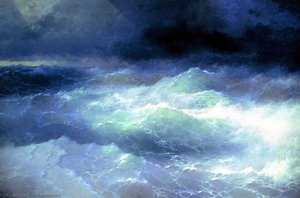
- Between the waves, about 1898 - Ivan Aivazovsky
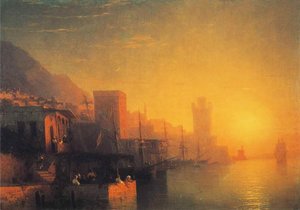
- The Island of Rhodes, 1861 - Ivan Aivazovsky
- Shipwreck - Ivan Aivazovsky
- Portrait of the Artist's Wife Anna Burnazyan, 1882 - Ivan Aivazovsky
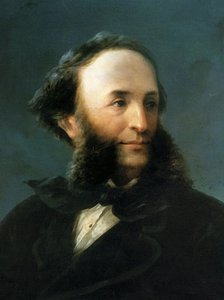
- Self-Portrait, 1898 - Ivan Aivazovsky
Masterpieces of the Collection
The presence of Ivan Aivazovsky’s hand is felt most strongly in the works that capture the specific light of the Black Sea. Moonlight in Feodosia, dated 1852, offers a study of a serene nighttime scene where the sky remains dark and stars are visible above the water. This quietude is contrasted by the movement found in Night in the Ukraine, created in 1871. In this work, the moonlight illuminates a tranquil riverbank, casting light upon the landscape, cattle, and trees to create an atmosphere of solitude.
The collection also holds works that address the more turbulent aspects of the sea. Shipwreck remains a significant presence within the gallery, capturing the raw power of the water. Similarly, the painting Between the waves, dating from about 1898, focuses on the intense energy of the ocean. These pieces allow for a direct encounter with the artist's ability to translate the moods and dangers of maritime life onto canvas.
Other significant works include The Island of Rhodes, dated about 1861, which reflects the artist's engagement with the Mediterranean and the Levant. Each painting exists as a specific moment of observation, from the calm of a moonlit coast to the chaos of a storm, providing a detailed record of the maritime environments that defined a lifetime of study.