

A Legacy of Light in Grant Park
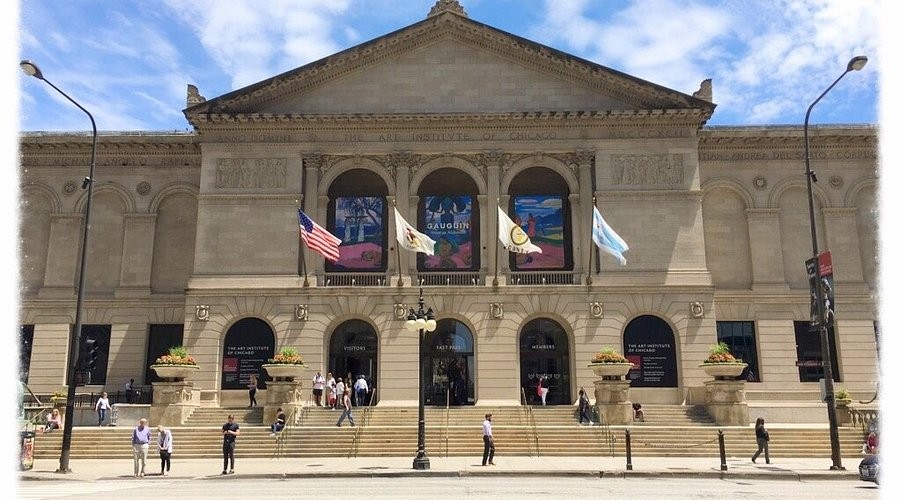
The Art Institute of Chicago occupies a prominent position within Grant Park, its presence defined by the heavy stone and classical lines of the Beaux-Arts architecture designed by Shepley, Rutan and Coolidge. The main structure, originally intended for the 1893 World’s Columbian Exposition, presents a grand Italian Renaissance facade to Michigan Avenue. Its arcaded entry loggia features three large Palladian arches supported by Corinthian half-columns, creating a formal threshold that leads into a complex of galleries. This historic core engages in a direct dialogue with Renzo Piano’s Modern Wing, a structure of glass and steel that opened in 2009 to expand the museum's footprint. The architecture reflects a transition from the opulent details of the late nineteenth century to a contemporary focus on natural light and sustainable design.
The building itself tells a story of survival and expansion. Following the Great Chicago Fire of 1871, the institution’s predecessor struggled with debt before the current organization emerged to claim its place on the lakefront. The museum's footprint now reaches nearly one million square feet, encompassing various additions such as the Fullerton Auditorium and the Ryerson Library. Within these walls, the heavy masonry of the original halls meets the transparent, airy volumes of the modern expansion, mirroring the city's own evolution from a frontier outpost to a global metropolis.
The Collected Vision
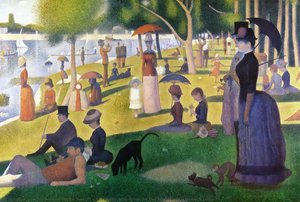
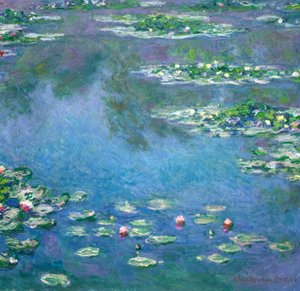
Walking through the galleries reveals a vast assembly of human expression spanning centuries and continents. The collection holds nearly 300,000 works, ranging from ancient Egyptian antiquities to twentieth-century American modernism. One finds the quiet intensity of Edward Hopper’s Nighthawks, which captures the stark reality of urban solitude, positioned alongside the rural gravity of Grant Wood’s American Gothic. The museum also houses significant pieces of the Impressionist movement, where the light of a riverside park is captured in Claude Monet’s Floden, and the domestic peace of a sun-drenched afternoon is rendered through the soft pastel hues of Pierre-Auguste Renoir’s Lady at the Piano.
The diversity of the holdings extends into more experimental territories:
- Post-Impressionist works: Including Vincent van Gogh’s La Berceuse, Portrait of Madame Roulin and his textured canvases that explore profound emotion.
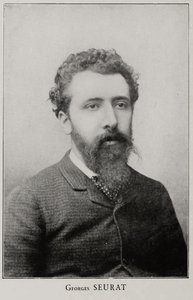
- Pointillism: Georges Seurat’s A Sunday on La Grande Jatte, which uses meticulous dots of color to build a scene of Parisian leisure.
- Modernist and Naive Art: Marc Chagall’s Vitrage at Art Institute of Chicago, featuring bold palettes and fantastical imagery inspired by his childhood in Belarus.
- American Imagism: The works of Gladys M. Nilsson, characterized by the bold colors and whimsical figures of the Chicago Imagists movement.
Beyond the paintings, the institution maintains a deep commitment to scholarship through the Ryerson and Burnham Libraries, one of the largest repositories for art history and architecture in the nation. This intellectual foundation supports the museum's role as a center for research, where conservation laboratories work to preserve the physical integrity of every object, from delicate portrait miniatures on ivory to massive bronze fountains like the Fountain of the Tritons.