



A Sanctuary of Inquiry: Unveiling The Royal Society’s Enduring Legacy
Step into a realm where centuries of scientific discovery converge—The Royal Society in London isn't merely a museum; it’s a living testament to the relentless pursuit of knowledge, a place where the very air hums with the echoes of groundbreaking ideas. Unlike traditional institutions dedicated to showcasing finished artworks, The Royal Society safeguards the genesis of modern science, preserving not polished masterpieces but the raw materials of intellectual revolution. Founded in 1663 amidst the fervent spirit of the “Invisible College,” this imposing Grade I listed building—once a German embassy—stands as a powerful symbol of Britain’s commitment to reason and empirical investigation. Its grand halls, adorned with portraits of its illustrious Fellows and housing an extraordinary archive of manuscripts, instruments, and scientific observations, offer a profound journey into the heart of human ingenuity.
The collection itself is a breathtaking tapestry woven from the threads of countless discoveries. Imagine tracing the meticulous calculations of Isaac Newton as he formulated his laws of motion, or peering through the lenses of early microscopes—instruments crafted by pioneers like Antonie van Leeuwenhoek—to witness the unveiling of a previously unseen world teeming with microscopic life. Beyond these textual treasures lie remarkable scientific instruments: Galileo’s telescopes, which forever altered our perception of the cosmos; precise balances used in groundbreaking experiments; and intricate devices that represent pivotal moments in observation and experimentation. Each object isn't simply a tool; it’s an embodiment of human curiosity, a tangible link to those who dared to question the established order and unlock nature’s secrets. The portraits lining the walls offer visual chronicles of the Society’s Fellows—a gallery of individuals who championed reason and dedicated their lives to unraveling the mysteries of the universe.
Architectural Grandeur and Historical Roots
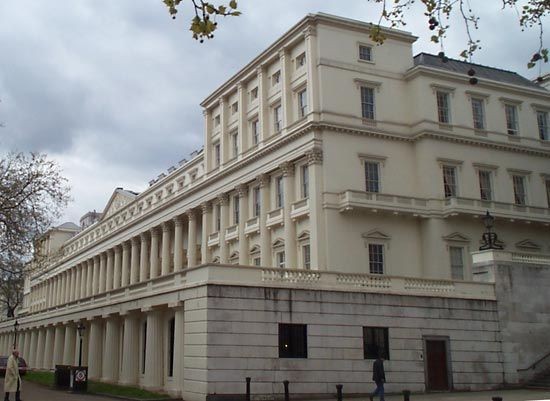
The building itself is a masterpiece of Georgian architecture, reflecting the grandeur and ambition of 18th-century London. Originally constructed as the German Embassy in 1749–50, designed by Robert Adam, it embodies a harmonious blend of classical elegance and understated sophistication. The façade, with its imposing columns and symmetrical design, speaks to the Society’s commitment to order and precision—qualities deeply ingrained in scientific inquiry. The interior spaces are equally impressive, featuring soaring ceilings, ornate plasterwork, and meticulously crafted details that evoke a sense of scholarly reverence. Its transformation into the Royal Society's home in 1934 marked a significant shift, elevating this stately building to become a symbol of Britain’s intellectual leadership. The choice of location—a prestigious address on Carlton House Terrace—underscored the Society’s commitment to being at the heart of London’s cultural and scientific life.
A Living Hub of Scientific Collaboration
The Royal Society's significance extends far beyond its historical collections; it remains a vibrant hub of scientific collaboration in the 21st century. Today, researchers from across the globe converge within its walls, exchanging ideas, tackling complex challenges, and pushing the boundaries of knowledge. This isn’t an isolated institution operating behind closed doors—it actively engages with policymakers, offering independent advice on pressing issues facing Britain, from climate change to public health crises. The Society's mission encompasses a broad spectrum of disciplines – astronomy, physics, biology, chemistry, and mathematics – each benefiting from the collective expertise of its esteemed Fellows. Its commitment to fostering international co-operation ensures that scientific advancements are shared globally, contributing to solutions for some of humanity’s most pressing challenges.
Notable Exhibitions and Digital Engagement
Throughout the year, The Royal Society hosts a diverse range of exhibitions designed to engage audiences of all ages. Past exhibits have explored topics ranging from the history of medicine to the wonders of space exploration, offering visitors a unique opportunity to delve deeper into scientific concepts. Recognizing the importance of accessibility in the digital age, the Society has embraced online resources, providing digitized manuscripts, interactive exhibits, and scholarly publications accessible worldwide. This virtual gateway allows individuals to explore its archives and connect with the legacy of groundbreaking discoveries—a testament to the Society’s commitment to making knowledge available to all.
A Legacy Rooted in “Nullius In Verba”
At the heart of The Royal Society's ethos lies its enduring motto: *“Nullius in verba”* – “Take nobody’s word for it.” This principle, deeply embedded within the Society’s culture, emphasizes the importance of critical thinking, rigorous experimentation, and independent verification. It reflects a commitment to questioning assumptions, challenging established beliefs, and pursuing knowledge through observation and evidence-based reasoning. The Royal Society stands as a powerful reminder that true understanding comes not from blind acceptance but from relentless inquiry—a legacy that continues to inspire scientists, thinkers, and innovators around the world.