
The Quietude of the Girolamini
Located in Naples, the Picture gallery of the Girolamini exists within a complex that has evolved through centuries of architectural layers. The site is situated near the Cathedral, tucked away from the primary movement of Via Duomo. Access to the art collection requires passing through a second 17th-century cloister, a space that transitions the visitor from the city streets into a more contemplative environment. The architecture reflects a long history of expansion, with the façade shaped by Ferdinando Fuga in 1780. While the library and certain galleries remain closed to the public, the presence of the Oratorian Fathers' legacy is felt in the very structure of the cloisters and the church dedicated to St. Filippo Neri.
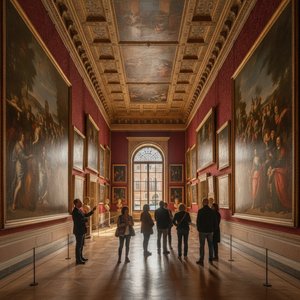
The atmosphere within the complex is one of stillness. The shadows in the cloisters and the weight of the stone walls create a sense of permanence. It is a place where the religious and the artistic are inseparable, held within a foundation that began in the 16th century. The light filters through the spaces in a way that emphasizes the physical presence of the objects kept within these walls.
The Presence of the Canvas
The collection held here is defined by the Neapolitan Baroque and the traditions of the Renaissance. The paintings are not merely decorations but are objects that command the space they inhabit. The works reflect a specific period of intense artistic production in Naples, where light and shadow are used to define form and spiritual weight. The following artists are represented within the gallery:
In the works of Guido Reni, such as the 1622 depictions of Saint Francis and the Flight to Egypt, there is a clarity of form that anchors the viewer. These pieces exist alongside the more dramatic, tactile works of Jusepe de Ribera, including Christ scourged. The tension in the brushwork of Ribera provides a counterpoint to the smoother, more idealized compositions found elsewhere in the collection. Battistello Caracciolo’s The Baptism of Christ offers a different approach to the interplay of light, marking a significant moment in the local artistic development.
A Legacy of Devotion
The art within the Girolamini is deeply tied to the religious purpose of the complex. The paintings were conceived to exist in dialogue with the liturgy and the architecture of the church. Even when viewed as historical artifacts, they retain a connection to the sacred spaces they were intended to inhabit. The collection serves as a record of the cultural and social influence the Oratorian Fathers exerted in Naples, using art to maintain a specific spiritual presence in the heart of the city. To stand before these works is to encounter the specific visual language of the Neapolitan Baroque, where the material and the divine are rendered through oil and pigment.