


Origins and History of the Pinacoteca Civica
The Pinacoteca civica di Ascoli Piceno was officially established on August 4, 1861. This date arrived on the eve of the festivities honoring Ascoli Piceno’s patron, Saint Emidio. The foundation of the institution followed the suppression of religious orders in January 1861, a decree enacted by Prefect Valerio. This historical shift allowed for the gathering of significant collections that had previously been held within monastic settings.
The establishment of the Pinacoteca civica di Ascoli Piceno was the result of the efforts of Giorgio Paci (1820-1914) and Giulio Gabrielli (1832-1910). These two figures provided the initial impetus for a public repository of art in the city. Their work ensured that the works acquired from the monasteries of Sant'Angelo Magno, San Domenico, and the Jesuits would find a permanent home within the civic structure.
The collection grew through various stages of acquisition and donation. In 1909, the holdings were expanded by the addition of 12,000 prints and drawings from Giulio Gabrielli. Later, in 1917, the institution received several 19th-century works on loan from the Galleria d'Arte Moderna in Rome. The arrival of the Ceci legacy in 1920 further added over one hundred paintings, sculptures, and ceramics to the permanent holdings.
The Imposing Palazzo dell'Arengo Building
The collection resides within the walls of the Palazzo dell'Arengo, a structure that provides a sense of continuity to the history of Ascoli Piceno. The interior is organized into fifteen rooms, each contributing to a specific atmosphere of quietude and permanence. Light filters through the space, often catching the glint of Murano chandeliers that hang from the ceilings. These glass elements are paired with precious drapery, which softens the architectural lines of the halls.
The arrangement of the rooms is complemented by a collection of 18th and 19th-century furniture. One finds consoles, armchairs, mirror cabinets, and chests placed throughout the space. These objects are not merely decorative; they occupy the rooms with a weight that anchors the paintings to their physical surroundings. The presence of these pieces creates a setting where the art is encountered within a domestic and aristocratic context, rather than in a sterile environment.
The atmosphere is shaped by the interplay between the heavy wood of the chests and the delicate glass of the chandeliers. This environment allows for a specific kind of contemplation. The furniture and the architectural details work together to frame the works, ensuring that the viewer experiences the art as part of a lived, historical space.
Major Acquisitions and Important Donations
The foundation of the collection rests upon the acquisition of religious works following the suppression of religious orders in January 1861. These pieces were gathered from the monasteries of Sant'Angelo Magno, San Domenico, and the Jesuits, bringing together objects that had long served the spiritual life of the region. Such transfers ensured that the history of local devotion remained physically present within the civic space.
The scope of the holdings expanded significantly through the generosity of private individuals and institutional loans. In 1909, the collection grew through the addition of 12,000 prints and drawings provided by Giulio Gabrielli. This was followed in 1917 by the arrival of various 19th-century works on loan from the Galleria d'Arte Moderna in Rome, which added layers of historical depth to the existing assembly.
A major turning point occurred in 1920 with the acquisition of the Ceci legacy. This donation, left by the surgeon Antonio Ceci, introduced over 100 items into the collection, including paintings, sculptures, and ceramics. These objects exist alongside the earlier acquisitions, forming a continuous record of artistic presence in Ascoli Piceno.
Masterpieces of the Art Collection
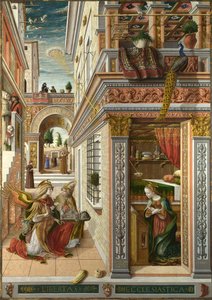
The presence of the 13th-century English-made Piviale, donated to the Duomo of Ascoli by Pope Nicholas IV in 1288, provides a profound connection to the medieval era. Nearby, the 15th-century triptychs of Valle Castellana by Carlo Crivelli command attention through their intricate detail. These works exist alongside the 16th-century depiction of San Francesco receiving the stigmata by Titian. The weight of history is felt in the quiet presence of Cola dell'Amatrice's 1527 work, La salita al Calvario, and the 1575 Annunciazione by Guido Reni.
The collection transitions through the centuries, holding Sebastiano Conca's Madonna con il Bambino and saints, a work that arrived in Ascoli in 1729. This piece occupies a space defined by the specific light of the gallery. Later, the atmosphere shifts with Pellizza da Volpedo's 1901 painting, Passeggiata amorosa. Each object remains a distinct entity within the halls of the Palazzo dell'Arengo.


