Early Life and Artistic Training
- Mariano José María Bernardo Fortuny y Marsal was born on May 11, 1838, in Reus, Catalonia, Spain—to an artistic family. His father, Mariano Fortuny y Marsal, a genre painter, died when Fortuny was three years old.
- His mother, daughter of Raimundo de Madrazo y Garreta, moved the family to Paris, France, where Fortuny received his early artistic training at Accademia Chigi.
- He showed a talent for painting as well as a passion for textiles from a young age, influenced by his parents’ fascination with materials and their collections of fabrics from various European shops. His father also collected metalwork and armour from previous ages as a hobby.
- As a child he was fascinated with all of these textiles and would dye pieces of material for amusement. This exposure led him to designing and producing his own textiles and dresses.
Travels and Influences
- Fortuny travelled throughout Europe seeking out artists he admired, among them Richard Wagner. He visited Germany where Wagner had built a theater specifically designed to put on his operas.
- He was captivated by Wagner’s work and began to paint scenes for his operas when he returned to Venice. During this time he studied the Museo del Prado’s collection of Spanish painting.
- His artistic vision was shaped by the Impressionists, particularly Eugène Delacroix, whose paintings inspired him to explore new techniques and themes.
Career Highlights: Painting and Stage Lighting Design
- Fortuny won the Prix de Rome in 1858, which enabled him to complete his studies at Rome.
- He accepted a commission to decorate one of the ceilings at the Paris residence of the Duke of Riánsares, resulting in “Queen Marie Christine Inspecting the Troops.”
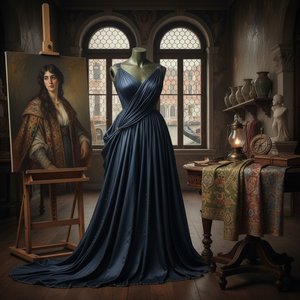
- He established a successful couture house in 1906 and continued until 1946, producing iconic designs like the Delphos gowns.
- Fortuny invented the fortuny cyclorama dome, a quarter dome shaped structure of plaster or cloth. He installed his dome in la scala opera house in Milan.
Orientalism and Innovation
- He travelled to Morocco again in 1862, reviving his fascination with the Islamic world and exploring its influence on his art.
- Fortuny developed a unique indirect lighting technique using reflectors and fans, which revolutionized theatrical stage lighting design.
- His innovative approach combined meticulous observation of nature with artistic imagination, resulting in works that captured both realism and emotion.
Legacy and Recognition
- Mariano Fortuny’s work was a source of inspiration to Marcel Proust, whose novel “Fortuny” explored the artist's life and creative process.
- His contributions to art history are celebrated worldwide, with his paintings displayed in major museums across Europe and America.
- Fortuny remains remembered as one of Spain’s greatest masters, embodying artistic excellence and innovation throughout his lifetime.
Preguntas y respuestas
¿En qué ciudad y país nació Mariano Fortuny Marsal?
Mariano Fortuny Marsal nació en Reus, España.
¿Con qué otros nombres se conoce a Mariano Fortuny Marsal?
Mariano Fortuny Marsal también es conocido como Mariano Fortuny, Maria Fortuny, Maria Fortuny Marsal, Fortuny, Mariano Fortuny y Marsal.
¿De dónde es Mariano Fortuny Marsal?
Mariano Fortuny Marsal nació en España.