


Introduction
The 18th century in Denmark marked a profound cultural awakening, a period where the visual arts transitioned from rigid formal traditions toward the nuanced elegance of the Enlightenment. As the Danish kingdom navigated shifting political landscapes and growing prosperity, its painters began to move away from purely religious iconography, embracing instead the humanistic ideals of portraiture, the serene grace of Rococo, and the burgeoning interest in landscape and naturalism. This era was defined by a sophisticated dialogue between local identity and the grand artistic movements sweeping through Europe, creating a unique aesthetic that balanced courtly refinement with a burgeoning sense of national character.
During this transformative century, artists became the visual chroniclers of a changing society, capturing the likenesses of the rising bourgeoisie and the quiet dignity of the Danish countryside. Their work reflects a mastery of light and composition that sought to elevate the everyday into something timeless. Today, these painters remain vital to our understanding of Northern European art history, offering a window into the psychological depth and stylistic evolution that paved the way for the Golden Age of Danish painting in the following century. Their ability to capture the essence of a moment through delicate brushwork and tonal harmony continues to resonate with modern sensibilities.
The following selection explores the diverse mastery of this period, highlighting the essential figures who defined the Danish aesthetic between 1701 and 1800, from the grand neoclassical compositions to the intimate, light-filled portraits that captured the spirit of an era.
Nicolai Abildgaard
 Christian V Presents Danish Law 1683 - Nicolai Abildgaard
A central figure in the development of Danish Neoclassicism, Nicolai Abildgaard (1743–1809) represents the intellectual height of 18th century Danish painters. His artistic journey, which began at the New Royal Danish Academy of Art under the guidance of masters like Johannes Wiedewelt, was profoundly transformed by his transformative sojourn in Rome. It was during this Roman awakening that Abildgaard moved beyond mere technical training to master the grand scale of history painting and mythological allegory, a hallmark of the era's academic excellence.
His ability to translate complex historical narratives into visual drama is exemplified in his 1784 work, Christian V Presents Danish Law 1683. This oil painting serves as a solemn documentary of a pivotal legislative moment, capturing a formal assembly of men in an interior defined by somber, umber tones. Through a sophisticated use of light and a composition that places the viewer as an observer within the council, Abildgaard elevates a political event into a scene of quiet, authoritative stillness. His work remains a testament to the era's shift toward classical order and the profound influence of antiquity on the Nordic artistic tradition."
Jens Juel
 Kommandørkaptajn Henrik Gerner - Jens Juel
As a preeminent figure of the Danish Golden Age of Neoclassicism, Jens Juel (1745–1802) stands as the most significant portraitist among 18th century Danish painters. His career, which spanned the transition from the late Baroque to the refined elegance of the Enlightenment, was shaped by a rigorous apprenticeship in Hamburg under Johann Michael Gehrman. This technical foundation allowed him to master a diverse range of genres, from expansive landscapes to intimate genre scenes, though he is most revered for his ability to capture the social standing and psychological depth of the era's elite.
A standout example of his mastery is the 1785 work, Kommandørkaptæn Henrik Gerner. In this bust-length portrait, Juel utilizes a sophisticated chiaroscuro technique, employing a dark, undifferentiated background to push the subject forward. The composition relies on a controlled palette of somber browns and blacks, punctuated by the crisp white of a lace cravat and the subtle red of a waistcoat. Through precise lighting and an eye for texture—from the delicate folds of fabric to the metallic sheen of embroidery—Juel elevated the formal portrait into a profound study of character and status.
Johann Georg Ziesenis
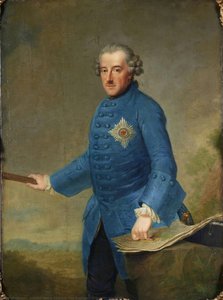 Friedrich der Große - Johann Georg Ziesenis
Born in Copenhagen in 1716, Johann Georg Ziesenis stands as a central figure among 18th century Danish painters, bridging the artistic traditions of the Danish court with the broader European Rococo movement. Having received his foundational training from his father, Johan Jürgen Ziesenis, he transitioned from the religious themes of his predecessor to become a master of secular portraiture. His career, which spanned from the Danish capital to the courts of Hanover and the Netherlands, exemplifies the cosmopolitan nature of 18th-century Danish artistry, as he moved seamlessly between serving Danish royalty and international nobility.
His technical mastery is vividly captured in his 1763 work, Friedrich der Große. This portrait of King Frederick II of Prussia serves as a profound example of the Rococo aesthetic, utilizing a sophisticated glazing technique to create luminous skin tones and deep, atmospheric textures. Rather than relying on excessive ornamentation, Ziesenis employs a muted palette of blues and browns to emphasize the psychological depth and serene authority of the monarch. Through this delicate application of translucent oil layers, he achieved a sense of contemplative grandeur that defined the portraiture of the Enlightenment era.
Peder Als
 Portrait of Christian VII, King of Denmark - Peder Als
A central figure in the development of Danish portraiture, Peder Als (1725–1776) represents the sophisticated artistic evolution occurring in Denmark during the 18th century. His career was marked by a profound technical mastery, evidenced by his celebrated copies of Raphael and his prestigious gold medal from the Royal Danish Academy. His work serves as a bridge between the formal traditions of the past and the refined sensibilities of the mid-1700s, cementing his status as a premier painter of the Danish realm.
His Portrait of Christian VII, King of Denmark stands as a definitive example of his ability to convey sovereign authority through meticulous detail. In this composition, the monarch is depicted in a formal stance beside a stone pedestal laden with coronation regalia. The artist employs a sophisticated command of texture, using fine brushwork to differentiate the shimmering silk of the doublet from the soft, heavy folds of the ermine-lined cloak. Through a careful arrangement of vertical elements—such as the fluted column and the upright scepter—Als creates a sense of monumental stability. The interplay of warm golds and deep pinks against architectural shadows highlights the material luxury central to 18th-century royal iconography.
Eric Paulsen
 En ridder i harnisk - Eric Paulsen
Born in 1749, Eric Paulsen remains a significant figure within the landscape of 18th century Danish painters, embodying the transition from rigid academicism to a more nuanced, atmospheric expression. His career, which spanned the latter half of the 1700s until his death in 1790, was defined by a profound mastery of the classical traditions that flourished in Denmark during this era. Paulsen’s work is characterized by a sophisticated command of anatomy and a poetic sensibility that elevates simple representation into a study of light and human dignity.
His technical brilliance is vividly captured in the 1777 work, En ridder i harnisk. This profile portrait, rendered in a striking monochrome palette, demonstrates his ability to navigate the complexities of chiaroscuro. Within its circular tondo composition, Paulsen achieves a remarkable tactile quality, contrasting the stiff, pleated white of a ruff collar against the dark, polished sheen of plate armor. Through the careful layering of glazes, he creates a sense of depth and atmospheric presence, using directional lighting to pull the subject out of deep shadow. The result is a somber, dignified study that exemplifies the high academic standards of 18th-century Danish artistry.
Andreas Møller
 Archduchess Maria Anna (1718-1744), Daughter of Charles VI at the Age of Nine, Kneeling Portrait - Andreas Møller
A master of intimacy and courtly elegance, Andreas Møller stands as a pivotal figure among 18th century Danish painters. Born in Copenhagen in 1684, he achieved international distinction that transcended his Nordic origins, earning the nickname "English Møller" due to his formative years in London. His career was a grand odyssey through the most prestigious European courts, from Paris to Vienna, allowing him to infuse his Danish heritage with a sophisticated, cosmopolitan style that defined his era.
Møller is best recognized for his pioneering work in portrait miniatures, where he utilized fine, precise brushwork to capture profound character within small, portable formats. His ability to balance delicate textures—such as the sheen of silk or the softness of skin—against deep, dramatic backgrounds makes his work instantly identifiable. This mastery is epitomized in his 1727 work, Archduchess Maria Anna (1718-1744), Daughter of Charles VI at the Age of Nine, Kneeling Portrait. In this piece, he captures a striking tension between youthful innocence and the heavy, regal expectations of the Habsburg court, using a rich palette of crimson and gold to immortalize a moment of historical significance.
Vigilius Eriksen
 Portrait of Caspar von Saldern - Vigilius Eriksen
In the Portrait of Caspar von Saldern (1750), the viewer is immediately confronted with the quiet gravity of a nobleman caught in a moment of formal stillness. The work exemplifies the technical precision that defined the career of Vigilius Eriksen, a prominent figure among 18th century Danish painters. Through a sophisticated command of light and shadow, Eriksen carves the subject's features out of an indistinct background, utilizing a subtle chiaroscuro that lends the sitter a profound psychological depth.
Born in Copenhagen, Eriksen’s journey as a Danish master began under the guidance of Johann Salomon Wahl. His talent eventually propelled him from the Royal Danish Academy of Fine Arts to the heights of the Russian imperial court, where he served as a court painter to Catherine the Great. His work is a testament to the Rococo era, characterized by a meticulous attention to the textures of wealth—the matte powder of a wig, the shimmer of silk, and the intricate gold embroidery of a uniform. By blending the elegance of courtly portraiture with a remarkable ability to capture the very soul of his subjects, Eriksen secured his legacy as a premier chronicler of 18th-century European nobility."
Benoît Le Coffre
 En ung matematiker - Benoît Le Coffre
In En ung matematiker (1704), a single figure is caught in a moment of intense concentration, head bowed over the weight of an open book. Light falls from the upper left, a sharp, directional beam that carves the forehead, the bridge of the nose, and the pale hands from the surrounding gloom. This chiaroscuro effect pulls the scholar out of the darkness, creating a sense of profound solitude. The heavy folds of the garment suggest a tactile thickness, while the textures of smooth skin and fragile paper edges create a three-dimensional presence that feels immediate and intimate.
Benoît Le Coffre (1671–1722) stands as a pivotal figure among 18th century Danish painters, serving as an early representative of the light Rococo sensibility within the Danish court. Born in Copenhagen and trained at the École des Beaux-Arts in Paris, he earned the prestigious Prix de Rome before returning to serve as Court Painter for King Frederick IV. His legacy is etched into the very architecture of the monarchy, having executed magnificent frescoes for Frederiksberg Palace, Rosenborg Castle, and the Eremitage Lodge. Whether through grand mythological wall decorations or intimate, somber studies of intellectual focus, Le Coffre bridged the gap between formal classical traditions and the emerging elegance of the Rococo era."
Christian Gullager
 Jeremiah Williams - Christian Gullager
Born in Copenhagen in 1759, Christian Gullager represents the profound artistic migration of the 18th century, carrying the rigorous technical precision of the Royal Danish Academy of Fine Arts across the Atlantic. His inclusion in this group of Danish painters is defined by his early academic excellence, notably earning a silver medal in 1780, which laid the foundation for a career that would eventually flourish in the American colonies.
A visitor recognizes Gullager’s hand through a sophisticated command of Neoclassical stillness and a somber, dignified atmosphere. His brushwork is characterized by a meticulous attention to texture, particularly in the way light interacts with fine fabrics, ruffles, and the crisp edges of parchment. In his representative work, Jeremiah Williams, he captures the quiet gravity of a merchant through a composition rich with symbols of status, such as books and commercial papers. The palette often leans toward deep, resonant tones, using light to sculpt the sitter’s features and project an aura of permanence and social authority. Whether portraying the elite of Boston or navigating the coastal settlements of New England, Gullager’s work remains a testament to the poised, formal elegance of the late eighteenth century.
Niels Rode
 Castle of Nieuw Teylingen, Niels Rode, c. 1785 - Niels Rode
Niels Rode (1732–1794) stands as a significant figure among 18th century Danish painters, embodying the stylistic transition from the playful elegance of the Rococo to the structured clarity of Neoclassicism. His career reflects the evolving aesthetic sensibilities of the Danish Golden Age, moving away from the exuberant pastel palettes of French masters toward a more restrained, Northern European sensibility. Rode possessed a remarkable ability to capture the psychological depth of his subjects, blending meticulous attention to texture with a sense of idealized beauty.
His mastery of light and atmosphere is particularly evident in his captivating interior and landscape compositions. In his work Castle of Nieuw Teylingen (c. 1785), Rode demonstrates a sophisticated command of perspective and environmental detail. The painting depicts the stately facade of the house, gracefully surrounded by a protective moat and framed by lush, verdant trees in the foreground. Through such works, Rode provided more than mere documentation; he offered a window into the refined social landscapes of 18th-century Denmark, immortalizing the architectural and natural splendor of the era with a delicate, observational touch.
Conclusion
The 18th century marked a transformative era for Danish art, as these ten masters transitioned from the rigid formalities of the Baroque into the emotive grace of the Rococo and the enlightened clarity of Neoclassicism. From the grand, dramatic compositions of Nicolai Abildgaard to the intimate, luminous portraiture of Jens Juel, this group of artists defined a national visual identity, capturing everything from the sweeping landscapes of the North to the refined elegance of the Danish aristocracy. Whether through the meticulous detail of Peder Als or the atmospheric textures of Christian Gullager, these painters collectively elevated the aesthetic standards of their time, leaving behind a legacy of light, color, and profound human expression.
For those looking to bring this historical elegance into a modern setting, Mus3ums.com offers the opportunity to own these masterpieces through our bespoke services. You can explore our full collection to find your favorite piece and transform your space with a museum-quality, hand-painted oil reproduction that captures the true soul and texture of these Danish legends.


