

Introduction
The 19th century served as a profound era of transformation for the artistic landscape of Ukraine, a period where the intersection of diverse cultural influences and shifting political borders gave rise to a unique visual language. Artists born in this region during the 1800s were often shaped by the grand traditions of European academicism, yet they infused their canvases with a distinct sensibility that captured the dramatic light of the Black Sea, the vastness of the steppe, and the deep psychological complexity of the human condition. This era was defined by a movement toward realism and romanticism, as painters moved away from rigid formal constraints to embrace the raw textures of nature and the intimate nuances of portraiture.
What unites these masters is their ability to navigate multiple cultural identities, often working across the great imperial academies while maintaining a soulful connection to their heritage. From the luminous, maritime mastery of Ivan Aivazovsky to the sweeping, narrative power of Ilya Repin, the works of this period reflect a sophisticated dialogue between local tradition and the broader European avant-garde. Their legacy remains vital today, as they provided the foundational brushstrokes for modernism and continue to offer a profound sense of atmosphere and historical depth that resonates in contemporary collections.
The following selection explores ten pivotal figures who defined this golden age, tracing the evolution of a style that transitioned from the classical elegance of the early century to the bold, expressive movements that would eventually reshape the world of art.
Kazimir Malevich
 Black Square (Plaster, 1920/30) - Kazimir Malevich
Born near Kiev in the late 1870s, Kazimir Malevich is a pivotal figure whose roots in the Ukrainian countryside deeply informed his artistic evolution. Growing up amidst the textures of rural life and folk art in the Kiev Governorate, his early years provided a sensory foundation that would eventually be transformed into the radical abstractions of the avant-garde. His journey from the rural landscapes of his youth to the structured studios of the Moscow School of Painting, Sculpture and Architecture, under the guidance of Fedor Rerberg, marks the transition from traditional observation to revolutionary expression.
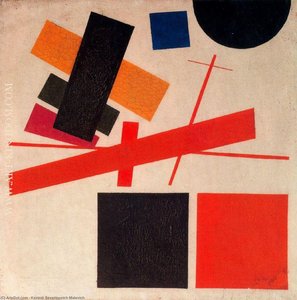
Malevich’s work represents a profound departure from the representational traditions of the 19th century, moving through Impressionism and Cubism to eventually found Suprematism. His iconic Black Square serves as the ultimate testament to this shift, stripping away the visible world to achieve a language of pure feeling. By reducing art to its most basic geometric elements, he liberated the canvas from the burden of objects, creating a silent, geometric truth that continues to resonate through the history of modernism.
Ivan Aivazovsky
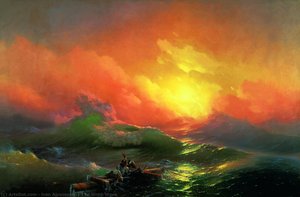 The Ninth Wave - Ivan Aivazovsky
Born in the Crimean port of Feodosia in 1817, Ivan Aivazovsky stands as a preeminent figure among 19th century Ukrainian painters. His deep connection to the Black Sea, which shaped his visual identity from childhood, allowed him to master the complexities of marine art. After receiving rigorous training at the Imperial Academy of Arts in Saint Petersburg under the landscape specialist Maxim Vorobyov, Aivazovsky’s talent reached a continental scale. His travels through Italy and the Mediterranean provided him with a sophisticated understanding of light and atmosphere, eventually earning him significant recognition across Europe.
Aivazovsky is most celebrated for his ability to capture the sublime and terrifying force of the ocean, a hallmark of the Romantic movement. His masterpiece, The Ninth Wave (1850), exemplifies this dramatic intensity. The work depicts a small boat struggling against turbulent, overwhelming waves under a fiery, atmospheric sky. Through a masterful use of color and light, he creates a sense of movement and texture that makes the sea appear both beautiful and devastating. His technical precision in rendering the translucent quality of water and the chaos of a storm remains a benchmark in the history of seascape painting.
Ilya Repin
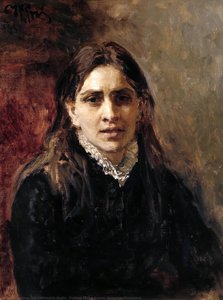 Portrait of the Actress Pelageya Strepetova - Ilya Repin
A master of Russian realism, Ilya Repin was born in 1844 in Chuguev, within the Kharkov Governorate of what is today Ukraine. His artistic journey began with the disciplined tradition of icon painting, a craft that instilled in him a profound understanding of religious composition and light before he transitioned to secular art. This Ukrainian upbringing, marked by the realities of provincial life, provided the emotional foundation for his later, powerful depictions of the human condition.
Repin’s work is instantly recognizable through its unflinching psychological depth and masterful use of chiaroscuro. He possessed a rare ability to sculpt form through dramatic contrasts of light and shadow, imbuing his subjects with a palpable, living presence. His brushwork is both precise and emotive, capturing the subtle textures of skin and fabric with astonishing clarity.
His 1882 masterpiece, Portrait of the Actress Pelageya Strepetova, serves as a quintessential example of his technical brilliance. In this work, Repin utilizes a striking crimson backdrop to focus the viewer's attention entirely on the subject's gaze, capturing a moment of intense, quiet contemplation that defines his contribution to 19th-century art.
Vladimir Borovikovsky
 Portrait of Sergei Yakovlev - Vladimir Borovikovsky
Born in Myrhorod, Ukraine, in 1757, Vladimir Borovikovsky emerged from a lineage of icon painters to become a preeminent figure in the transition from Rococo to Romanticism. His journey from the religious traditions of his father, a Ukrainian Cossack, to the imperial courts of Saint Petersburg defines the artistic evolution of the region during the 19th century. Borovikovsky’s ability to infuse formal portraiture with a profound sense of intimacy and sentimentality allowed him to capture the essence of the era's nobility, earning him the patronage of Empress Catherine II.
In the representative work, Portrait of Sergei Yakovlev, we witness the master's command over light and texture. The composition utilizes a dramatic interplay of shadow and illumination to define the subject's dignified presence. A dark, tailored coat absorbs the light, contrasting sharply with a crisp white collar and a glinting medal that speaks to high social standing. The background, featuring deep crimson drapery and an ethereal, cloud-like visage, creates a theatrical atmosphere that elevates the portrait from a mere likeness to a psychological study. Through seamless brushwork, Borovikovsky captures a moment of quiet, purposeful composure, embodying the sophisticated emotional depth characteristic of his celebrated style.
Mihály Munkácsy
 Apotheosis of the Renaissance - Mihály Munkácsy
Born in the town of Munkács, in what is now Ukraine, Mihály Munkácsy (1844–1900) rose from a childhood of profound hardship to become a titan of 19th-century Realism. After being orphaned at age seven, his innate talent was nurtured by the itinerant painter Elek Szamossy, eventually leading him to the prestigious academies of Vienna, Munich, and Düsseldorf. His early training in the Düsseldorf school provided the technical foundation for a career that would bridge the gap between gritty social realism and grand, theatrical drama.
Munkácsy’s oeuvre is characterized by a powerful sense of movement and a mastery of light and shadow. While his early works focused on the dignity of peasant life, he achieved international renown for his monumental compositions. His representative masterpiece, Apotheosis of the Renaissance, exemplifies this dramatic evolution. In this work, he captures a celestial triumph through energetic brushwork and a sophisticated use of impasto, creating a sense of volume that makes the heavens feel tangible. By blending the heavy, earthy tones of human existence with a luminous, divine palette, Munkácsy solidified his legacy as a master of emotional and architectural grandeur.
Konrad Krzyżanowski
 Portrait of Maria Krzymuska (Theresita). - Konrad Krzyżanowski
Born in Kremenchuk, Ukraine, Konrad Krzyżanowski (1872–1922) represents a vital link between the academic traditions of the 19th century and the burgeoning modernism of the early 20th. His artistic identity was forged in the cultural crossroads of the region, beginning with his formative training at the Kyiv Drawing School under the respected Mykola Murashko. This Ukrainian foundation provided the technical rigor that would later define his expressive capabilities, even after his departure for the Imperial Academy of Arts in Saint Petersburg and his subsequent move to Munich.
Krzyżanowski became a pioneer of Polish Expressionism, a movement characterized by a shift from representational accuracy toward intense psychological depth. His work often prioritizes the subjective emotional experience, a trait exemplified in his Portrait of Maria Krzymuska (Theresita). In this striking oil on canvas, the artist utilizes a somber, monochromatic palette and dramatic chiaroscuro to turn the gaze inward, capturing the sitter's internal state through heavy, earthy tones and indistinct, organic shapes. By blending the formal training of his youth with the bold, emotive styles encountered in Munich, Krzyżanowski left an indelible mark on the evolution of modern European art.
Jan Stanisławski
 Tatra Mountains in the winter - Jan Stanisławski
Born in 1860 in Velsk, Jan Stanisławski represents a vital link in the landscape traditions of the 19th century. As a painter born in Ukraine, his artistic evolution was uniquely shaped by a foundation in mathematics, a discipline that provided him with a precise understanding of structure and light. This scientific rigor, combined with the mentorship of Wojciech Gerson at the Warsaw School of Fine Arts, allowed him to approach the natural world with both intellectual depth and emotional fluidity. His later immersion in the revolutionary art scenes of St. Petersburg and Paris introduced him to the shimmering light of Impressionism and the organic rhythms of Art Nouveau, which he masterfully synthesized into his mature style.
In his representative work, Tatra Mountains in the winter (1891), Stanisławski demonstrates this profound command of atmosphere. The painting captures a frozen symphony of snow-laden summits and tranquil valleys, using rhythmic brushwork to simulate the heavy texture of fresh snowfall. Through a delicate balance of precise observation and expressive movement, he transforms a rugged mountain vista into a serene meditation on the purity of nature, cementing his legacy as a master of the landscape.
Nikolai Yaroshenko
 The Student - Nikolai Yaroshenko
Born in Poltava, Ukraine, in 1846, Nikolai Yaroshenko emerged as a profound voice within the 19th-century Ukrainian artistic landscape. His path was uniquely shaped by a dual life; while training for a military career at the Mikhailovsky Military Artillery Academy in Saint Petersburg, he simultaneously immersed himself in the artistic disciplines of the Imperial Academy of Arts. This tension between military discipline and creative passion defined his evolution into a leading realist, eventually earning him the reputation as the "conscience" of the Peredvizhniki movement.
Yaroshenko’s work is characterized by a somber, dramatic intensity, often focusing on the social struggles and the psychological depth of his subjects. His masterpiece, The Student (1881), serves as a striking example of his ability to move beyond mere portraiture to address broader social phenomena. In this work, he captures the essence of a young woman seeking education, utilizing a jarring visual dissonance—such as the juxtaposition of masculine attire with ragged clothing—to represent the realities of academic pursuit. Through his unflinching honesty and mastery of genre scenes, Yaroshenko remains a vital figure in the history of 19th-century painters from Ukraine."
Henryk Siemiradzki
 Princess Marie Lubomirska - Henryk Siemiradzki
Born in 1843 in the region of Belgorod, Henryk Siemiradzki stands as a monumental figure among 19th century Ukrainian painters. His work is instantly recognizable by its theatrical grandeur and a sophisticated command of light that seems to emanate from within the canvas itself. A master of Academic Realism, Siemiradzki possessed a unique ability to transport viewers into the sun-drenched splendor of Greco-Roman antiquity or the profound depths of biblical narratives through dramatic, large-scale compositions.
His technical evolution was shaped by rigorous training at the Imperial Academy of Arts in Saint Petersburg and later by the influence of Karl von Piloty in Munich. This academic foundation, combined with his long residency in Rome, allowed him to master the interplay of shadow and luminous texture. In his representative work, Princess Marie Lubomirska (1881), his skill is on full display. Through a controlled light source and a luxurious palette of midnight blue and crimson, he achieves a photographic precision that captures both the physical presence and the dignified essence of his subjects. His canvases remain powerful testaments to the height of 19th-century academic excellence."
Henryk Rodakowski
 Portrait of Leon Sapieha - Henryk Rodakowski
Born in 1823, Henryk Rodakowski stands as a distinguished figure among 19th century painters from Ukraine, bridging the gap between academic rigor and Romantic sensibility. His artistic journey took him from the lecture halls of the University of Vienna to the vibrant salons of Paris, where he studied under Léon Cogniet. It was in the French capital that he achieved significant acclaim, notably winning first prize in 1852 for his portrait of General Henryk Dembiński, a success that drew the attention of masters like Eugène Delacroix.
Rodakowski’s mastery of light and texture is epitomized in his 1878 work, Portrait of Leon Sapieha. This composition utilizes a dramatic chiaroscuro effect, where a singular light source carves the subject out of an atmospheric, dark void. The painting is a profound study of status and tactile reality; the artist meticulously renders the heavy folds of a dark velvet jacket and the intricate, metallic glint of gold buttons and embroidered sashes. Through such precise brushwork, Rodakowski captures the quiet authority of the sitter, immortalizing the subject through a sophisticated interplay of shadow and light that defines the pinnacle of 19th-century portraiture."
Conclusion
The legacy of these 19th-century masters lies in their ability to capture the profound tension between the sweeping romanticism of the sea, the dramatic light of historical epic, and the quiet soul of the landscape. From the luminous maritime visions of Aivazovsky to the psychological depth found in the portraits of Repin and Yaroshenko, these artists collectively defined a visual language that bridged the gap between classical tradition and the dawn of modernism. Whether through the textured impasto of a landscape or the grand scale of a historical scene, their work remains a testament to the diverse artistic spirit that emerged from this region during a transformative century.
At Mus3ums.com, we invite you to bring this extraordinary history into your own space. Our artisans specialize in creating museum-quality, hand-painted oil reproductions that honor the specific brushwork and tonal depth of these masters. You can explore our full collection to find a piece that resonates with your aesthetic and live with these timeless masterpieces every day.


