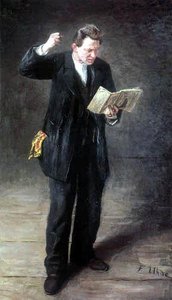
Introduction
German realist painters emerged during a transformative era in the 19th century, a period when the romanticized ideals of the past began to yield to the unvarnished truths of a rapidly industrializing society. Moving away from the idealized heroics of academic tradition, these artists turned their gaze toward the immediate and the tangible. They sought to capture the essence of everyday life, documenting the dignity of labor, the quietude of rural landscapes, and the complex psychological depth of the common person without the embellishment of myth or grandeur.
This movement was deeply rooted in a cultural shift toward empirical observation and social awareness. As the social fabric of Germany evolved, painters like Wilhelm Leibl and Fritz von Uhde led a visual revolution, prioritizing the authentic textures of reality over staged perfection. Their work served as a mirror to a changing nation, capturing the grit of the working class and the subtle nuances of light and shadow in domestic settings. By focusing on the "here and now," they challenged the boundaries of what was considered worthy of high art, elevating the mundane to the level of the monumental.
Today, these artists remain vital for their profound honesty and their technical mastery of light and form. Their ability to find beauty in the ordinary continues to resonate with modern sensibilities, offering a grounding counterpoint to the digital abstractions of the contemporary age. By studying their approach, one gains a deeper understanding of how art can serve as a truthful witness to the human condition.
The following selection explores ten pivotal figures who defined this movement, ranging from masters of portraiture to those who captured the sweeping, honest landscapes of the German spirit.
Franz von Lenbach
 Alois Hauser (1831 - 1909) - Franz von Lenbach
Born in Bavaria in 1836, Franz von Lenbach rose from humble beginnings as a mason’s son to become the celebrated Malerfürst, or Painter Prince, of the German art scene. His technical mastery was forged at the Academy of Fine Arts in Munich under the guidance of Karl von Piloty, and further refined during formative travels to Rome and Paris. Lenbach’s contribution to the German realist movement lies in his profound ability to chronicle the essence of human character through meticulous, unembellished observation. Unlike the idealized portraits of previous eras, his work focused on the psychological weight and physical presence of his subjects, capturing the dignity of the individual with a precision that defined 19th-century portraiture.
In his representative work, Alois Hauser, painted in 1885, Lenbach demonstrates this mastery of realist characterization. The portrait utilizes a dramatic, monochromatic palette and directional lighting to sculpt the subject's features, creating a palpable sense of three-dimensionality. By stripping away distracting backgrounds, he focuses entirely on the architecture of the human face, using a sophisticated interplay of smooth skin tones and textured, painterly brushwork in the beard to convey a profound, somber presence.
Fritz von Uhde
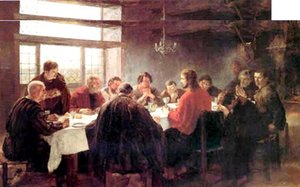
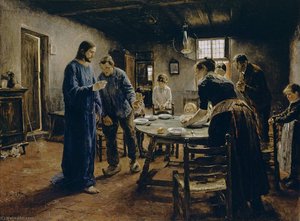 The Mealtime Prayer - Fritz von Uhde
Fritz von Uhde (1848–1911) stands as a transformative figure among German realist painters, known for bridging the gap between stark social observation and the luminous qualities of Impressionism. His artistic journey was marked by a bold departure from the rigid, conservative traditions of the Dresden Academy. After a brief period serving as a Lieutenant in the army, Uhde sought a more authentic way to capture life, eventually moving toward a style that brought the natural, unadorned truth of the human condition to the forefront of German art.
His commitment to Realism is most profoundly felt in his ability to find the sacred within the mundane. In his 1885 masterpiece, The Mealtime Prayer, Uhde exemplifies this approach by placing a religious ritual within a modest, rustic domestic setting. Rather than depicting grand, idealized biblical scenes, he focuses on the quiet, humble reality of a family gathered around a table. Through a subdued, diffused light that enters from a side window, he captures a serene moment of devotion, proving that the most profound spiritual experiences are often found in the simplest, most ordinary aspects of everyday life.
Hubert von Herkomer
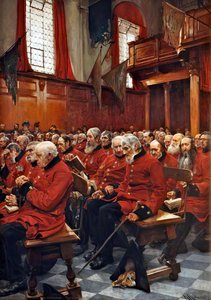 The Last Muster - Hubert von Herkomer
In his seminal 1875 work, The Last Muster, Hubert von Herkomer captures a heavy, silent moment within the wood-panelled chapel of the Royal Hospital, Chelsea. The painting depicts Chelsea pensioners in their distinctive scarlet coats, gathered for a Sunday service. The atmosphere is thick with the weight of memory and the quiet dignity of veterans, as the scene pivots on the somber realization that a soldier has passed away during the roll call, marking his final muster. This profound observation of mortality and ritual highlights the artist's ability to find gravity in the most human of transitions.
Born in Germany in 1849, von Herkomer became a defining figure of the Realist movement through his commitment to depicting the unvarnished realities of the working class and the hardships of everyday life. His work is characterized by a poignant social commentary, often focusing on the struggles of the common man, as seen in his famous piece Hard Times. Whether through his evocative portraits of prominent figures or his dramatic scenes of rural life, his palette and technique serve to elevate the ordinary to the level of high art. His dedication to portraying life exactly as it is, without embellishment, firmly establishes him among the most significant German-born realist painters of the 19th century.
Wilhelm Leibl
 Interior - Wilhelm Leibl
Wilhelm Leibl stands as a transformative figure among German realist painters, famously breaking away from the polished idealism of the Munich Academy to embrace a more visceral, unvarnished truth. His artistic evolution was profoundly shaped by the influence of Gustave Courbet, whose alla prima technique—painting directly from nature with bold, immediate brushstrokes—liberated Leibl from rigid academicism. This approach allowed him to capture the essence of Bavarian peasant life with a directness that prioritized the lived experience over romanticized myth.
His work is characterized by a masterful tension between disciplined drawing and a luminous, tactile application of paint. In his representative work, Interior (1897), Leibl demonstrates this ability to find dignity in the mundane. The painting avoids the grandiosity typical of his predecessors, focusing instead on a quietude of shadow and light. Through a heavy, somber use of impasto, he sculpts the atmosphere, using light to pierce through deep, velvety shadows and define the textures of a domestic space. By eschewing the need to make his subjects appear grander than they were, Leibl solidified his place as a cornerstone of the German Realism movement, emphasizing the profound weight of everyday existence.
Wilhelm Trübner
 Portrait of Actor Josef Kainz - Wilhelm Trübner
Wilhelm Trübner (1851–1917) stands as a pivotal figure in German Realism, specifically through his association with the influential Leibl Circle. Moving away from the rigid, polished constraints of academic tradition, Trübner embraced an unsentimental approach to his subjects, favoring the truth of the natural world. His technique was deeply shaped by the alla prima method, a spontaneous yet restrained approach that allowed him to capture light and atmosphere with remarkable immediacy. This commitment to directness and the rejection of idealized beauty firmly places him within the realist movement, as he sought to portray life without embellishment.
His 1879 work, Portrait of Actor Josef Kainz, serves as a profound testament to this stylistic evolution. In this study, Trübner eschews a detailed setting in favor of a dark, indistinct background, focusing entirely on the psychological presence of the subject. The painting utilizes a high-contrast interplay of light and shadow to carve the sitter's features from the darkness, emphasizing the structural anatomy of the face. Through visible, painterly brushstrokes and a restrained palette, he captures the tactile quality of skin and fabric, achieving a sense of quiet, internal gravity that defines the realist's mastery of character over artifice.
Ludwig Knaus
 Portrait of Mrs. Müller - Ludwig Knaus
Ludwig Knaus (1829–1910) stands as a preeminent figure of German realist painters, distinguished by his ability to elevate the mundane experiences of rural and domestic life into moments of profound dignity. Moving away from the somber, heavy tones of his early training at the Düsseldorf school under masters like Schadow, Knaus underwent a transformative period in Paris. Studying under Thomas Couture, he refined a luminous, nuanced approach to light that allowed him to master the genre painting style, capturing the heartbeat of the nineteenth century with unwavering accuracy and emotional resonance.
His commitment to the realist movement is exemplified in his 1848 work, Portrait of Mrs. Müller. In this piece, Knaus eschews grandiosity to focus on the quiet, stoic presence of a woman rendered with meticulous precision. The painting avoids theatricality, instead utilizing a subtle play of chiaroscuro to highlight the textures of aging skin and the delicate glint of gold jewelry. Through this grounded, empathetic lens, Knaus transforms a simple, still moment into a monumental study of character and human stability.
Hermann Struck
 Nablus (Palestine) - Hermann Struck
Hermann Struck (1876–1944) represents a profound intersection of technical mastery and social observation within the German realist tradition. Trained at the Berlin Academy of Fine Arts, Struck moved beyond mere idealization to capture the unvarnished essence of his subjects, a hallmark of the realist movement. He is particularly celebrated for his ability to document the human condition through meticulous etchings and lithographs, focusing on the lived experiences of Jewish figures and the quiet rhythms of everyday life.
His commitment to realism is vividly evident in his 1900 work, Nablus (Palestine). In this evocative piece, Struck utilizes a sophisticated range of tonal values to depict a sun-drenched street scene, capturing the architectural textures and the communal movement of figures with an intimacy that avoids the grandiosity of romanticism. Beyond his landscape work, his portraiture of prominent intellectuals and activists showcased a keen ability to render psychological depth through precise line work. As a seminal theorist who authored Die Kunst des Radierens, Struck’s influence extended through his dedication to the technical truth of printmaking, ensuring that the textures of reality—whether in a bustling Middle Eastern thoroughfare or a quiet studio portrait—were preserved with absolute clarity.
Albert Lang
 Self-Portrait - Albert Lang
In his 1875 Self-Portrait, Albert Lang offers a profound study of identity, capturing the artist in a moment of quiet introspection. This work serves as a testament to his technical precision, where the steady gaze of the subject meets the viewer through a masterful application of light and shadow. Lang’s transition from the structured geometry of architecture—having studied at the Berlin Bauakademie under Heinrich Strack—to the fluid, tactile world of painting allowed him to bring a unique sense of structural integrity to his canvases.
Lang’s place within the German realist movement is defined by his spirited resistance against the grand, idealized historical styles of the 19th century. Influenced by the works of Wilhelm Leibl, he sought a truth found in the immediate and the unadorned. His time in Italy, particularly his residency in Florence, further refined this approach, blending the weight of realist observation with a burgeoning fascination for how light interacts with the physical world. Whether documenting the human form or capturing the essence of landscapes like <Landschaft bei Lerici, Lang’s oeuvre remains anchored in the authentic, eschewing the grandiose in favor of the tangible reality of his subjects.
Adolf Eberle
 A futile attempt - Adolf Eberle
Adolf Eberle (1843–1914) stands as a quintessential figure among German realist painters due to his unwavering commitment to the dignity of the everyday. Trained at the Munich Academy of Fine Arts under the mentorship of Karl von Piloty, Eberle moved away from the grandiosity of historical or mythological subjects to embrace the essence of genre painting. His work is defined by a meticulous observation of the Bavarian and Tyrolean landscapes, where he captured the authentic rhythms of rural life, from the labor of farmers to the quietude of domestic settings.
In his 1880 work, A futile attempt, Eberle demonstrates the profound capacity of the realist movement to find weight in the mundane. This piece presents a somber, intimate slice of 19th-century German life, utilizing a masterful interplay of light and shadow to define a cramped, stony interior. Through a precise arrangement of tones, he renders the tactile reality of the world:
- The heavy, textured grain of wooden floorboards.
- The soft, voluminous folds of fabric in the women's garments.
- The weathered, honest features of the figures caught in a silent, melancholic pause.
By stripping away artifice, Eberle ensures that the focus remains entirely on the raw, unadorned geometry of existence.
Lothar Von Seebach
 Marchand à la jambe de bois Hausierer (Titre attribué) - Lothar Von Seebach
In Marchand à la jambe de bois Hausierer, the viewer is confronted with the quiet, heavy dignity of a weathered woodcutter. This work exemplifies the essence of the German Realism movement through its unflinching focus on the textures of manual toil and the somber reality of rural life. Rather than idealizing his subject, the artist uses a palette of earthy ochre, brown, and muted greens to ground the figure in a tactile, immediate reality. The composition emphasizes the physical weight of the man and his tools, utilizing visible brushstrokes and a naturalistic play of light to define the rugged contours of a life spent outdoors.
Lothar Von Seebach (1853–1930) was a pivotal Alsatian artist whose commitment to capturing the authentic spirit of Strasbourg and its inhabitants placed him firmly within the realist tradition. Trained at the Karlsruhe Academy of Fine Arts under Ferdinand Keller, Seebach eschewed academic prestige and professorships to maintain a fiercely independent practice. His work often bridges the gap between academic precision and expressive freedom, capturing the soul of the Alsatian landscape and its people with an observational depth that honors the ordinary over the grand.
Conclusion
The legacy of German realist painters lies in their uncompromising commitment to the truth of the human condition, whether through the dignified portraiture of Franz von Lenbach or the profound social observations of Wilhelm Leibl. These artists moved away from idealized fantasies to capture the raw textures of everyday life, the weight of labor, and the quiet dignity of the common person. From the atmospheric landscapes of Adolf Eberle to the intricate detail found in the works of Hermann Struck, this movement provided a visual language for a changing society, grounding art in the tangible reality of the world around them.
For those looking to bring this sense of historical depth and authentic character into a modern space, Mus3ums.com offers a way to honor these masters. Our artisans specialize in creating museum-quality, hand-painted oil reproductions that preserve the essential brushwork and tonal depth of these German masters. You can explore our full collection to find the perfect piece and invite the enduring spirit of German Realism into your home through our bespoke, handmade artistry.