A Legacy Carved in Stone and Oil
London, 1777. The son of the architect James Wyatt enters a world defined by structural precision and familial ambition. Matthew Cotes Wyatt grows up within the shadow of great designs, the brother of Benjamin Dean Wyatt, and a student of the Royal Academy Schools from 1800. His early years are spent navigating the fine line between the brush and the chisel. Between 1800 and 1814, he presents portraits and historical subjects in oils at the Royal Academy exhibitions. The paint is his first language.
A shift occurs. The desire for permanence pulls him away from the canvas. He begins to teach himself the demanding disciplines of modelling and carving. This transition is not a sudden break but a calculated movement toward the monumental. By 1813, he unveils his first public work: a memorial sculpture to Lord Nelson in Liverpool. It is a moment of arrival for a man finding his true medium.
The Weight of Royal Commission
The year 1805 brings a significant connection to the Crown. Through his father’s influence, Wyatt finds himself working at Windsor Castle under the direction of George III. He spends time restoring and extending the ceilings of Antonio Verrio. This proximity to royal splendor shapes his later ambitions for large-scale public works.
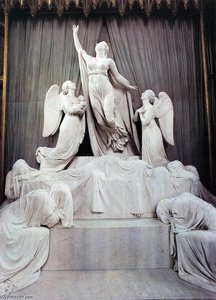
The marble cenotaph to Princess Charlotte in St George's Chapel, Windsor, marks a definitive peak in his reputation. Completed around 1820, this work anchors his name to the very heart of British royal history. His hands move from the delicate restoration of ceilings to the heavy, solemn task of memorializing royalty.
His sculptural output expands into the bronze medium with immense scale:
- A bronze equestrian statue of George III, positioned at the junction of Pall Mall East and Cockspur Street.
- The massive bronze equestrian statue of the Duke of Wellington, which once occupied the top of the Wellington Arch at Hyde Park Corner before its relocation to Aldershot.
Ambition and the Hound
In 1831, a singular commission arrives from John Ward, the 1st Earl of Dudley. The task is the sculpture of a favourite hound named Bashaw. This project demands an intense, repetitive engagement with the subject; the dog is brought to Wyatt’s London studio approximately fifty times to sit for the sculptor. The scale of the investment is immense, with a fee of 5,000 guineas promised.
The physical reality of the work reaches a level of extreme detail. To complete the eyes of Bashaw, Persian topaz and sardonyx are provided from the Earl's own collection. Yet, the project becomes a site of financial struggle. Following the death of Lord Dudley in 1833, his executors refuse to pay the agreed fee. Wyatt is left holding the sculpture, which he continues to exhibit, including at The Great Exhibition of 1851.
He remains a figure of significant presence in the London art scene until his death in 1862. He leaves behind an estate valued at approximately £80,000 and a body interred in Highgate Cemetery.
Küsimused ja vastused
Millises ajaloolises perioodis töötas Matthew Cotes Wyatt?
Matthew Cotes Wyatt töötas 19th Century perioodil. See ajastu aitab määratleda kunstniku tegevust ajaloolises kontekstis.
Millest riigist on pärit Matthew Cotes Wyatt?
Matthew Cotes Wyatt sündis riigis United Kingdom.
Millises linnas ja riigis on Matthew Cotes Wyatt sündinud?
Matthew Cotes Wyatt sündis London, United Kingdom.