Early Life, Family and Training
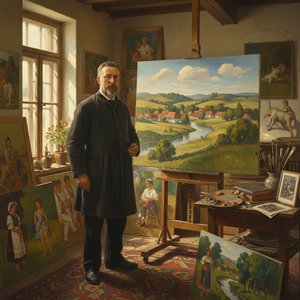
Sándor Galimberti entered the world in 1883, born into a family that had immigrated to Kaposvár in Southern Hungary. His lineage was marked by an artistic inclination; his father, Luigi Galimberti, hailed from Trieste, Italy, and had received his training at the Fine Arts Academy in Venice. This familial connection to the brush provided a foundation for Sándor, whose burgeoning talent was recognized early on by those within the Hungarian art circles.
His formal education followed a path through the major academic centers of Europe. He began his studies at the School for Applied Arts in Budapest before moving toward more classical training at the Fine Arts Academy in Munich. These formative years provided the technical discipline that would later allow him to experiment with more radical modern styles. His education was not confined to the classroom, however, as he sought the light and atmosphere of the Nagybánya artists' colony, where he studied under Simon Hollósy.
The final stage of his academic development took him to the heart of the avant-garde. In 1905, Sándor Galimberti arrived in Paris to study at the Julian Academy. This period of immersion in the French capital allowed him to engage directly with the shifting currents of modernism, moving beyond the traditionalism of his earlier training toward the experimental energy that would define his brief but significant career.
Artistic Movements and Style
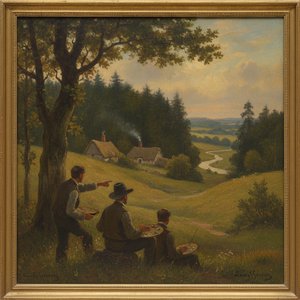
The trajectory of Galimberti’s aesthetic development was marked by a restless pursuit of modernism. His early works were rooted in the traditions of the Nagybánya artists' colony, characterized by the naturalism of plein air painting. During this formative period, his brushwork sought to capture the immediate effects of light and atmosphere. However, this observational foundation soon gave way to a more intense preoccupation with the expressive power of color and form. He moved away from mere representation, seeking instead to harness the emotional weight of his palette.
As his style evolved, Galimberti embraced the radical shifts occurring in the European avant-garde. In his Fauvist period, he utilized vivid, pure colors to define his subjects, prioritizing chromatic intensity over naturalistic accuracy. This experimentation continued as he moved toward more structured approaches. His Cubist compositions saw a shift toward the dominance of geometric forms, stripping away the softness of his earlier landscapes to find a new, more rigorous visual language. His artistic interests were broad, spanning the transition from Secession and Fauvism into the structured realms of Cubism and, in a certain sense, Futurism.
Life and Career in Paris
In 1905, Galimberti arrived in Paris, drawn by the magnetic pull of the city's burgeoning avant-garde scene. This move marked a departure from his earlier training, placing him at the center of a radical shift in European modernism. He did not navigate this landscape alone; in the early 1910s, he married Valéria Dénes, a fellow painter. Together, they became a significant presence in the Parisian art community, their lives and creative ambitions deeply intertwined as they explored the shifting boundaries of form and color.
The couple’s professional lives were characterized by a steady presence in the city's most important circles. They exhibited almost every year at the Paris Salons, maintaining a consistent visibility within the established art world. Their reach extended into the more experimental quarters of the city as well. In 1914, just before the onset of the Great War, the pair held a solo exhibition in Montmartre at the Galerie Berthe Weill. This exhibition occurred at a moment when the very foundations of modern art were being redefined, placing the Galimbertis at the heart of a transformative era.
Key Works and Provenance
The progression of Galimberti’s output reveals a shifting focus from the naturalism of his early years toward the complex energy of urban life. His 1899 work, Autumn, captures a sense of seasonal transition, while his later explorations moved toward more structured compositions. Around 1910, he produced Nagybánya, a piece reflecting the influence of the landscape and the light of the colony. By 1911, his interest in the modern pulse of the city was evident in The Dynamics of the City (Budapest, Óbuda Scene), an oil on canvas that bears his GS monogram in the lower left.
The movement of these works through private collections provides a glimpse into their history. One notable piece was formerly held in the property of József Gróf, later passing to Mme József Gróf. These transitions from private hands to public view have helped preserve the visual record of his brief but intense career. His paintings have been featured in various exhibitions, including those held at the Hungarian National Gallery and the Rippl-Rónai Múzeum.
Küsimused ja vastused
Mis on Sándor Galimberti sünnipaik ja sünnahöstua?
Sándor Galimberti sündis Kaposvár linnas aastal 1883.
Millest riigist on pärit Sándor Galimberti?
Sándor Galimberti sündis riigis Hungary.
Mis on Sándor Galimberti pseudonüümid või alternatiivsed nimed?
Kunstnik Sándor Galimberti on tuntud ka nimeel Galimberti Sándor.