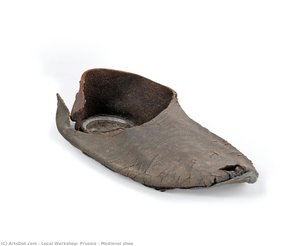
A Legacy of Medieval Craftsmanship: The Soul of Prussian Ceramics
To wander through the annals of fourteenth-century artistry is to encounter the silent, enduring echoes of the Local Workshop, Prussia. This era of craftsmanship, rooted in the fertile cultural landscapes of Brandenburg and Silesia, represents a profound moment in the history of medieval ceramic art. While the biographical identity of the individual artisan remains shrouded in the mists of time—documented only through the tactile reality of surviving vessels—their presence is felt in every meticulously fired edge and glazed surface. This workshop was not merely a site of production but a crucible of cultural heritage, where the emerging traditions of Warmian pottery began to coalesce into a distinct visual language that would define the region for generations.
The origins of this artistic lineage are deeply intertwined with the socio-political shifts of the 1360s. Born likely within the artisanal heartlands of Brandenburg under the burgeoning influence of the Hohenzollern rule, the creator of these works was a product of an era defined by both movement and stability. It is easy to imagine a formative life spent amidst the rhythmic sounds of the potter's wheel and the intense heat of the kiln, learning the delicate alchemy of glaze formulation through generations of inherited wisdom. The aesthetic vision of this period was heavily informed by the soaring lines of Gothic architecture and the intricate, symbolic narratives found in illuminated manuscripts, all of which infused the ceramic medium with a sense of sacred geometry and structural grandeur.
The Language of Heraldry and Geometric Precision
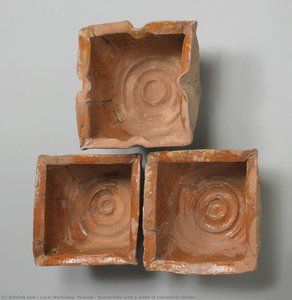
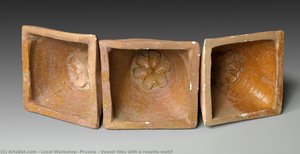
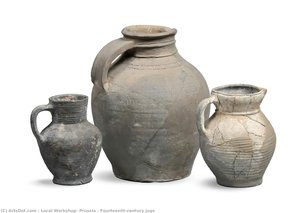
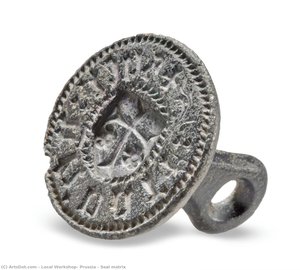
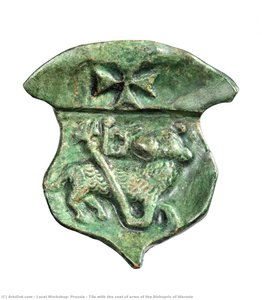
The true brilliance of the Prussian workshop lies in its ability to transform utilitarian objects into powerful instruments of social communication. The artist’s technique was characterized by an unwavering commitment to geometric precision, a skill that allowed for the seamless integration of complex heraldic emblems onto the curved surfaces of jugs and bowls. These were not merely decorative flourishes; they were the visual shorthand of a hierarchical society. Through the masterful application of coats of arms, rosettes, and concentric circles, the ceramicist captured the very essence of noble lineage and territorial allegiance.
Every vessel served as a canvas for identity, where:
- Heraldic Emblems functioned as permanent markers of political and familial pride.
- Rosette Motifs provided a rhythmic, organic counterpoint to the rigid lines of heraldry.
- Concentric Circles offered a sense of cosmic order and mathematical harmony.
Historical Significance and the Endurance of Form
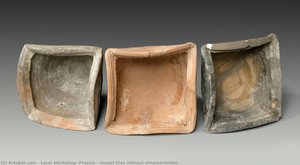
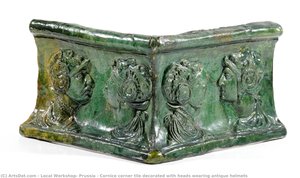
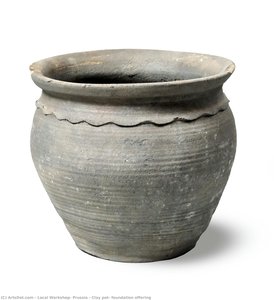
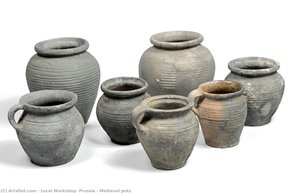
The impact of this local workshop extends far beyond the boundaries of the fourteenth century. By mastering the technical challenges of kiln firing and the chemical complexities of glazes, these artisans laid the groundwork for a tradition of German ceramic excellence that would persist through the centuries. The works produced—ranging from foundation offering clay pots to intricately decorated vessel tiles—stand as archaeological witnesses to a time when art was inseparable from daily life and political structure. Even as the borders of Prussia shifted and the medieval world transitioned into the Renaissance, the fundamental motifs established by this workshop remained embedded in the cultural DNA of the region.
Today, we look upon these fragments of the past not just as relics, but as a testament to the human desire to leave a permanent mark upon the earth. The Local Workshop, Prussia reminds us that true artistry lies in the ability to marry technical mastery with profound symbolic meaning, creating objects that are at once functional and eternal. Through the preservation of these ceramic treasures, the spirit of the medieval artisan continues to speak, offering a window into a world where every curve of a bowl and every stroke of a glaze told a story of belonging, power, and enduring beauty.
प्रश्न और उत्तर
Local Workshop, Prussia कहाँ के रहने वाले हैं?
Local Workshop, Prussia का जन्म Germany में हुआ था।