Early Life, Family and Artistic Training
Paris, 16 April 1755. Louise Élisabeth Vigée Le Brun enters a city defined by the strict hierarchies of the Ancien Régime. She is born to Jeanne Maisin, a hairdresser from a peasant background, and Louis Vigée, a portraitist, pastellist, and member of the Académie de Saint-Luc. The household is one of art and observation. From a young age, she displays an innate gift for drawing, producing sketches that catch her father's attention. He recognizes her potential early, providing the foundational lessons that will shape her technical skill.
The training is rigorous and self-directed. Beyond the instruction of her father, she seeks out the masters by studying their hands. She spends hours in the Louvre, meticulously copying the works of Rubens, Van Dyck, and Rembrandt to refine her understanding of light and form. This period of intense study is supplemented by access to private collections; she spends significant time copying paintings from the collection of Jean-Baptiste-Pierre Le Brun. These sessions are not mere imitation but a pursuit of psychological depth and technical precision. She absorbs the prevailing aesthetic currents of the late 18th century, preparing for a career that will eventually move from the private studios of Paris to the royal courts of Europe.
Patrons, Workshop and Royal Commissions
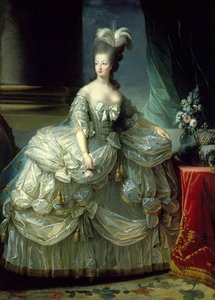
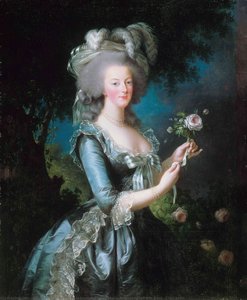
The year 1778 marks a sudden shift in her trajectory. A commission to paint Marie Antoinette moves her from the periphery of the art world into the center of the French court. This is no mere professional engagement; she becomes a personal friend to the Queen. As the official portraitist to Marie Antoinette, Vigée Le Brun navigates the high-stakes atmosphere of the royal family, capturing the likeness of the monarchy while becoming a close associate of the court's inner circle.
Her studio becomes a destination for the European aristocracy and nobility. The demand for her portraits extends through the highest echelons of society, where her ability to render status and personality attracts a steady stream of elite patrons. Among those who seek her brush is Joseph Hyacinthe François de Paule de Rigaud, Comte de Vaudreuil. Her success in these circles transforms her from a rising talent into a central figure of the 18th-century social landscape.
- Portrait of Marie Antoinette
- Portrait of the Comte de Vaudreuil
Exile and International Career
The political tremors of the French Revolution force a sudden departure. In 1789, Vigée Le Brun flees France to escape persecution, leaving behind the courtly life of Paris for a life of movement across a fractured Europe. Her first refuge is Italy, where she remains from 1789 to 1792. This period of displacement does not halt her production; instead, it expands her reach. She establishes studios in Rome, Naples, and Venice, navigating the shifting borders of a continent in upheaval.
The movement continues. From 1792 to 1795, she resides in Austria, followed by a significant period in Russia from 1795 to 1801. In the imperial circles of St. Petersburg, her reputation as a portraitist finds new, wealthy patrons. After a brief stay in Germany in 1801, her path leads to London. Throughout these years of exile, she maintains a professional presence by setting up studios in Milan and various other European hubs, proving herself a self-supporting artist in a landscape of political instability.
Technique and Artistic Style
The brush moves with a specific intent, navigating the transition between two eras. Her work sits at the intersection of Rococo aesthetics and the emerging clarity of Neoclassicism. She employs delicate lines and a palette of soft colors to build form, moving away from heavy ornamentation toward a more balanced composition. This approach allows for a deep understanding of human psychology to emerge through the sitter's expression rather than through mere decorative flourish.
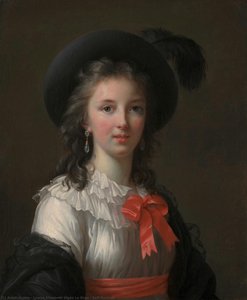
Texture defines her technical range. She works in both oil and pastel, utilizing the medium to render the tactile reality of her subjects. There is a meticulous focus on the way light interacts with material; she captures the sheen of silk and the intricate detail of lace to highlight social status and refinement. Her subjects often appear in elaborate attire, a deliberate choice that communicates their standing within the hierarchy of the 18th and early 19th centuries. In her self-portraits, this technique manifests in the soft rendering of skin and the fluid movement of muslin fabric.
- Self-Portrait, 1781
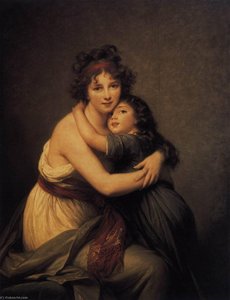
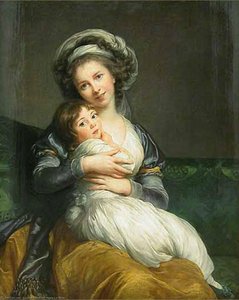
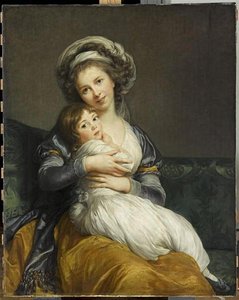
- Self Portrait with Her Daughter, Julie, about 1789
Key Works and Notable Paintings
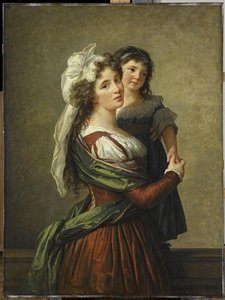
The early years of her career find expression in the portrait of Jeanne Massin, painted about 1772. As her reputation grows, her brush captures the shifting social landscape of the French court. In 1789, the political atmosphere in France begins to fracture, a tension mirrored in the intimate Self Portrait with Her Daughter, Julie. Here, the artist presents a serene image of youthful femininity, her daughter Julie appearing as a central figure in this portrayal of maternal connection. This same year, she captures Madame Rousseau and Her Daughter, another study in familial closeness.
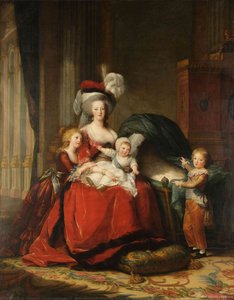
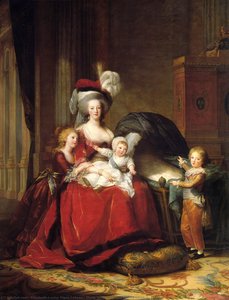
Her relationship with the French monarchy is most visible in her depictions of the royal family. Marie Antoinette and her Children captures the Queen in a manner that balances grandeur with a sense of humanity. This proximity to the throne defines much of her most recognized output. Even as she moves through different social circles, her ability to render personality remains constant, as seen in the 1791 portrait of Hyacinthe Gabrielle Roland.
The artist’s own image remains a recurring subject, often used to assert her identity and status. In her 1781 Self Portrait, she presents herself with a remarkable self-awareness, wearing a flowing muslin gown that reflects the fashions of the period. This work, along with her Self-Portrait in a Straw Hat, reveals a woman deeply aware of her own presence and the visual language of her era.
Legacy and Where to See Her Works
Vigée Le Brun remains a pioneer for women in the arts, having navigated a professional landscape almost exclusively reserved for men. Her success was not merely a matter of talent but of sheer persistence through political upheaval and exile. She moved through the courts of Europe, establishing studios from Rome to St. Petersburg, ensuring her name survived the shifting tides of the French Revolution. Her ability to maintain an independent career while managing high-profile patronage changed the trajectory for female artists seeking professional legitimacy.
Today, her presence is felt in the major galleries of the world. In Paris, her paintings hang within the Louvre. The Wallace Collection in London holds several of her portraits, preserving the likenesses of the 18th-century elite. In Washington, D.C., the National Museum of Women in the Arts maintains her works, securing her place in the history of feminine identity and artistic achievement. These collections offer a direct connection to the era of Marie Antoinette and the social hierarchies she documented.
- Self-Portrait with Her Daughter, Julie (1789)
- Portrait of Marie-Gabrielle de Gramont, Comtesse de Caderousse (1784)
- The comte d'Espagnac (1786)
- Madame Perregaux (1789)
Pitanja i odgovori
Odakle dolazi Louise Élisabeth Vigée Le Brun?
Louise Élisabeth Vigée Le Brun rođen/a je u Francuska.
Gdje je i kada je rođen/a Louise Élisabeth Vigée Le Brun?
Louise Élisabeth Vigée Le Brun rođen/a je u gradu Pariz 1755. godine.