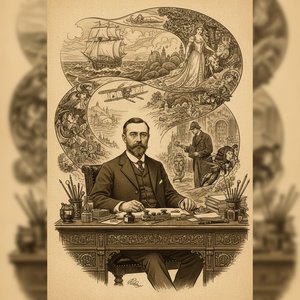
A Quiet Voice in the Thrilling World of Crime Fiction
Harold Robert Daniels (1919–1980) was an author who occupied a singular, understated space within the mid-century landscape of American crime and mystery literature. Born in the quiet town of Winchendon, Massachusetts, Daniels did not seek the flamboyant spotlight often associated with pulp fiction; instead, he cultivated a reputation for a meticulous, almost surgical precision in his storytelling. His literary voice was characterized by a deceptive simplicity, a prose style that eschewed grandiosity to focus on the profound psychological tremors beneath the surface of everyday life. Through his narratives, he explored the darker recesses of human motivation, weaving tales where suspense was not merely a product of external action, but a consequence of internal moral decay and existential uncertainty. His early career in the 1950s marked the emergence of a talent deeply attuned to the shifting sensibilities of the postwar era. With the publication of works such as In His Blood and The Girl in 304, Daniels established himself as a writer capable of navigating the complex intersections of guilt and paranoia. These early novels were notable for their ability to present characters grappling with unsettling truths, often set against backdrops that felt palpably real and atmospheric. As he progressed through the 1960s, with titles like The Accused, The Snatch, and later House on Greenapple Road, his mastery of the genre deepened, reflecting a broader cultural fascination with psychological realism and the disillusionment that permeated much of the era's intellectual thought.Technical Mastery and Literary Influence
Beyond the mechanics of plot construction, Daniels’ work was profoundly shaped by his unique professional background and the prevailing philosophical currents of his time. Before becoming a mainstay in crime fiction, he possessed a deep technical expertise in metallurgy, serving as an editor for Metalworking magazine for over a decade. This scientific rigor and attention to detail translated seamlessly into his writing; his ability to reconstruct settings with such authenticity allowed readers to become fully immersed in the environments he created. There is a structural integrity to his prose that mirrors the precision of his engineering roots, ensuring that every shadow cast and every whispered threat serves a larger, cohesive purpose within the narrative architecture. The thematic depth of his bibliography suggests an author deeply influenced by the existentialist movements of the mid-20th century. His stories often functioned as explorations of:- The weight of moral dilemmas and the inescapable nature of past transgressions.
- The pervasive sense of paranoia and the fragility of social order in a postwar world.
- The psychological nuances of characters confronting their own disillusionment.
Legacy and Historical Significance
While Harold Robert Daniels may not have achieved the ubiquitous fame of some of his contemporaries, his contribution to the Golden Age of crime fiction remains significant. His work continues to be recognized by scholars and enthusiasts of the mystery genre for its atmospheric depth and psychological complexity. He successfully bridged the gap between the hardboiled traditions of the past and the more nuanced, character-driven psychological thrillers that would come to define later decades. Even in the realm of short stories, appearing in prestigious publications like Alfred Hitchcock's Magazine and Ellery Queen's Mystery Magazine, his ability to captivate a reader with brevity and tension was unparalleled. Ultimately, the legacy of Daniels lies in his commitment to authenticity and his refusal to rely on stylistic flourishes at the expense of substance. He remains a master of the quiet suspense, an author who understood that the most terrifying mysteries are often those found within the human heart. His life and work stand as a testament to the power of understated brilliance, leaving behind a body of work that continues to resonate with anyone drawn to the shadows of the human psyche.Pitanja i odgovori
U kojem su gradu i državi rođen/a Harold Robert Daniels?
Harold Robert Daniels rođen/a je u gradu Winchendon, u United States of America.
Gdje je i kada je rođen/a Harold Robert Daniels?
Harold Robert Daniels rođen/a je u gradu Winchendon 1919. godine.
U kojem je povijesnom razdoblju stvarala/radio Harold Robert Daniels?
Harold Robert Daniels je stvarala u razdoblju Modern. To razdoblje smješta umjetnikov rad u povijesni kontekst.