A Visionary of the German Renaissance
Jörg Ratgeb, also known as Jerg Ratgeb, stands as one of the most compelling and visceral figures of the German Renaissance. Born in Schwaebisch Guemund, Germany, his life and art were inextricably linked to the profound spiritual and social upheavals of the early sixteenth century. As a contemporary of the legendary Albrecht Dürer, Ratgeb carved out a unique space in the artistic landscape, characterized by an expressive intensity that often bordered on the nightmarish. His journey likely took him through the heart of Italy around the turn of the 15th to 16th century, where he encountered the revolutionary use of perspective and the refined aesthetics of the Italian Renaissance. This exposure allowed him to infuse his Northern European roots with a sophisticated understanding of spatial depth, creating works that were both structurally complex and emotionally raw.
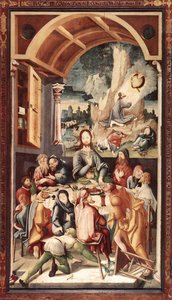
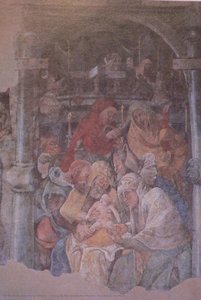
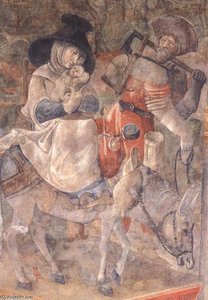
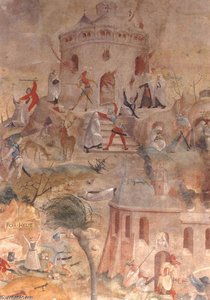
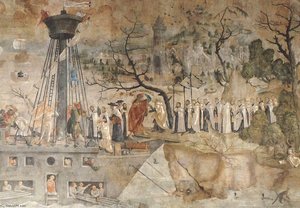
Upon returning to Germany, Ratgeb settled in Heilbronn, but his artistic footprint stretched far across the region. His career was marked by significant commissions that showcased his ability to blend sacred narrative with human chaos. In 1510, he contributed to the altar of Saint Barbara in Schwaigern, and between 1514 and 1517, he achieved a monumental feat in Frankfurt am Main. There, he painted the walls of the refectory and cloister of the Karmeliterkloster (Carmelite Monastery). These frescoes, which were among the largest wall paintings known north of the Alps during that era, demonstrated his mastery of large-scale narrative painting and his ability to transform architectural spaces into immersive religious experiences.
Style, Influence, and the Chaos of Humanity
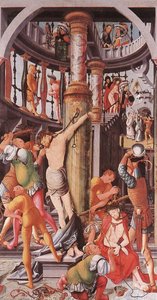
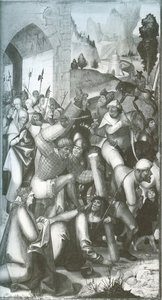
The artistry of Ratgeb is a fascinating tapestry woven from the threads of several great masters. While the structural precision of Albrecht Dürer is evident in his work, there is an unmistakable presence of the spiritual agony found in Matthias Grünewald and the surreal, often unsettling imagination of Hieronymus Bosch. This synthesis resulted in a personal style that was profoundly expressive, capable of capturing the intersection of divine suffering and earthly turmoil. In masterpieces such as his Flagellation of Christ, painted around 1518, Ratgeb does not merely illustrate a biblical event; he creates a whirlwind of movement and tension. The physical agony of the central figure is mirrored by the chaotic energy of the surrounding crowd, utilizing meticulous detail in skin, fabric, and stone to draw the viewer into a cosmic struggle between innocence and cruelty.
His technical prowess was matched by his involvement in the turbulent politics of his time. Ratgeb’s life took a dramatic turn during the German Peasants' War in 1525. Having moved to Stuttgart and become a member of the city council, he found himself negotiating with rebelling farmers. His commitment to the cause led him to join the military contingent requested by the rebels, even being elected as a councillor and chancellor by the peasants. This period of intense social upheaval deeply mirrored the themes of struggle and upheaval present in his art, marking him as an artist whose very existence was caught in the crosscurrents of history.
Legacy and Notable Works
The enduring significance of Jörg Ratgeb lies in his ability to translate the profound anxieties of the Renaissance era into a visual language that remains hauntingly potent. His works serve as vital windows into a period of intense religious fervor and social transformation. Among his most celebrated contributions to the art world are:
- The Herrenberg Altarpiece: Completed in 1521, this is widely considered his most famous work, originally created for the Stiftskirche in Herrenberg and now preserved in the Staatgalerie in Stuttgart.
- Carmelite Monastery Frescoes: His monumental wall paintings in Frankfurt, which showcased his ability to command vast architectural spaces with narrative power.
- Flagellation of Christ: A profound exploration of divine suffering through a complex, multi-layered composition.
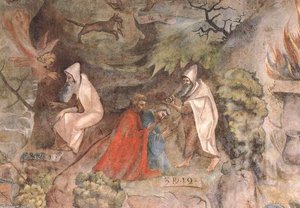
- Scenes from the Life of Prophet Elijah: Dramatic works that highlight his skill in depicting intense religious narratives.
Pitanja i odgovori
U kojem je povijesnom razdoblju stvarala/radio Jerg Ratgeb?
Jerg Ratgeb je stvarala u razdoblju Renaissance. To razdoblje smješta umjetnikov rad u povijesni kontekst.
Gdje je i kada je rođen/a Jerg Ratgeb?
Jerg Ratgeb rođen/a je u gradu Schwäbisch Gmünd 1480. godine.
Odakle dolazi Jerg Ratgeb?
Jerg Ratgeb rođen/a je u Germany.