The Life and Career of Master Theoderic
Master Theoderic, known in Latin as Magister Theodoricus, was a Czech painter who left a clear mark on the Gothic era. He was active between approximately 1360 and 1380, a period when his presence in the Bohemian court was well-documented. He holds the distinction of being the first Bohemian painter whose name can be linked to a specific body of work. His hands moved through the workshops of the time, likely following a study trip to northern Italy in the 1350s that brought new influences to his practice.
His life was closely tied to the halls of power in Prague. He served as the favourite court painter of Charles IV, the Holy Roman Emperor. The emperor himself referred to him as Pictor noster et familiaris, a title that suggests a level of familiarity and trust within the royal circle. This connection placed him at the center of significant religious and secular commissions, working in both the city of Prague and at Karlštejn Castle.
The records show he was a man of some standing, mentioned in 1359 as a house owner in Hradčany. His work was not merely a matter of craft but a central part of the visual landscape of the Bohemian court. He was the best-documented Gothic painter in Bohemia, providing a rare, tangible link to the artistic life of the fourteenth century.
Patrons, Workshop and Major Commissions
The artist’s hand was tied closely to the court of Charles IV, the Holy Roman Emperor. Between 1359 and 1367, he worked as the leading court painter in Prague and at Karlštejn Castle. The emperor’s favor was evident in the way he was addressed, referred to as Pictor noster et familiaris. This connection placed his work at the very center of imperial life, moving between the urban settings of Prague and the stone walls of the castle.
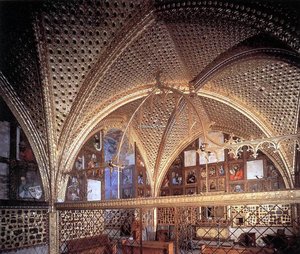
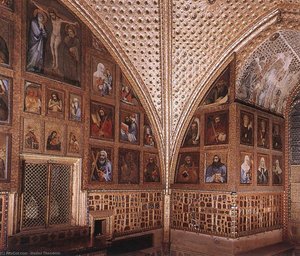
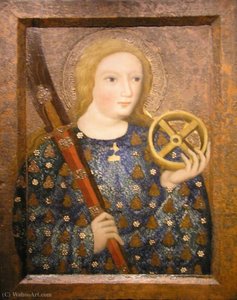
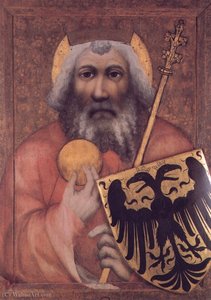
His most significant undertaking involved the Chapel of the Holy Cross at Karlštejn Castle. Around 1360, he devised the concept for the chapel's decoration, establishing the specific composition and the palette that would define the space. This was not a series of isolated pieces, but a unique, unified decoration for the entire chapel. The commission for this work likely began around 1357 and continued through 1367, involving a large collection of half-length portraits of saints and other figures set against gold grounds.
- Chapel of the Holy Cross, Karlštejn (c. 1357–67)
Artistic Technique and Italianate Style
There is a distinct Italianate quality to the way he handles a surface. Having likely traveled from the Rhineland to northern Italy during the 1350s, he brought back more than just new ideas; he brought a specific way of seeing. His panels often carry a curiously Sienese character, though he avoids the extreme delicacy found in the works of Siena. Instead, his hand moves toward a heavier, more modeled approach. He builds form through weight and shadow, giving figures a sense of physical presence that feels grounded.
The surfaces of his works are rarely flat. He used pastiglia, applying relief decoration to cover backgrounds and frames, which gives the paintings a tactile, three-dimensional quality. This layering of material creates a physical depth that catches the light differently than a simple brushstroke. He also employed silver coverings and hammered gold, a choice that reflects a Byzantine effect. These metallic elements, often found in the halos, change the way the viewer interacts with the light in the room.
In his more schematic works, such as the depictions of Saint Simon, the rendering of faces becomes harder and more simplified. The drapery loses some of its plasticity, and the hair and beards are twisted into regular, rhythmic meanders. This shows a different side of his hand, one that favors order and pattern over the heavy modeling seen in his other commissions.
Notable Works and Masterpieces
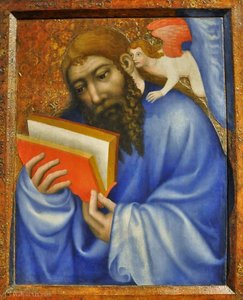
The Chapel of the Holy Cross at Karlštejn Castle holds his most significant undertaking. Within its walls, a large series of half-length panel portraits covers the space. These figures, depicting saints and other notable people, are slightly over-lifesize and set against a gold ground. The collection includes portraits of prophets, kings, and knights, each rendered with a specific presence. The work was commissioned in 1359 and developed over several years.
In the Chapel of the Holy Cross, the paintings follow a specific composition and palette. One such work is Saint Simon, an oil tempera on beech board created around 1360-1365. This piece is notable for its preservation of metal gilding elements. These traces of metal, often found in the halos, suggest a tactile, three-dimensional quality to the original surfaces. The figure of the apostle is shown with a book and a short sword.
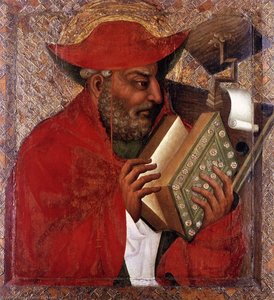
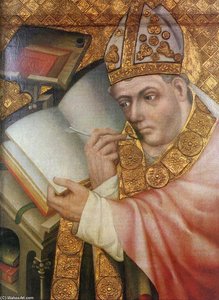
- St Jerome (about 1360)
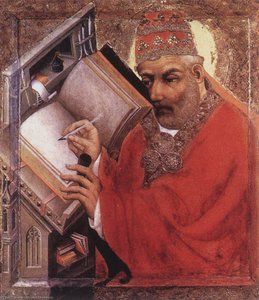
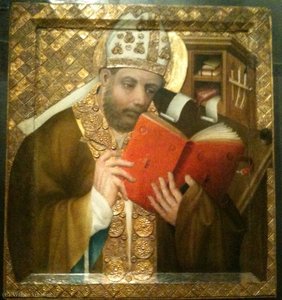
- St Gregory (about 1360)
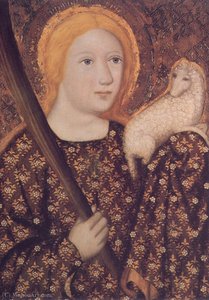
- Saint Agnes of Rome
- Saint Catherine
Where to See the Works Today
To see his hand in person, one must travel to the Chapel of the Holy Cross at Karlštejn Castle. This space holds the weight of his most significant decorative program. Within this chapel, two of his works remain, part of the larger series of panel portraits that line the walls. The light in such a setting reveals the way he used metal gilding and relief to catch the eye. You can find his depictions of saints and figures here, where the scale of the paintings feels slightly larger than life.
The Národní Galerie in Prague also keeps several of his pieces. Three specific works from our catalog are held within this collection, allowing for a closer look at his specific handling of form and color. These paintings offer a chance to observe the heavy modeling and the way he treated drapery. Seeing them in a gallery setting provides a different perspective than the original chapel, focusing on the individual details of the faces and the textures of the backgrounds.
- St Jerome, about 1360
- St Gregory, about 1360
- Chapel of the Holy Cross, about 1360
Pitanja i odgovori
Pod kojim drugim imenima ili pseudonimima poznat je/poznata je Master Theoderic?
Master Theoderic poznat/a je i pod drugim imenima: Magister Theodoricus, Theodoric Of Prague.