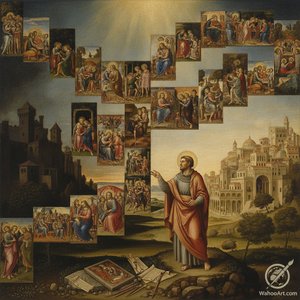
The Legacy of Abelardo Bustamante
In the annals of art history, certain names resonate through the quiet strength of their presence and the enduring impact of their creative vision. Abelardo Bustamante, a figure whose life spanned the transformative decades of the early twentieth century, remains an evocative subject for those seeking to understand the artistic currents of his era. Born in 1888, Bustamante lived through a period of profound social and cultural shifts, navigating a world that was rapidly redefining its aesthetic boundaries. While much of his personal narrative remains shrouded in the mists of time, his existence is inextricably linked to the broader movements of the FamousArtists tradition, representing a bridge between classical sensibilities and the burgeoning modernism of his generation.
The era in which Bustamante practiced was one of intense experimentation. As the nineteenth century gave way to the twentieth, artists were increasingly challenged to look beyond mere representation toward deeper emotional truths and structural innovations. Though specific biographical details regarding his early training are sparse, the historical context suggests an artist deeply embedded in the artistic dialogues of his time. His life, which concluded in 1934, serves as a poignant reminder of a generation of creators who laid the groundwork for the monumental shifts in visual language that would follow in the decades after their passing.
Artistic Context and Historical Significance
To contemplate the work associated with the name Abelardo Bustamante is to engage with the spirit of an age defined by transition. The early 1900s were characterized by a tension between established academic traditions and the radical new perspectives offered by movements such as Impressionism, Expressionism, and later, the rise of Mexican Muralism. While Bustamante’s specific stylistic evolution is often viewed through the lens of his historical era, his significance lies in his place within this complex tapestry of FamousArtists.
The importance of artists like Bustamante extends beyond the individual canvas; they represent the cultural pulse of their time. His era was marked by:
- The evolution of medium: A period where traditional oil painting began to share space with new graphic and experimental forms.
- Social transformation: An age where art became increasingly intertwined with political identity and the documentation of human struggle.
- Aesthetic shifts: The movement from romanticized realism toward more abstracted and symbolic interpretations of reality.
Though his career was relatively brief, ending in 1934, the echoes of his era continue to influence how we perceive the development of modern art. He stands as a testament to the enduring power of the artist to capture the essence of an epoch, leaving behind a legacy that invites contemporary viewers to rediscover the beauty and complexity of a world in flux.
Kérdések és válaszok
Melyik városban és melyik országban született Abelardo Bustamante?
Abelardo Bustamante Santiago, Chile városában született.
Honnan származik Abelardo Bustamante?
Abelardo Bustamante Chile-ban született.