Early Life, Family and Training
Jean-Baptiste-Siméon Chardin entered the world in Paris on November 2, 1699. He was born into the practical, tactile environment of a cabinetmaker’s household. This early exposure to the physical properties of wood and the meticulous nature of craftsmanship likely shaped his later sensitivity to texture and form. While his lineage was rooted in the trade of the artisan, his inclinations moved toward the canvas. He sought formal instruction through apprenticeships with history painters Pierre-Jacques Cazes and Noël-Nicolas Coypel. These early years were spent learning the structured language of grand narratives, even as his own interests began to drift toward the quietude of the domestic sphere.
His ascent within the Parisian art community was marked by steady, disciplined progress. By 1724, he had achieved the status of a master in the Académie de Saint-Luc. This recognition provided a foundation for a career that would largely bypass the flamboyant trends of the era. Rather than pursuing the dramatic or the mythological, he found his footing in the observation of the tangible. His training under established masters provided the technical rigor necessary to render the simplest objects with profound presence, turning the mundane into a subject of serious study.
Artistic Development in Paris
Chardin’s presence in Paris was marked by a steady, quiet ascent through the city's artistic circles. For much of his career, he resided on the Left Bank near Saint-Sulpice, a location that anchored his life within the familiar rhythms of the neighborhood. His rise was not a sudden explosion of fame but a gradual accumulation of respect. By 1752, his standing was such that Louis XV granted him a pension of 500 livres. This recognition provided a measure of stability as he continued to refine his focus on the domestic and the mundane.
The height of his professional standing arrived in 1757 when the King granted him lodgings within the Louvre. This move placed him at the very heart of the French artistic establishment. His status was further solidified by his appointment as premier peintre du roi. Even as he occupied this prestigious position, his subject matter remained rooted in the tangible reality of the everyday, eschewing the grandiosity often expected of a royal painter. He remained a dedicated academician, attending meetings for fifty years and overseeing the installation of Salon exhibitions.
Technique and Artistic Style
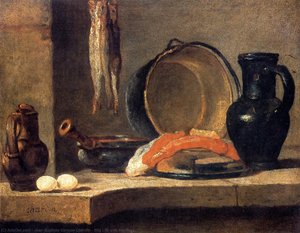
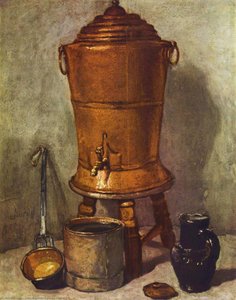
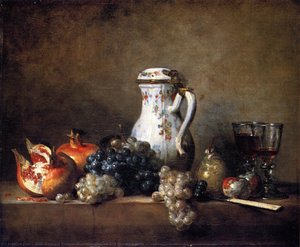
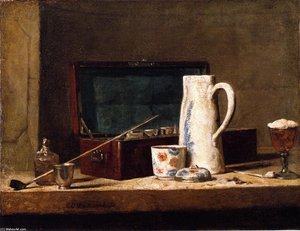
Chardin’s approach to the canvas was defined by a physical, almost tactile engagement with his materials. He rejected the smooth, polished surfaces favored by many of his contemporaries, opting instead for a deliberate and granular impasto. By combining delicate glazes with roughly dragged, thick applications of paint, he achieved a sense of volume that made the objects on his tables feel heavy and present. This method allowed him to capture the specificities of texture, from the papery skin of a garlic bulb to the cool, reflective surface of a copper vessel. He built up layers of pigment to create surfaces that seemed to hold a soft diffusion of light, giving his compositions a quiet, internal glow.
His color palette remained disciplined and restrained, favoring muted, earthy tones. He relied on a foundation of browns, grays, ochres, and creams to construct his scenes. Within these limited hues, he found a way to manipulate light and shadow through a sophisticated use of chiaroscuro. This interplay of light and dark did more than define shape; it created an atmosphere of stillness and intimacy. He focused on the way light might catch the edge of a glass or settle into the folds of a cloth, treating the mundane details of a kitchen or a dining room with the same technical rigor applied to grander subjects. His work was a study in observation, where the subtle variations in tone were enough to convey the essence of the tangible world.
Key Still Life Works
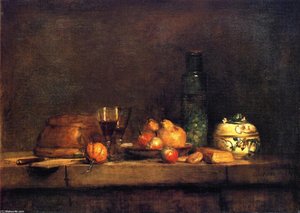
Chardin’s early reputation was built upon his ability to grant weight and presence to the inanimate. In 1728, he produced The Ray, a work that demonstrated a remarkable capacity to render the glistening scales of a fish and the rough texture of cloth. This period saw him refining a method of capturing the essence of objects through a masterful manipulation of light and shadow. His ability to create a palpable sense of volume was evident in The Silver Tureen, painted about 1728, where he focused on the interplay of light across metallic surfaces.
As his career progressed, his compositions became studies in quietude and material reality. The Meat-Day Meal, completed in 1731, exemplifies his interest in the textures of food and the humble dignity of kitchen items. He moved away from the grandiosity of his contemporaries, choosing instead to focus on the tactile qualities of the everyday. By the mid-1730s, his command of surface and light had matured significantly. This is seen in Still Life with Herrings, painted about 1735, which highlights his skill in depicting varied surfaces through a combination of delicate glazes and thick, textured paint.
- The Ray (1728)
- The Silver Tureen (about 1728)
- The Meat-Day Meal (1731)
- Still Life with Herrings (about 1735)
Key Genre Paintings
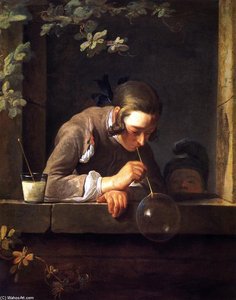
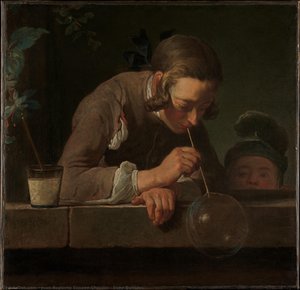
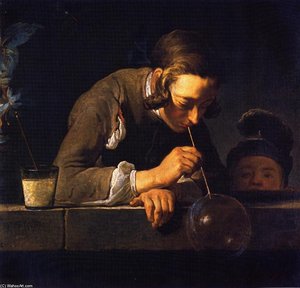
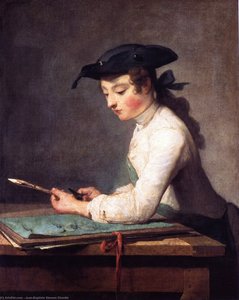
While his reputation was built upon the quietude of inanimate objects, Chardin eventually turned his gaze toward the human presence. His first foray into figural composition was Soap Bubbles, a work that moved him away from the purely still life. This painting depicts a young man engaged in the fleeting act of blowing a bubble, a subject that suggests the transience of life through a simple, domestic moment. It marked a significant shift in his career, proving he could apply his tactile sensitivity to the living form.
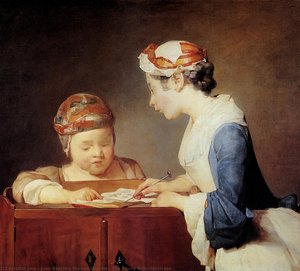
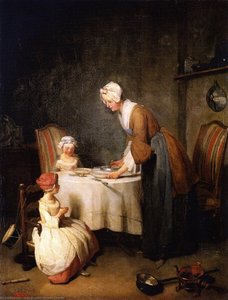
As his career progressed, he became increasingly interested in the dignity of the domestic sphere. In 1739, he produced The Return from Market, a scene that captures the quietude of everyday life. By 1740, his focus on human interaction had matured into more structured studies of instruction and devotion. The Young Schoolmistress, painted in 1740, offers a study of concentration and the quiet transmission of knowledge, while Saying Grace, also from 1740, captures a moment of familial tenderness. These works avoid the grandiosity of the era, opting instead for an honest portrayal of the common people of Paris.
- Soap Bubbles
- The Return from Market (1739)
- The Young Schoolmistress (1740)
- Saying Grace (1740)
Later Years and Death
The later decades of Chardin's life were marked by a continued presence within the institutional heart of French art. In 1759, he exhibited nine paintings at the Salon, maintaining his standing even as artistic tastes shifted. His commitment to the Salon remained steady for many years, a period of professional stability that allowed him to refine his observational approach. Even in his final years, he continued to participate in these significant exhibitions, making his last appearance at the Salon in 1779.
As he aged, his focus remained tethered to the quietude of his subjects. His final years saw him navigating the complexities of a changing Parisian art scene, yet he remained steadfast in his dedication to the tangible reality of the objects and domestic scenes he had spent a lifetime studying. He passed away in Paris on December 6, 1779, at the age of 80.
Legacy and Enduring Influence
The reach of Chardin’s vision extended far beyond the domestic interiors of 18th-century Paris. His insistence on finding substance in the mundane provided a foundation for those who would later seek to strip art of its grandiosity. By focusing on the tangible reality of a copper pot or a piece of fruit, he paved the way for the Realist movement, influencing painters like Gustave Courbet who sought to depict life without embellishment. His work offered a quiet alternative to the flamboyant trends of his era, proving that the ordinary could sustain profound artistic inquiry.
This influence resonated deeply with the architects of modern painting. Paul Cézanne, Édouard Manet, and Henri Matisse all found something essential in his approach to form and light. Cézanne famously acknowledged this debt, referring to Chardin as the father of us all. This recognition speaks to a structural integrity that transcended the specific subjects of his canvases. His ability to capture the weight and presence of objects provided a template for artists grappling with the transition into more modern, structured ways of seeing.
Beyond the canvas, his paintings have functioned as meditations for thinkers across disciplines. Writers, philosophers, and art historians have long found resonance in his depictions of mortality and simplicity. His work invites a slow, deliberate observation that mirrors the very act of living. He remains a figure of study for those interested in how the most unassuming subjects can hold a sense of permanence and truth.
Where to See the Works Today
To encounter the quietude of Chardin’s vision, one must travel to the great repositories of European and American art. His presence is felt strongly in Paris, where the Musée du Louvre holds a significant portion of his output. Within those halls, his ability to render the weight of a silver vessel or the texture of a peach remains a central part of the collection. His life was tied to this city, and his works remain anchored there, inviting a slow, steady observation of the domestic sphere.
Beyond France, his influence is preserved in several major international institutions. In Washington D.C., the National Gallery of Art maintains works that demonstrate his command over light and shadow. The Metropolitan Museum of Art in New York City also holds pieces that reflect his departure from the grander, more theatrical styles of the eighteenth century. In Saint Petersburg, the Hermitage Museum preserves his ability to find dignity in the most unassuming objects.
- The Ray (about 1728)
- Soap Bubbles (about 1735)
- The Young Schoolmistress (1740)
- The Meat-Day Meal (1731)
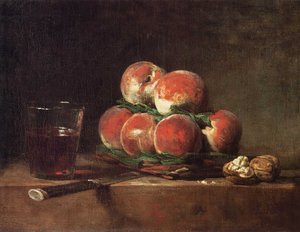
- Basket of Peaches (1768)
Kérdések és válaszok
Mely történelmi korszakban alkotott Jean-Baptiste-Siméon Chardin?
Jean-Baptiste-Siméon Chardin a Korai modern kor korszakban alkotott. Ez az időszak a művész tevékenységét a történelembe helyezi.
Hol és 어느 해 született Jean-Baptiste-Siméon Chardin?
Jean-Baptiste-Siméon Chardin Párizs városban született, 1699 évben.
Honnan származik Jean-Baptiste-Siméon Chardin?
Jean-Baptiste-Siméon Chardin Franciaország-ban született.