A Pioneer of Abstraction: The Life and Legacy of Hilla Rebay
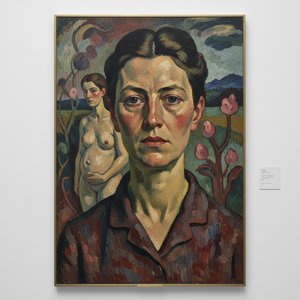
Born Hildegard Anna Augusta Elisabeth Freiin Rebay von Ehrenwiesen in 1890, the woman who would become known simply as Hilla Rebay emerged from a world steeped in German aristocracy. Her birthplace, Strasbourg – then part of the German Empire – provided an early backdrop to a life that would traverse national boundaries and artistic movements with remarkable fluidity. The daughter of Baron Franz Josef Rebay von Ehrenwiesen, an officer in the Prussian Army, she received an upbringing befitting her station, yet it was not societal expectations but an intrinsic creative drive that ultimately defined her path. From a young age, Rebay demonstrated a keen aptitude for art, setting the stage for a journey that would lead her to become a pivotal figure in the development of abstract expression and a champion of non-objective aesthetics. Her initial artistic training at the Cologne Kunstgewerbeschule and later at the Académie Julian in Paris provided a solid foundation in traditional techniques – landscape, portraiture, genre painting, and history painting – skills she would skillfully employ before embarking on her radical departure into abstraction. These early years weren’t merely about mastering form; they were about absorbing the visual language of the past, which she would later deconstruct and reimagine.From Traditional Roots to Avant-Garde Visions
The seeds of Rebay's artistic revolution were sown in Munich in 1910, where exposure to the work of German Jugendstil painter Fritz Erler opened her eyes to the burgeoning world of modern art. This encounter marked a turning point, propelling her towards experimentation and challenging conventional artistic norms. Her participation in exhibitions at the Cologne Kunstverein in 1912 and the Salon des Indépendants in Paris in 1913 brought her into contact with a constellation of avant-garde artists – Archipenko, Brâncuși, Chagall, Delaunay, Gleizes, Rivera, and van Rees among them. While exhilarating, this experience also prompted a period of intense self-assessment, leading Rebay to question the direction of her own work. A pivotal moment arrived with her meeting Hans (Jean) Arp in Zurich. Through Arp, she was introduced to the groundbreaking non-objective works of Kandinsky, Klee, Marc, Chagall, and Bauer – artists who dared to abandon representational form altogether. This exposure ignited a profound shift in Rebay’s artistic vision, inspiring her to explore the expressive potential of pure abstraction. She began experimenting with geometric forms, overlapping planes, and dynamic lines, moving away from traditional subject matter and embracing a purely visual language. Her early abstract works were characterized by a sense of movement and energy, reflecting her fascination with the underlying rhythms of nature and the spiritual dimensions of art.A Patronage Forged in Vision: Rebay and Solomon Guggenheim
In 1927, Rebay embarked on a new chapter, immigrating to New York City. This move proved transformative, not only for her own artistic development but also for the landscape of American art. It was in New York that she forged an extraordinary relationship with Solomon R. Guggenheim, a bond built on mutual respect and a shared passion for non-objective art. Rebay quickly became Guggenheim’s confidante and trusted advisor, guiding his collecting endeavors and shaping what would become one of the world's most significant collections of modern art. She tirelessly championed artists like Bauer and Kandinsky, recognizing their genius and advocating for their inclusion in Guggenheim’s holdings. This patronage wasn’t merely about acquiring artworks; it was about fostering a new aesthetic sensibility and challenging prevailing artistic conventions. Rebay understood that abstract art held the potential to transcend traditional notions of beauty and representation, offering viewers a direct experience of form, color, and emotion. She actively sought out works by artists who were pushing the boundaries of abstraction, including Piet Mondrian, Kazimir Malevich, and Wassily Kandinsky – whose influence on her own work was particularly profound. In 1930, she facilitated a meeting between Guggenheim, Kandinsky, and Arp, solidifying their collaborative relationship and further expanding Guggenheim’s collection.The Birth of the Museum: A Vision Realized
Driven by her belief in the importance of non-objective art, Rebay played a crucial role in establishing the Museum of Non-Objective Painting – the precursor to the Solomon R. Guggenheim Museum – in 1939. She meticulously curated the inaugural exhibition, selecting works that showcased the diversity and dynamism of abstract expression. Her vision extended beyond simply creating a museum; she sought to establish a space where visitors could engage with art on a deeper level, free from preconceived notions about representation and beauty. Rebay’s influence was evident in every aspect of the museum's design and programming, reflecting her commitment to fostering an environment that celebrated innovation and experimentation. She understood that the museum should be more than just a repository for artworks; it should be a dynamic center for artistic dialogue and education. In 1943, she commissioned Frank Lloyd Wright to design a permanent building for the museum – a masterpiece of modern architecture that continues to inspire awe today. The spiral form of the Guggenheim reflects Rebay’s belief in the interconnectedness of art, architecture, and spirituality, creating a space that is both visually stunning and intellectually stimulating.A Lasting Impact: Legacy and Historical Significance
Hilla Rebay’s influence extends far beyond her own artistic creations. She was a tireless advocate for non-objective art, organizing numerous exhibitions throughout Europe and the United States, and fostering dialogue around its aesthetic principles. As director of the Museum of Non-Objective Painting/Solomon R. Guggenheim Museum, she played a vital role in establishing its reputation as a leading center for modern art. Her guidance to Solomon Guggenheim not only shaped the development of a world-renowned collection but also contributed to the broader acceptance and appreciation of non-objective aesthetics. Though her later years were marked by personal challenges within the Guggenheim family – ultimately leading to her departure from the museum’s board – Rebay continued to paint, receiving recognition for her own abstract works. She remains a pivotal figure in 20th-century art history, a pioneer who dared to challenge conventions and champion a new aesthetic vision. Her legacy is one of artistic courage, unwavering dedication, and a profound belief in the power of abstraction to transform our perception of the world.Key Achievements
- Co-founder of Der Krater: A significant artist group promoting avant-garde expression.
- Advisor to Solomon R. Guggenheim: Instrumental in shaping his collection of non-objective art.
- Founder and First Director of the Museum of Non-Objective Painting (now the Guggenheim): Established a leading institution for modern art.
- Commissioned Frank Lloyd Wright to design the Guggenheim Museum: Resulting in an iconic architectural landmark.
- Champion of Abstract Art: Organized exhibitions and fostered dialogue around non-objective aesthetics.
Kérdések és válaszok
Honnan származik Hilla von Rebay?
Hilla von Rebay Franciaország-ban született.
Mely történelmi korszakban alkotott Hilla von Rebay?
Hilla von Rebay a Modern kor korszakban alkotott. Ez az időszak a művész tevékenységét a történelembe helyezi.