A Life Painted in Prismatic Hues: The World of Roger de la Fresnaye
Roger de La Fresnaye, born into the aristocratic lineage of the La Fresnayes in 1885, was a painter whose brief but incandescent career illuminated the burgeoning landscape of early 20th-century art. His story is one of inherited privilege tempered by artistic ambition, classical training disrupted by avant-garde fervor, and ultimately, a life tragically cut short by illness. The Château de la Fresnaye in Falaise, ancestral home to his family with its long history of military service, provided an early backdrop for a life that would eventually blend tradition with radical innovation. Though steeped in the values of his upbringing, young Roger found himself drawn not to the battlefield but to the canvas, embarking on a journey that would see him navigate the complex currents of Symbolism, Cubism, and beyond. His initial education was classically grounded, yet it quickly evolved as he sought artistic instruction at the Académie Julian and later the École des Beaux-Arts in Paris – institutions where the seeds of his future stylistic explorations were sown.From Nabis Dreams to Cubist Geometry
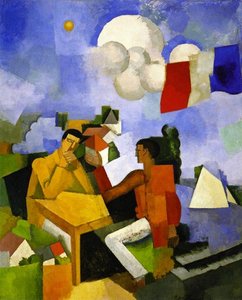
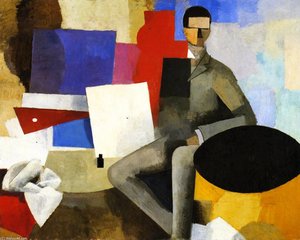
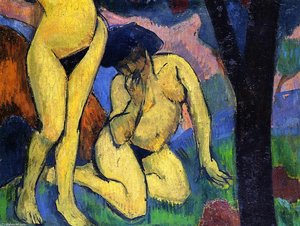
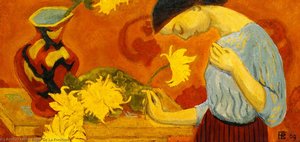
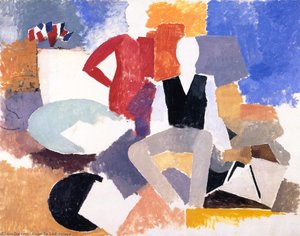
The early years of de La Fresnaye’s artistic development were profoundly shaped by the *Nabis*, a group of Post-Impressionist painters who prioritized subjective experience and symbolic meaning over strict representation. Studying under Maurice Denis and Paul Sérusier at the Académie Ranson, he absorbed their emphasis on flattened forms, decorative patterns, and evocative color palettes – qualities evident in works like Woman with Chrysanthemums. This period reveals a dreamlike quality, a stylistic echo of the Nabis’ pursuit of spiritual resonance through art. The influence of Denis and Sérusier is palpable; De La Fresnaye's early canvases resonate with the muted hues and stylized compositions characteristic of this influential movement. He wasn’t merely copying their techniques but internalizing their ethos—a belief that art should transcend mere imitation to convey deeper truths about human existence. However, this initial path was not destined to be his final destination. The allure of more radical experimentation soon beckoned. Around 1912, de La Fresnaye joined the *Section d'Or*, a collective of artists passionately committed to exploring the revolutionary ideas championed by Pablo Picasso and Georges Braque – pioneers of Cubism. This marked a pivotal shift in his artistic trajectory. He wasn’t simply mirroring; he was responding, interpreting, and ultimately forging his own unique voice within the movement. The Section d'Or embraced geometric abstraction as a means of dismantling traditional perspective and representing reality from multiple viewpoints simultaneously—a daring challenge to established conventions. De La Fresnaye skillfully blended Cubist principles with Orphism’s vibrant chromatic explorations, creating canvases that pulsated with energy and luminosity. Consider The Conquest of the Air – a monumental composition dominated by bold reds, yellows, and blues, fractured planes intersecting in dynamic diagonals. It embodies the spirit of the Section d'Or while retaining de La Fresnaye’s distinctive artistic sensibility.War, Illness, and a Shifting Aesthetic
The outbreak of World War I profoundly impacted de La Fresnaye’s life and work. He enlisted in the French army, driven by patriotic fervor and a desire to serve his country—a sentiment shared by many young men of his generation. However, his military service was tragically curtailed by tuberculosis – a debilitating illness that ravaged his body and irrevocably altered his artistic output. The physical suffering endured during the war instilled in him a heightened awareness of mortality and fueled a preoccupation with fragility—themes that would permeate his later paintings. His robust Cubist style gave way to a more restrained aesthetic, characterized by linear precision and an introspective gaze. This stylistic transformation wasn’t merely a reaction to illness; it represented a fundamental reconsideration of artistic priorities. He abandoned the complex spatial illusions of Cubism for a simpler visual language—one that prioritized form and color in relation to each other rather than striving to depict reality as perceived from multiple perspectives. The resulting canvases possess a quiet dignity, conveying a sense of melancholy and contemplation that speaks to the artist’s own personal experience.Notable Works & Legacy
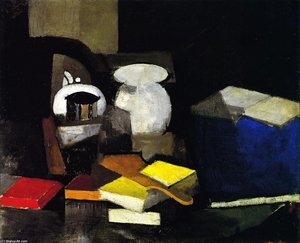
Roger de La Fresnaye produced a remarkable body of work during his relatively short artistic career—approximately 150 paintings and drawings. Among his most celebrated achievements are:- The Rower – Demonstrates masterful draftsmanship and captures the essence of human movement with understated elegance.
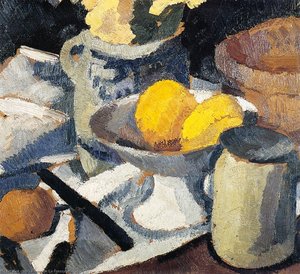
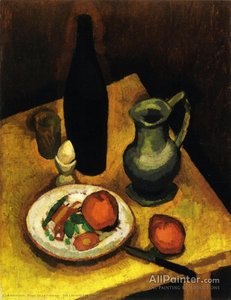
- Still Life with Lemons – Exemplifies de La Fresnaye’s ability to distill complex ideas into deceptively simple forms, utilizing color palettes that evoke mood and atmosphere.
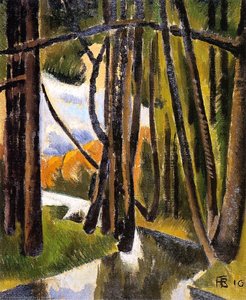
- Undergrowth – Reveals a fascination with organic textures and patterns—a stylistic hallmark of his oeuvre.
- La Madelon – A portrait imbued with tenderness and psychological depth—reflecting de La Fresnaye’s sensitivity to human emotion.
- Le Cuirassier – Represents the heroic figure of a soldier in a dynamic composition that captures both physical strength and spiritual contemplation.
Kérdések és válaszok
Mely történelmi korszakban alkotott Roger de La Fresnaye?
Roger de La Fresnaye a Modern kor korszakban alkotott. Ez az időszak a művész tevékenységét a történelembe helyezi.
Honnan származik Roger de La Fresnaye?
Roger de La Fresnaye Francia-ban született.
Melyik városban és melyik országban született Roger de La Fresnaye?
Roger de La Fresnaye Le Mans, Francia városában született.