Introduction
The landscape of the United Kingdom underwent a profound emotional and visual transformation during the late eighteenth and early nineteenth centuries, as the rigid structures of Neoclassicism gave way to the untamed spirit of Romanticism. This movement was not merely a change in style, but a fundamental shift in the human psyche, prioritizing the sublime power of nature, the intensity of individual emotion, and the awe-inspiring mystery of the unknown over the rationalism of the Enlightenment. In the misty valleys of the English countryside and the turbulent seas of the Atlantic, artists began to capture the world not as a static object of study, but as a living, breathing force capable of evoking both terror and transcendence.
As the Industrial Revolution began to reshape the physical world, these painters sought refuge in the wildness of the natural realm. Their works often serve as a visual dialogue between the fragility of man and the overwhelming scale of the cosmos. Through dramatic chiaroscuro, swirling atmospheres, and a revolutionary approach to light, they moved beyond mere representation to express the internal turbulence of the human soul. This era produced a unique visual language where a storm at sea or a solitary ruin became metaphors for the complexities of existence itself.
Today, the legacy of these masters remains vital, as their ability to evoke profound empathy through color and texture continues to resonate in a modern world often disconnected from the elemental. Their influence can be felt in everything from contemporary landscape photography to the epic scale of modern cinema. By examining the lives and brushstrokes of the most significant figures of this movement, we gain a deeper understanding of how art can bridge the gap between the seen world and the felt experience. The following artists represent the pinnacle of this British Romantic tradition, each offering a distinct window into the sublime.
William Blake
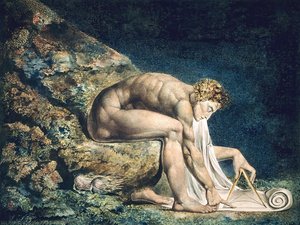 Newton - William Blake
William Blake stands as a singular visionary within the group of British Romantic painters, a figure whose work transcended the era's rationalism to explore the profound depths of the human psyche. While many of his contemporaries focused on the sublime in nature, Blake’s Romanticism was deeply internal and mystical, driven by an intense imagination that began in his London childhood. His technical mastery was forged through a rigorous apprenticeship under the engraver James Basire, where he internalized the structural elegance of Gothic architecture, a fascination that would later inform his unique approach to relief etching and illuminated prints.
His representative work, Newton, serves as a powerful testament to this departure from Neoclassical order. In this monotype, Blake moves beyond mere portraiture to create a symbolic meditation on the tension between reason and the infinite. By depicting the scientist stripped of societal constraints and submerged in a dark, vast abyss, Blake captures the quintessential Romantic struggle: the solitary, often overwhelming pursuit of knowledge against the backdrop of the unknown. Through his innovative printmaking techniques, he achieved a textural fluidity and tonal depth that perfectly mirror the complex, spiritual landscapes of the Romantic movement.
John Constable
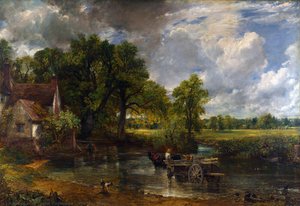 The Hay Wain - John Constable
Born in 1776 in the village of East Bergholt, Suffolk, John Constable developed a profound, lifelong connection to the rhythms of the River Stour. The son of a prosperous corn and coal merchant, his early life was shaped by the practicalities of the water and the local trade. After training at the Royal Academy Schools, where he studied anatomy and the old masters, he transitioned from the disciplined study of form to a deeply personal exploration of the natural world. This shift from formal structure to emotional observation is what defines his place among the British Romantic painters.
Constable’s work embodies the Romantic movement by prioritizing authentic feeling and the sublime nuances of nature over the rigid, idealized rules of previous eras. Rather than seeking dramatic, manufactured grandeur, he focused on the atmospheric truth of the English countryside. His 1821 masterpiece, The Hay Wain, serves as a quintessential example of this approach, capturing a harmonious, nostalgic vision of rural life and the shifting light of the Dedham Vale. Through his expressive brushwork and mastery of light, he transformed the mundane landscapes of his youth into emotive, timeless testaments to the power of the natural environment.
J. M. W. Turner
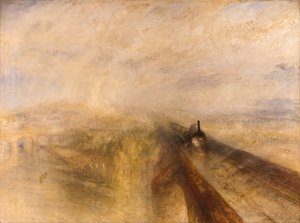
In Rain Steam and Speed, The Great Western Railway, the raw power of the Industrial Revolution meets the ethereal sublime. This masterpiece captures a locomotive piercing through a hazy, mist-laden landscape, where the boundaries between machine, rain, and light begin to dissolve. Turner’s signature use of impasto creates a tactile, textured surface, allowing thick brushstrokes to build a symphony of golden yellows, fiery oranges, and deep purples that evoke a dramatic summer storm.
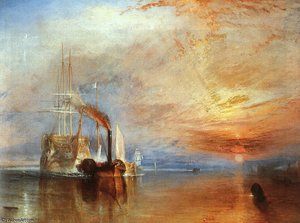
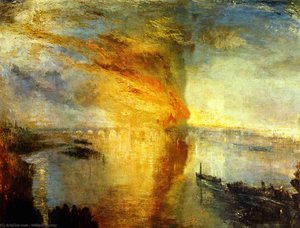
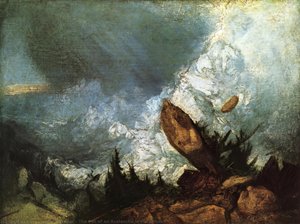
Joseph Mallord William Turner (1775–1851) stands as a titan of British Romanticism, a movement defined by its emphasis on emotion and the overwhelming force of nature. Born in London to a barber and art dealer, his early training under topographical draughtsmen and his time at the Royal Academy Schools allowed him to transition from precise architectural rendering to a revolutionary, expressive style. His ability to translate the intangible—the movement of steam, the fury of a sea, or the glow of a sunset—into visceral visual experiences makes him a central figure of this era. By blending technical discipline with a profound sense of atmospheric drama, Turner transformed the landscape into a stage for the sublime, forever changing the trajectory of British art.
William Etty
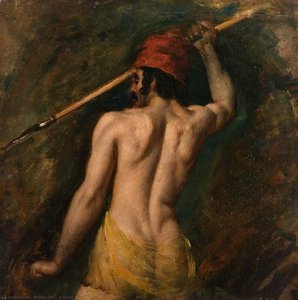 A Greek Slave - William Etty
Born in York in 1787, William Etty’s journey to artistic mastery was far from traditional. He began his career not in a studio, but as an apprentice printer in Hull, a mechanical foundation that instilled in him a profound understanding of visual reproduction. This discipline eventually led him to the Royal Academy Schools and a pivotal period of study under Thomas Lawrence. It was this rigorous training that allowed him to master the complex nuances of human anatomy and the play of light across skin.
Etty stands as a vital figure among British Romantic painters due to his intense focus on the emotional and physical reality of the human form. While many of his contemporaries sought idealized perfection, Etty embraced the raw, dramatic tension central to the Romantic movement. His 1812 work, A Greek Slave, exemplifies this approach. Through a masterful use of light and shadow, he sculpts the figure with a visceral intensity that emphasizes both vulnerability and resilience. By utilizing a palette of earthy ochres and reds and employing visible, textured brushstrokes, Etty moved beyond mere representation to capture the profound psychological weight of his subjects, cementing his legacy as a pioneer of the British nude.
George Stubbs
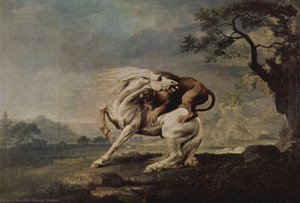 Lion Attacking a Horse - George Stubbs
George Stubbs stands as a pivotal figure in the transition toward Romanticism, bridging the gap between scientific precision and the raw, untamed power of nature. While his technical foundation was built upon a rigorous, self-directed study of anatomy—informed by his time dissecting specimens under the guidance of surgeon Charles Atkinson—his work transcends mere biological documentation. By capturing the visceral tension of living creatures, Stubbs infused his subjects with a sense of drama and wildness that became a hallmark of the Romantic movement.
His masterpiece, Lion Attacking a Horse (1765), exemplifies this intersection of anatomical mastery and emotional intensity. In this work, the struggle is not merely a study of muscle and sinew, but a dramatic confrontation that evokes the sublime. The painting utilizes sophisticated light and shadow to heighten the tension of the conflict, transforming a scene of natural predation into a profound exploration of life and death. By moving beyond the calm order of traditional portraiture to embrace such violent, high-stakes naturalism, Stubbs helped define the emotional depth and dramatic spirit that would characterize British Romanticism.
Thomas Lawrence
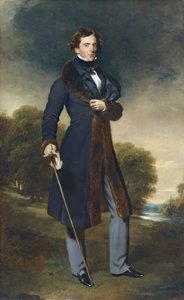 Portrait of David Lyon - Thomas Lawrence
Born in Bristol in 1769, Sir Thomas Lawrence was a child prodigy whose path to artistic mastery began in the lively atmosphere of his father's inns. Without formal instruction, he supported his family by sketching remarkably accurate portraits, a self-reliance that would define his meteoric rise within the British art scene. By the age of eighteen, he had already secured a royal commission for Queen Charlotte, establishing himself as the preeminent portraitist of the Regency era.
Lawrence’s inclusion in the group of Romanticism painters from United Kingdom stems from his ability to infuse formal portraiture with the era's characteristic psychological depth and emotional nuance. While his contemporaries often focused on the sublime power of nature, Lawrence applied a Romantic sensibility to the human spirit, capturing the inner character and dignity of his subjects through a virtuoso handling of oil paint.
His 1825 work, Portrait of David Lyon, serves as a quintessential example of this approach. In this piece, Lawrence places his subject within a tranquil landscape—a hallmark of Romantic composition—to underscore a sense of introspection. Through a melancholic gaze and sophisticated brushwork, he transcends mere likeness to achieve the soulful elegance central to the movement.
Joseph Wright of Derby
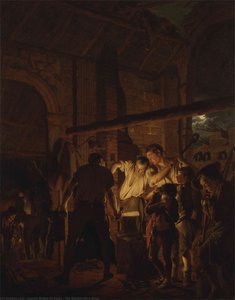 The Blacksmith's Shop - Joseph Wright of Derby
In The Blacksmith's Shop, Joseph Wright of Derby captures the rhythmic strike of hammer against iron, transforming a scene of manual toil into a monumental event. Through his masterful use of chiaroscuro, the glow from the central hearth breathes life into metallic textures, casting an ethereal radiance that elevates the mundane labor of the forge. This dramatic interplay of intense light and deep, enveloping darkness serves as a visual manifesto for the dawn of the Industrial Revolution.
Born in 1734, Wright was a visual philosopher who moved beyond traditional aristocratic portraiture to explore the energy of scientific discovery and the Enlightenment. His work belongs to the Romanticism movement through its profound emphasis on the power of emotion and the sublime tension between human innovation and the natural world. By utilizing light as a symbol of the unveiling of knowledge, he captured the spirit of an era that would redefine civilization. His technical precision, developed during his studies under Thomas Hudson in London, allowed him to depict the grit and determination of the human spirit with a unique, dramatic sensibility that remains a cornerstone of British Romanticism.
Thomas Sully
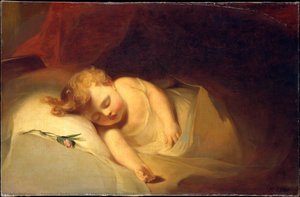 Child Asleep (The Rosebud) - Thomas Sully
Born in Lincolnshire in 1783, Thomas Sully represents a unique transatlantic bridge within the Romanticism movement. His artistic journey began in the United Kingdom, where his early exposure to the theatricality of his actor parents instilled in him a profound ability to capture fleeting human expressions. After an initial period of training in miniature painting, his style underwent a transformative evolution during his studies in London under Benjamin West. It was here that the influence of Thomas Lawrence became paramount, steering Sully toward a more elegant, luminous, and emotive approach to portraiture that defined his career.
Sully’s work embodies the Romantic emphasis on feeling and the spiritual essence of the subject. In his 1841 masterpiece, Child Asleep (The Rosebud), he moves beyond mere likeness to create a profound meditation on innocence. Through fluid brushstrokes and a masterful use of light, he imbues the scene with an ethereal quality, using symbolic elements like birds and roses to evoke the ephemeral nature of beauty. His ability to marry meticulous detail with a soft, atmospheric glow ensures his place among the great Romantic painters, capturing the soul as much as the surface.
Henry Raeburn
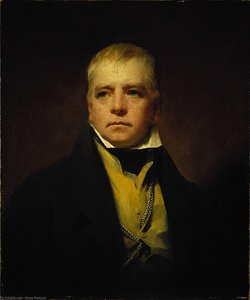 Sir Walter Scott - Henry Raeburn
In his 1822 masterpiece, Sir Walter Scott, Henry Raeburn captures the very essence of the Romantic spirit through a profound connection between character and identity. This portrait of the celebrated novelist utilizes dramatic chiaroscuro to sculpt the subject's features against a dark, atmospheric background, imbuing the scene with a theatrical intensity that transcends mere likeness. Raeburn’s technical precision is evident in the tactile rendering of velvet textures and the subtle sheen of spectacles, grounding the literary icon in a tangible, emotive reality.
A pivotal figure in British Romanticism, Raeburn moved beyond the rigid constraints of classical order to focus on the psychological depth and individual spirit of his subjects. Born in 1756, the Scottish master transitioned from the meticulous precision of goldsmithing and miniature painting to grand-scale oil portraiture. His ability to infuse portraits with a sense of vital presence and emotional weight aligns him perfectly with the Romantic movement's emphasis on feeling and the sublime. Through his mastery of light and texture, Raeburn transformed portraiture into a medium capable of expressing the profound legacies of the era's most influential figures.
Augustus Wall Callcott
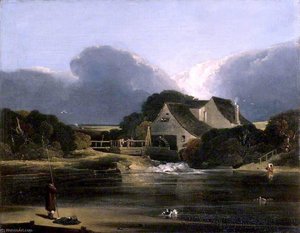 Landscape with Water Mill - Augustus Wall Callcott
In his 1803 masterpiece Landscape with Water Mill, Augustus Wall Callcott captures a serene vision of the English countryside that epitomizes the emotional depth of the Romantic movement. This work transcends mere topographical recording, using a loose, expressive brushwork to evoke a sense of atmosphere and the quiet drama of the natural world. Through the depiction of weathered stone, flowing water, and a sky heavy with impending change, Callcott invites a meditation on the sublime—the awe-inspiring power of nature that lies just beneath a tranquil surface.
Born in 1779 in Kensington, Callcott’s artistic journey began under the tutelage of John Hoppner at the Royal Academy. While his early training leaned toward portraiture, he eventually became a defining figure of British Romanticism by dedicating his career to the landscape. His ability to master tonal qualities and atmospheric perspective allowed him to move beyond the rigid rules of classicism, focusing instead on the evocative power of light and shadow. Whether rendering the bustling mouth of the Tyne or the quietude of a rural river, his compositions emphasize the profound connection between the human spirit and the vast, untamed beauty of the landscape.
Conclusion
The legacy of these British Romantic painters lies in their profound ability to capture the sublime, whether through the tempestuous, light-drenched seascapes of Turner, the serene and pastoral landscapes of Constable, or the visionary, spiritual depths of William Blake. Each artist contributed a unique lens to the movement, moving beyond mere representation to evoke the raw power of nature and the intensity of human emotion. From the dramatic chiaroscuro of Joseph Wright of Derby to the delicate portraiture of Henry Raeburn, these masters redefined the visual language of the nineteenth century, ensuring that the tension between order and wildness remains a central theme in art history.
For those looking to bring this era of passion and dramatic movement into a modern setting, Mus3ums.com offers a way to connect with these historical giants. Our artisans specialize in creating museum-quality, hand-painted oil reproductions that preserve the tactile brushstrokes and deep tonal ranges characteristic of these Romantic masterpieces. You can explore our full collection to find the perfect piece and invite the enduring spirit of British Romanticism into your own home through our bespoke, fine-art commissions.