Introduction
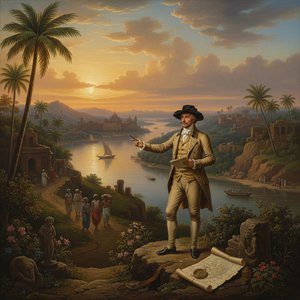
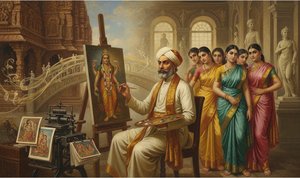
The 19th century in India was a period of profound cultural metamorphosis, a time when traditional aesthetics met the evolving visual languages of a changing world. This era saw a fascinating convergence of indigenous sensibilities and foreign influences, as artists navigated the intricate intersection of classical Indian traditions and the emerging Western techniques of realism and perspective. It was a century defined by the movement of ideas, where the sacred imagery of ancient epics began to coexist with the portraiture and landscapes of a modernizing society.
As the subcontinent underwent significant social and political shifts, the art produced during this time captured a unique visual dialogue. Painters began to experiment with new mediums and styles, blending the delicate, stylized grace of traditional miniature traditions with the dramatic lighting and anatomical precision introduced by European academic training. This synthesis created a rich, hybrid aesthetic that documented the elegance, the divinity, and the daily life of a nation in transition.
Today, these works remain vital for understanding the roots of modern South Asian art. They serve as visual chronicles of a pivotal epoch, offering a window into the soul of a culture that was simultaneously preserving its heritage and embracing the new. By examining the brushwork and the subjects of this period, we gain a deeper appreciation for the complexity of Indian identity during a transformative age.
The following selection explores the diverse masters of this era, ranging from the pioneers of lithographic color to the virtuosos of oil and portraiture, including the legendary Raja Ravi Varma, the evocative Raja Deen Dayal, and the skilled hands of Krishnappa Chitragara.
Raja Ravi Varma
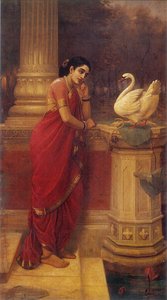 Damayanti And Hamsam - Raja Ravi Varma
In the serene composition Damayanti And Hamsam, the viewer is transported into a realm where myth and reality softly intertwine. This 1899 masterpiece captures a quiet encounter between the beautiful Damayanti and a graceful white swan, or hamsa, set against a soft, hazy landscape that suggests the grandeur of a distant palace. Through this work, we see the profound tranquility and emotional depth that defined the career of Raja Ravi Varma.
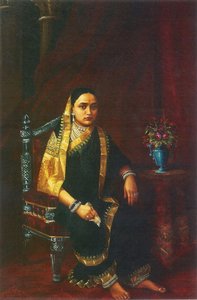
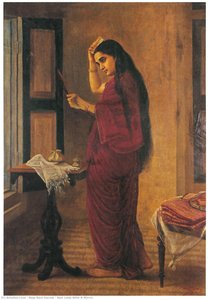
Born in 1848 into the royal lineage of Kilimanoor Palace, Varma emerged as a transformative figure in 19th-century Indian art. He acted as a cultural bridge, skillfully blending the principles of European academic realism—such as precise anatomy, perspective, and chiaroscuro—with the rich, vibrant tapestry of Hindu mythology. His technical mastery is evident in the way he uses oil on canvas to render the tactile weight of traditional saris and the luminous texture of feathers. By adapting Western techniques to serve distinctly Indian narratives, Varma moved beyond mere imitation, establishing a sophisticated visual language that brought the divine stories of the 19th century to life with unprecedented realism and grace.
Julia Margaret Cameron
 St Agnes (Alice Liddell) - Julia Margaret Cameron
Born in Calcutta, India, in 1815, Julia Margaret Cameron carries a profound connection to the 19th century Indian landscape through her heritage. Her early years were shaped by the vibrant cultural tapestry of Anglo-Indian society, a background that instilled in her a cosmopolitan sensibility and a unique appreciation for beauty. This diverse upbringing provided the foundational perspective that would later define her revolutionary approach to the photographic medium.
Though she discovered her passion for the camera later in life, her ability to capture the human soul was immediate. In her 1872 masterpiece, St Agnes (Alice Liddell), she moves beyond mere documentation to create a vision of Victorian devotion. By casting the young Alice Liddell in an allegorical role, Cameron utilizes a soft-focus technique that imbues the portrait with an ethereal, melancholic quality. The work transcends the clinical precision of her contemporaries, using light and shadow to explore themes of innocence and spiritual gravity. Her ability to blend reality with mythic storytelling marks her as a vital artistic voice of the era, bridging the gap between the tangible world and the profound depths of the human imagination.
Valentine Cameron Prinsep
 Leonora of Mantua - Valentine Cameron Prinsep
Born in Calcutta in 1838, Valentine Cameron Prinsep’s artistic identity was deeply shaped by his origins in India. As a child of the British colonial landscape, his early years in the subcontinent provided a cultural foundation that would later inform his fascination with exoticism and historical narratives. This connection to the 19th-century Indian experience places him firmly within this era of cross-cultural artistic exchange.
A pivotal moment in his development occurred during an expedition to Halicarnassus, where he studied classical ruins, a journey that ignited a lifelong obsession with historical grandeur. This passion is vividly realized in his 1873 masterpiece, Leonora of Mantua. In this evocative oil on canvas, Prinsep moves beyond mere portraiture to construct a phantom of the Italian Renaissance. The subject is draped in opulent silks and lace, her presence anchored by a pyramidal composition that exudes quiet prestige. Light dances across the iridescent eye of a peacock feather fan and the glint of fine jewelry, creating a tactile, romantic atmosphere. Through Leonora of Mantua, Prinsep captures the stillness of a vanished courtly era, blending the meticulous detail of the Pre-Raphaelite movement with a profound sense of historical mystery."
Ravi Varma Lithographic Press
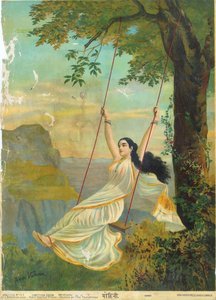 Mohini or The Temptress - Ravi Varma Lithographic Press
Established in 1894 in Malavli, the Ravi Varma Lithographic Press stands as a transformative force within the landscape of 19th century Indian painters. While not an individual artist, this press was the essential vessel for the legacy of Raja Ravi Varma, serving as the primary engine that brought his unique fusion of European academic realism and Indian mythological themes to the masses. By utilizing advanced lithographic processes, the press effectively democratized art, moving it from the private galleries of royalty into the homes of the general public across the subcontinent.
The technical precision of the press allowed for the meticulous reproduction of complex compositions, capturing the vibrant colors and soft textures of the original works. A quintessential example of this mastery is Mohini or The Temptress. In this work, the lithographic technique achieves a dreamlike quality, rendering the ethereal grace of a woman in flowing white garments as she rests upon a swing. The interplay of light and shadow creates a serene, atmospheric haze over the lush landscape, embodying the romanticized aesthetic that defined this era of Indian art history.
Kennett Watkins
 The Phantom Canoe: A Legend of Lake Tarawera - Kennett Watkins
Born in Ootacamund, India, in 1847 to a major of the Indian Army, Kennett Watkins represents the profound global connections of the 19th century. His identity as a painter from this era is rooted in his colonial origins, having been born on Indian soil before his formative years took him through Switzerland and France, eventually leading him to become a pivotal figure in the art scene of New Zealand.
A visitor can recognize a Watkins composition by its evocative, atmospheric approach to landscape and light. He possessed a remarkable ability to capture the tension between serene natural beauty and the supernatural. His brushwork often navigates the delicate balance between detailed botanical observation and the dramatic, sweeping moods of the wilderness. This is masterfully demonstrated in his 1888 work, The Phantom Canoe: A Legend of Lake Tarawera. In this piece, he transforms a historical sighting into a spectral nocturnal vision, using a silhouetted mountain and a zigzag of lightning to heighten the sense of impending disaster. His work remains a testament to the era's fascination with both the physical landscape and the rich, mystical cultural heritage of the territories he inhabited.
Arthur Boyd Houghton
 Baby - Arthur Boyd Houghton
Born in Kotagiri, Madras, Arthur Boyd Houghton represents a unique intersection of colonial origins and the height of the English Pre-Raphaelite movement. As a painter born in India during the 19th century, his early years in the subcontinent provided a foundational perspective that he later carried through his travels in America and Russia. His artistic journey was marked by a remarkable ability to bridge the meticulous precision of wood-engraved illustration with the emotive, atmospheric depth of fine art oil painting.
Houghton’s work is characterized by a poetic realism, often utilizing a controlled, somber palette to explore intimate human connections. His 1861 oil painting, Baby, serves as a profound example of his mastery of Academic Realism. In this piece, he employs a dramatic chiaroscuro effect, where light enters from a single source to illuminate a white cloth and the soft skin of an infant against the deep, espresso tones of a tufted red armchair. Through his delicate handling of light and shadow, Houghton captures a sense of volume and quiet domesticity, securing his legacy as a master of both line and light.
Sajnu of Mandi
 Vishnu on Garuda - Sajnu of Mandi
A luminous figure within the Pahari painting tradition, Sajnu of Mandi represents the sophisticated evolution of the Guler school during the 19th century. Operating from the verdant landscapes of Mandi, India, his work arrived at a pivotal moment when the artistic influences of the Kangra and Guler schools began to reshape the aesthetics of lesser courts. Sajnu is credited with transforming the local Mandi style, moving it away from a robust and strident character toward a more refined, softer tonality and a quieter, more graceful palette.
His mastery is most evident in his ability to blend sacred geometry with a celestial luminosity, using delicate layering to bring Hindu deities to life. A quintessential example of this technical brilliance is the 1810 work Vishnu on Garuda. Attributed to a follower of his atelier, this piece exemplifies the shift in 19th-century Mandi art; rather than focusing on complex narrative epics, it celebrates the singular, serene beauty of Lord Vishnu and his avian vehicle. Through such works, Sajnu’s legacy helped define a period where the divine was captured through a harmonious balance of vibrant color and spiritual intensity.
Howard, Bourne & Shepherd
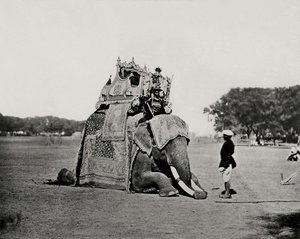 His Eminence the Viceroy - Howard, Bourne & Shepherd
In the evocative portrait His Eminence the Viceroy, the viewer is transported to the height of the colonial era, where the dignity of Indian royalty meets the formal precision of Victorian composition. This work, dating to 1877, exemplifies the mastery of Howard, Bourne & Shepherd, a pioneering photographic institution established in 1863 in Shimla. As a vital part of the 19th century Indian artistic landscape, the studio transitioned the era's visual narrative from traditional painting to the sophisticated chemistry of the silver lens.
The studio's legacy is defined by a profound ability to document a subcontinent in transition. Their repertoire spans from the intimate, dignified portraiture of the ruling elite to the sublime, sweeping landscapes of the Himalayas. Samuel Bourne’s daring expeditions into rugged mountain terrains allowed the studio to capture geological and botanical wonders with unprecedented clarity. Utilizing masterful albumen silver prints, their work often features a palette of muted, earthy tones, such as the putty hues seen in their formal commissions. Through their scientific curiosity and artistic eye, Howard, Bourne & Shepherd transformed photography into a powerful medium of documentation, capturing the soul of 19th-century India.
Raja Deen Dayal
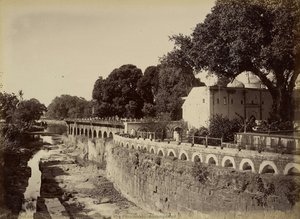 Channel near the Punchukki, Aurangabad - Raja Deen Dayal
In his 1888 work, Channel near the Punchukki, Aurangabad, Raja Deen Dayal offers a serene portal into the architectural grandeur of 19th-century India. This composition captures the harmonious integration of Mughal design and the natural landscape, utilizing a sophisticated linear perspective to guide the eye through weathered stone corridors toward a distant, domed structure. The use of diffused light and a muted, sepia-toned palette lends an ethereal, tranquil quality to the scene, emphasizing the historical weight of the landscape.
A pivotal figure in the visual history of 19th-century Indian art and documentation, Dayal (1844–1905) transitioned from an engineering background at Thomason College of Civil Engineering to become a master of the albumen print. His career reached the highest echelons of society, serving as the court photographer to the Nizam of Hyderabad and receiving a royal warrant from Queen Victoria in 1897. His lens captured the essence of the era, from the majestic temples and palaces of the subcontinent to formal portraits of Indian rulers and British officials. Through his meticulous technique, Dayal transformed documentary photography into a profound medium of cultural preservation.
Krishnappa Chitragara
 Saraswati - Krishnappa Chitragara
Krishnappa Chitragara stands as a foundational figure in the evolution of Indian art, bridging the traditional sensibilities of the 19th century with pioneering modern techniques. His inclusion in this era is marked by his early mastery of sacred themes and his ability to capture the spiritual essence of the period. Born in Bengaluru, his artistic journey began at the dawn of the 20th century, yet his roots and foundational works are deeply intertwined with the aesthetic traditions of the 19th-century Mysore School.
His most significant contribution is the 1900 masterpiece, Saraswati, a work that exemplifies the profound spiritual depth of his era. In this depiction of the goddess of learning, Chitragara employs a sophisticated mixed media approach that was ahead of its time. He achieves a palpable, tactile depth by applying gold and silver leaf over a raised relief of limestone paste, creating a luminous, shimmering effect that interacts dynamically with light. The goddess is framed within an architectural archway, emphasizing a sense of sacred enclosure. Through the use of rich Phthalo Green tones and intricate ornamentation, the work serves as a visual hymn to wisdom, capturing the divine resonance of cosmic harmony.
Conclusion
The 19th century was a transformative era for Indian art, marked by a profound dialogue between traditional sensibilities and emerging global influences. From the masterful mythological storytelling of Raja Ravi Varma to the intricate visual records captured by the Ravi Varma Lithographic Press and the evocative portraiture of Raja Deen Dayal, these artists collectively bridged the gap between classical heritage and modern realism. Whether through the delicate nuances of portraiture or the grand scale of lithographic prints, this group of painters redefined the visual identity of a nation in transition.
At Mus3ums.com, we invite you to bring this rich history into your own living space. Our artisans specialize in creating museum-quality, hand-painted oil reproductions that capture the soul and texture of these historical masterpieces. You can explore our full collection to find the perfect piece and experience the timeless elegance of Indian art through our bespoke, handmade craftsmanship.