
Introduction
The 20th century marked a profound metamorphosis in the visual language of the Indian subcontinent, as artists navigated the complex intersection of ancient heritage and burgeoning modernity. This era was defined by a powerful search for identity, where painters sought to reconcile traditional aesthetics—rooted in classical mythology and spiritual symbolism—with the evolving influences of Western techniques and the urgent socio-political shifts of a nation moving toward independence. It was a period of intense experimentation, where the canvas became a site for both cultural preservation and radical innovation.
From the delicate, wash-like textures of the Bengal School to the bold, structural explorations of modernism, these artists redefined what it meant to be an Indian painter. They moved beyond mere imitation, instead synthesizing local sensibilities with global movements to create a unique visual vernacular. This movement was not just about style, but about the very soul of a changing society, capturing the tension between the sacred and the secular, the rural and the urban.
Today, these works remain vital, serving as essential windows into a transformative epoch that shaped the aesthetic consciousness of a modern nation. Their legacy continues to resonate in contemporary art, offering a profound dialogue between the past and the present. In the following sections, we examine ten pivotal figures of this movement, including the legendary Raja Ravi Varma, the visionary Abanindranath Tagore, and the influential Nandalal Bose, whose contributions continue to define the richness of Indian art history.
Raja Ravi Varma
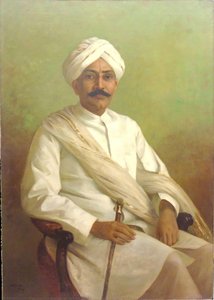 Bandi Balaiah Naidu - Raja Ravi Varma
A pivotal figure in the evolution of modern Indian aesthetics, Raja Ravi Varma (1848–1906) served as a vital bridge between traditional sensibilities and the emerging modern era. Although his life began in the 19th century, his profound influence and stylistic innovations laid the essential groundwork for the 20th century Indian painters who followed, establishing a visual language that merged local identity with global technique. Born into the royal lineage of Kilimanoor Palace, Varma was nurtured by his uncle, Raja Raja Varma, within the Tanjore School tradition, yet his vision eventually transcended these classical roots.
His genius lay in his ability to master European academic realism—specifically the precision of anatomy, perspective, and the play of light—and apply it to the divine narratives of Hindu mythology. This synthesis is masterfully captured in his 1904 portrait, Bandi Balaiah Naidu. In this work, Varma elevates the subject through a sophisticated command of shadow and texture, rendering the subject's traditional attire with a luminosity that feels both photographic and deeply soulful. By bringing such academic rigor to Indian subjects, he transformed the way the subcontinent perceived its own cultural and mythological grandeur.
Rabindranath Tagore
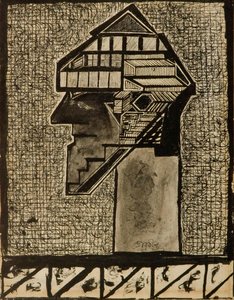 Head Study (Geometric) - Rabindranath Tagore
A polymathic force whose creative reach extended far beyond the written word, Rabindranath Tagore stands as a defining figure of 20th century Indian painters. While globally celebrated as a Nobel laureate and literary titan, his visual journey began unexpectedly in 1928, marking a profound shift in Bengali art history. His late-life immersion into painting allowed him to transcend conventional boundaries, moving from the structured world of prose into a realm of intense, subconscious exploration that characterizes the modern era of Indian art.
His work is a testament to contextual modernism, blending a deep sensitivity to visual aesthetics with an innovative approach that bridged traditional heritage and contemporary sensibilities. This is vividly captured in his 1929 work, Head Study (Geometric). In this piece, Tagore moves toward a singular vision of modernism, utilizing angular shapes and a sophisticated, almost architectonic approach to the human form. Rather than adhering to strict realism, he embraced a visual language of fantasy and wild imagination, often influenced by the primal energy of ancient cultures and the expressive depths of European movements. Through his prolific output, Tagore transformed the act of painting into a profound investigation of perception and the inner landscape.
Abanindranath Tagore
 Bharat Mata - Abanindranath Tagore
A central figure in the 20th century Indian painters movement, Abanindranath Tagore (1871–1951) was the visionary founder of the Bengal School. His work represents a profound departure from Western academic realism, seeking instead to revitalize indigenous traditions. A visitor can recognize his mastery through a lyrical, ethereal quality, often characterized by delicate watercolor washes and a rhythmic, calligraphic line influenced by Japanese and Chinese traditions. His palette often favors soft, atmospheric tones that evoke a sense of spiritual serenity.
His most iconic contribution to the national identity is the 1905 masterpiece, Bharat Mata. In this seminal work, he personifies the nation as a serene, saffron-clad goddess, using a frontal, iconographic composition to elevate the concept of the motherland to a divine status. This piece, along with his Arabian Nights series, demonstrates his ability to blend Mughal and Rajput aesthetics with a modern, Swadeshi sensibility. By integrating these historical styles with a unique, fluid brushwork, Tagore successfully bridged the gap between ancient heritage and the emerging modernism of 20th-century India.
Faustin Elmer Chaudhry
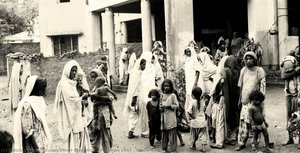 Partition 1947 - Women At A Refugee Camp - Faustin Elmer Chaudhry
In the poignant work Partition 1947 - Women At A Refugee Camp, the raw reality of human displacement is captured through a lens of profound empathy. This image, characterized by muted putty tones, depicts women and children seeking shelter in abandoned properties, their vulnerability serving as a silent testament to the chaos of the era. Faustin Elmer Chaudhry, born in Saharanpur, British India, was a vital visual witness to the 20th century's most defining historical shifts. Although his professional calling transitioned from teaching science to pioneering photojournalism, his work functions as a pictorial history of the Indian subcontinent.
Chaudhry’s perspective is essential to the 20th century Indian painters and visual artists group because his archives provide an irreplaceable record of the Partition and the birth of a new nation. His ability to document both monumental political milestones, such as the 1940 Muslim League Session, and the intimate, harrowing struggles of refugees, makes his body of work a cornerstone of South Asian visual heritage. Through his camera, he transformed fleeting, turbulent moments into a permanent, evocative narrative of identity and survival.
Y. G. Srimati
 Eklavya Practicing Archery before an Icon of Dronacharya - Y. G. Srimati
In her evocative 1945 work, Eklavya Practicing Archery before an Icon of Dronacharya, Y. G. Srimati captures a profound moment of spiritual transcendence and discipline. The painting depicts the legendary figure from the Mahabharata, showing the young archer releasing his arrow before a monochromatic clay icon of his guru, a composition that emphasizes the power of meditation and devotion. This mastery of narrative and form establishes Srimati as a vital voice among 20th century Indian painters, as her work deeply engaged with the cultural and political shifts of her era.
Born in Mysuru in 1926, Srimati was a multifaceted artist whose vision was shaped by her training in Carnatic music and Bharatanatyam dance. Her aesthetic was profoundly influenced by the rhythmic lines of the Ajanta caves and the nationalist sentiments of the independence movement. Having performed devotional songs at rallies for Mahatma Gandhi, she channeled this spiritual fervor into her canvases, often exploring Hindu mythology and rural life. Her palette and style evolved through a unique synthesis of traditional Indian aesthetics and the evolving modernism of mid-century India, making her a singular figure in the nation's artistic history.
Angela Rita Clara De Almeida Trindade
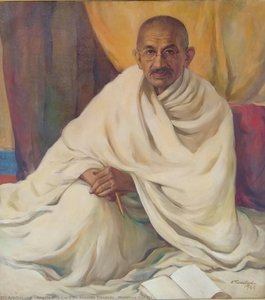 Mahatma Gandhi - Angela Rita Clara De Almeida Trindade
A trailblazing figure in the 20th century Indian painters movement, Angela Rita Clara De Almeida Trindade (1909–1980) redefined the boundaries of local artistic expression. Born in Bombay, she broke significant gender barriers at the esteemed Sir J.J. School of Art, where she became the first woman to be granted a prestigious fellowship. Her inclusion in this group of 20th century Indian painters is cemented by her ability to synthesize Western portraiture with the profound spiritual essence of Indian culture, a fusion that became her signature.
Trindade developed a unique stylistic language known as Trindadism, characterized by the use of symbolic elements such as the triangle and the trinity. This approach allowed her to navigate complex themes, blending Christian iconography with indigenous sensibilities. Her 1948 portrait, Mahatma Gandhi, serves as a profound testament to her mastery. In this work, she captures the "Father of the Nation" not as a political icon, but as a man of quiet, spiritual repose. Through a sophisticated dialogue of light and texture, she portrays Gandhi in a moment of stillness, grounding the historical figure in a sense of serene, personal conviction that resonates with the transformative spirit of mid-century India.
Vidita Singh Of Barwani
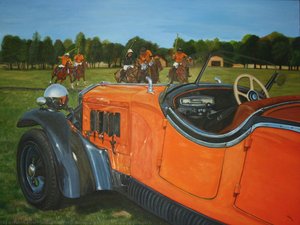 Lancia at the polo match - Vidita Singh Of Barwani
In the vibrant composition of Lancia at the polo match, the viewer is transported into a world where the thundering pulse of sport meets refined elegance. Created in 2000, this work serves as a breathtaking window into a moment of high-spirited competition, capturing the raw, kinetic energy of a polo match in full swing. The painting documents a scene where the rhythmic movement of powerful horses meets the sleek, modern sophistication of a classic Lancia, creating a striking dialogue between organic strength and mechanical artistry.
As a prominent figure in 20th-century Indian painting, Vidita Singh of Barwani brings a unique perspective to the era's contemporary realism. Her work is deeply informed by her heritage; born into a lineage connected to India’s automotive history, she possesses an intimate understanding of the prestige and historical weight carried by vintage machinery. Her artistic language is a sophisticated blend of technical precision and cultural storytelling, often employing a unique perspective that focuses on reflections and the distorted beauty found in chrome surfaces. Whether utilizing the fluid depth of oil paints or the meticulous, textured application of mosaics—which mirrors the ancient beauty of pietra dura inlay—her paintings possess a rhythmic quality that captures both motion and the soul of a bygone era.
Manik Lal Das
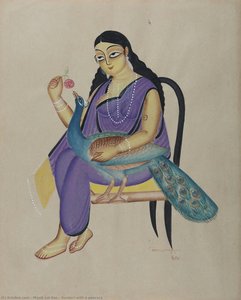 Sundari with a peacock - Manik Lal Das
Born in 1962 in Krishnanagar, Manik Lal Das represents the vital continuation of Indian artistic evolution into the late 20th and early 21st centuries. As a contemporary exponent of the Kalighat tradition, he emerged from the Patua community of scroll painters, a lineage of storytellers that has shaped the visual language of Bengal for generations. His work is essential to the history of 20th-century Indian painters because he spearheaded the revival of Kalighat painting, a significant movement that had faced decline after the 1930s. By breathing new life into this heritage, Das bridges the gap between ancient folk traditions and modern sensibilities.
In his representative work, Sundari with a peacock, this revival is palpable through a luminous use of watercolor. The piece captures a moment of profound stillness, where a woman in a rich violet sari engages in a silent, intimate dialogue with a magnificent bird. Through delicate strokes and a mastery of color, Das transforms traditional motifs into emotive, modern masterpieces. His ability to blend the conventions of West Bengal scrolls with a sophisticated, contemporary grace ensures that the legacy of Indian miniature painting remains a living, breathing force in the modern era.
Ram Kinker Baij
 Binodini - Ram Kinker Baij
In the evocative portrait Binodini, created in 1949, we encounter the profound psychological depth that defines the work of Ram Kinker Baij. This piece serves as a masterful example of his ability to capture the human spirit, presenting a young woman from Manipur’s aristocratic lineage in a moment of suspended contemplation. Baij’s technique is remarkably tactile; by executing the work in oil upon gunny cloth, he achieves a sculptural quality that grants the figure an undeniable physical presence and volume.
As a foundational figure of the 20th century Indian painters, Baij’s legacy is rooted in his role as the progenitor of modern Indian sculpture. Born in 1906 in Bankura, West Bengal, his artistic evolution was shaped by the intellectual sanctuary of Santiniketan under the mentorship of Nandalal Bose. His work represents a vital bridge between the traditional rhythms of rural India and the burgeoning international modernist movement. Through his signature contextual modernism, Baij moved beyond mere imitation, instead using texture and form to redefine Indian identity during this transformative century. His ability to blend Western influences with local sensibilities ensures his place as a monumental architect of modern Indian art.
Nandalal Bose
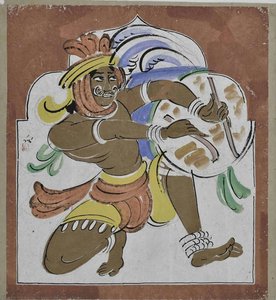 Dhaki - Nandalal Bose
A central figure in the evolution of 20th century Indian painters, Nandalal Bose (1882–1966) was instrumental in defining a modern aesthetic that remained deeply rooted in national identity. His work represents a pivotal shift in the 20th century as he moved away from purely Western academic traditions to forge a unique "Indian style." This approach synthesized classical influences, such as the ancient murals of the Ajanta caves, with Persian elements, creating a visual language that resonated with the cultural revival of his era. His mastery was so profound that he was entrusted with the monumental task of illustrating the Constitution of India.
His 1937 masterpiece, Dhaki, serves as a quintessential example of this rhythmic, folk-inspired sensibility. The painting captures a drummer in a moment of percussive grace, his form defined by fluid, expressive lines that evoke the vitality of village life. Through works like this, Bose elevated the everyday experiences of the Indian people—from the pulse of traditional music to the quietude of nature—into the realm of high art, securing his legacy as a pioneer of the modern Indian movement.
Conclusion
The legacy of these 20th century Indian painters represents a profound dialogue between ancient tradition and modern expression. From the mythological grandeur of Raja Ravi Varma to the delicate, lyrical sensibilities of the Tagore lineage, these artists collectively redefined a national visual identity. Whether through the bold, experimental strokes of Ram Kinker Baij or the nuanced, spiritual depth found in the works of Nandalal Bose, each master contributed a unique layer to the evolving tapestry of Indian art history. Their ability to synthesize local heritage with global movements ensures their influence remains vital in the contemporary era.
At Mus3ums.com, we invite you to bring this rich cultural heritage into your own space. Our artisans specialize in creating museum-quality, hand-painted oil reproductions that capture the soul and texture of these historical masterpieces. You can explore our full collection to find the perfect piece and experience the profound beauty of these legendary works through our bespoke, fine-art craftsmanship.


