The Life of Henri De Toulouse-Lautrec
Born on November 24, 1864, in Albi, France, Henri De Toulouse-Lautrec entered a world of significant social standing. His full name, Comte Henri Marie Raymond de Toulouse-Lautrec-Montfa, reflected a lineage of considerable weight. He was the firstborn child of Count Alphonse de Toulouse-Lautrec Montfa and Adèle Zoë Tapié de Celeyran. His ancestry connected him to the Counts of Toulouse and Odet de Foix, Vicomte de Lautrec, as well as the Viscounts of Montfa.
Despite this aristocratic foundation, his life was defined by a restless engagement with the fringes of society. He was a man of many disciplines, working as a painter, printmaker, draughtsman, caricaturist, and illustrator. His perspective was shaped by a unique physical reality that set him apart from the social circles of his birth. Rather than retreating into the seclusion of his class, he sought out the energy of the Parisian streets.
His career was a brief but intense documentation of a changing era. He moved through the shadows of the Belle Époque, capturing the people and places that defined the turn of the century. His work remains a record of the human condition as seen through the eyes of an observer who lived among his subjects.
Early Life, Family and Training
Born into the French aristocracy, Henri Marie Raymond de Toulouse-Lautrec-Monfa entered a world of significant privilege. He was the son of Count Alphonse de Toulouse-Lautrec Montfa and Adèle Zoë Tapié de Celeyran. His lineage was distinguished, descending from the Counts of Toulouse and the Viscounts of Montfa. However, his early years were marked by a physical struggle that would forever alter his perspective. A rare genetic condition, suspected to be pycnodysostosis, halted the growth of his legs at a young age. This condition left him with a disproportionately small lower body and an adult torso, a physical reality that would shape his observational gaze for the rest of his life.
His formal education in the arts began under the guidance of Léon Bonnat. While his aristocratic background provided the means for such training, his temperament was not suited for the rigid constraints of academic tradition. After a period spent in Albi, he returned to Paris in 1882 to continue his studies under Bonnat. His technical foundation was further solidified through the tutelage of Fernand Cormon. These years of instruction provided him with the essential skills of a Salon painter, even as his interests began to drift away from the historical and mythological subjects favored by his mentors and toward the lived realities of the Parisian streets.
The Bohemian World of Montmartre
The rigid structures of his aristocratic upbringing found no purchase in the winding streets of Montmartre. Instead, he sought the company of the city's fringes, drawn to a district defined by its restless, bohemian energy. This was a landscape of smoke and gaslight, where the social hierarchies of Paris dissolved within the walls of dance halls, cabarets, and theaters. He did not merely observe this world from the periphery; he inhabited it, becoming a fixture in the very spaces that defined the era's nightlife.
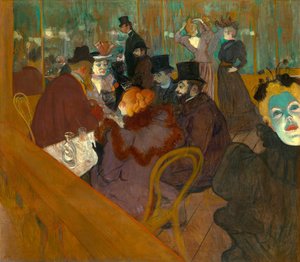
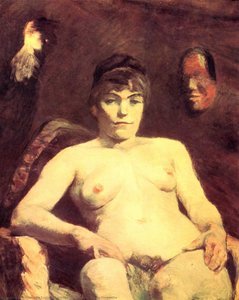
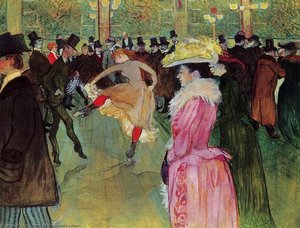
His presence was felt in the crowded café-concerts and the dimly lit corners of the urban underclass. He possessed a particular fascination with the lives of prostitutes and the performers who navigated the precarious social margins of the Belle Époque. Rather than viewing these figures through a lens of sensationalism, he documented their existence with a directness that captured the raw pulse of the district. From the high-energy atmosphere of the Moulin Rouge to the more relaxed settings of the Moulin de la Galette, he moved through these establishments as a chronicler of the human condition in its most unvarnished states.
This immersion provided him with a steady stream of subjects that were often ignored by the polite society of the time. He found a sense of belonging among the singers, gamblers, and workers who populated the nocturnal streets. His work from this period reflects a deep familiarity with the textures of this life, capturing the fleeting moments of a world that thrived in the shadows of the city.
Technique and Artistic Style
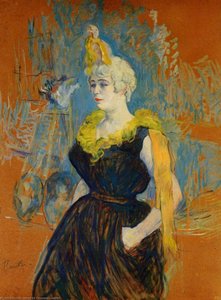
His hand moved with a precision that transformed simple lines into instruments of character and emotion. He did not merely outline a figure; he used the stroke to capture the kinetic energy of a dancer or the weary slump of a cabaret singer. This mastery of line was often paired with a flattened perspective and bold compositions, a stylistic choice heavily influenced by the aesthetic of Japanese woodblock prints. By rejecting traditional depth, he achieved a directness that mirrored the immediacy of the Parisian nightlife he inhabited.
The artist’s palette was frequently striking, utilizing bold outlines and colors that could appear jarring to the eye. He was a pioneer in the use of color lithography, a medium that allowed his imagery to reach a mass audience through posters and illustrations. To achieve specific textures, he employed the crachis technique, a method of spattering ink to create a distinctive speckled effect. On other surfaces, such as cardboard, he worked with peinture à l’essence, an oil thinned with turpentine that allowed for a more fluid, expressive application of pigment.
Key Works and Artistic Achievements
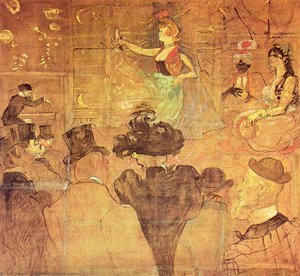
Between 1891 and 1901, his output was defined by a prolific engagement with the lithographic medium. He produced nearly 350 lithographic posters, editioned portfolios, and illustrations during this decade, often utilizing the crachis technique—a method of spattering ink to create delicate textures and tonal ranges. A notable example of this technical precision is La grande loge, which demonstrates the subtle effects achievable through such spattered-ink application. His ability to translate the atmosphere of the Parisian night onto paper helped bridge the gap between fine art and the burgeoning field of graphic design.
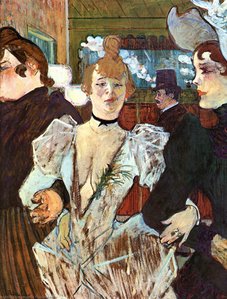
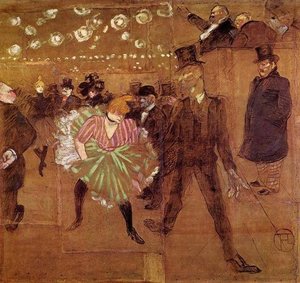
His subject matter remained tethered to the figures of the Montmartre nightlife. In La Goulue at the Moulin Rouge, he depicts a dancer nicknamed "The Glutton," capturing her presence within the social fabric of the dance halls. Other significant works include Divan Japonais and La Passagère du 54, ou Promenade en Yacht, created in 1896. These pieces reflect a career spent documenting the transient movements of performers and patrons alike, often through bold outlines and a flattened perspective that prioritized the character of the subject over traditional depth.
- La Goulue at the Moulin Rouge
- Divan Japonais
- La Passagère du 54, ou Promenade en Yacht (1896)
- La grande loge
Later Years and Death
The intensity of the Montmartre lifestyle eventually exacted a heavy toll on the artist. His career, though prolific in its reach, lasted just over a decade. During these years, he struggled against the physical and personal consequences of a life lived on the edge of Parisian society. He battled alcoholism and syphilis, conditions that increasingly complicated his existence and shadowed his creative output.
The end came swiftly. On September 9, 1901, he died at the age of 36. His passing was the direct consequence of years spent battling both alcoholism and syphilis. He left behind a body of work that captured a specific, fleeting era of French history, recorded before his health finally failed him.
Legacy and Lasting Influence
The transition from Impressionism to modern art found a distinct voice in the works of Henri de Toulouse-Lautrec. He occupies a central position in the Post-Impressionist movement, situated alongside figures such as Cézanne, Van Gogh, Gauguin, and Seurat. Rather than adhering to the rigid structures of the academy, he sought to document the shifting social landscape of Paris, capturing the energy of the Belle Époque through a lens that was both personal and unflinching.
His contribution to the visual language of the twentieth century extended far beyond the canvas. Through his prolific output of lithographic posters, he helped herald the birth of graphic design. These works transformed advertising into a legitimate medium for artistic expression, utilizing bold lines and flattened perspectives to reach a mass audience. This innovation bridged the gap between high art and the street, influencing the trajectory of early 20th-century illustration and leaving a mark on contemporary graphic design.
His ability to translate the atmosphere of Montmartre into a graphic format ensured his influence would persist long after his death. By treating the poster as a site for serious artistic inquiry, he altered how the public consumed imagery in urban spaces. His legacy is found in the intersection of fine art and commercial communication, a space he helped define through his unique command of line and color.
Where to See the Works Today
To encounter the breadth of his output, one must travel to Albi, France. The Musée Toulouse-Lautrec, housed within the Palais de la Berbie, maintains the most significant collection, containing over 1000 works that trace his evolution from an aristocratic youth to a chronicler of the Parisian night.
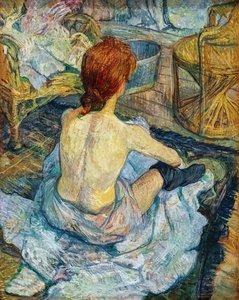
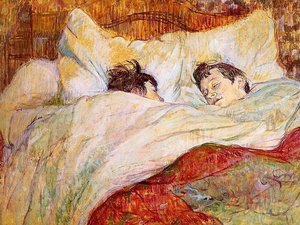
In Paris, his presence is felt within the halls of the Musée d'Orsay. Here, one can find Le Lit, a work that captures the intimate, often quiet moments of his subjects. His influence also extends to the Museum of Modern Art in New York City, where his graphic contributions are held for public study.
Across the Atlantic, the Detroit Institute of Arts preserves significant pieces of his visual language, including Le Divan Japonais. These various repositories ensure that his specific perspective on the Belle Époque remains accessible to those seeking to understand the atmosphere of Montmartre.
კითხვები და პასუხები
რა ქალაქსა და ქვეყანაში დაიბადა ანრი დე ტულუზ-ლოტრეკი?
ანრი დე ტულუზ-ლოტრეკი დაიბადა ალბი-ში, საფრანგეთი-ში.
სად და რა წელს დაიბადა ანრი დე ტულუზ-ლოტრეკი?
ანრი დე ტულუზ-ლოტრეკი დაიბადა ალბი-ში, 1864 წელს.