

Origins and History of the Institution
The history of the École Nationale Supérieure des Beaux-Arts spans over three and a half centuries. It began in 1648 as the Royal Academy of Painting and Sculpture under the direction of Cardinal Mazarin. This early foundation established the institution as a central site for artistic training in Paris, France. The school's identity evolved through significant structural changes, including a revival in 1817 when it merged with the Académie d'architecture. This period marked a shift in how the institution organized its focus on both fine arts and the principles of building.
A major turning point occurred in 1863 when Napoleon III granted the school independence from the government. This autonomy allowed the institution to further define its pedagogical methods and its place within the French academic tradition. The composition of the student body also underwent a significant transformation at the end of the nineteenth century. In 1897, women were admitted to the school, expanding the community of practitioners within its walls.
The Architecture of the Beaux-Arts Building
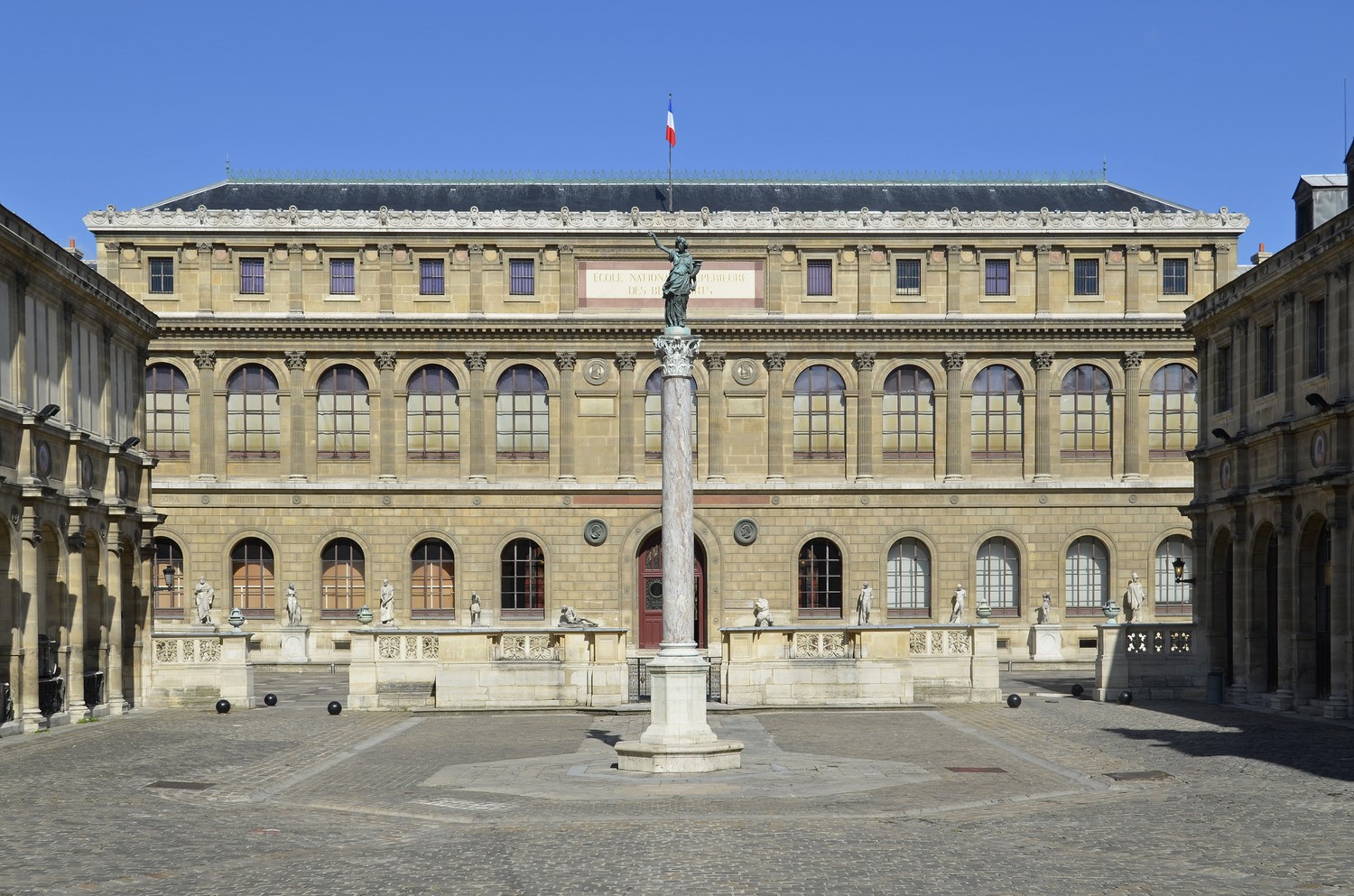
Located on the left bank of the Seine in Paris, across from the Louvre, the building reflects the principles of the Beaux-Arts style. Designed by Félix Duban in the mid-19th century, the structure emphasizes classical symmetry and order. Corinthian columns rise with a sense of permanence, framing elaborate sculptures that define the facade. The architecture seeks to impose a sense of scale and purpose upon the surrounding urban landscape.
The central courtyard remains the heart of the institution. This vast, light-filled expanse provides a quiet core for the school, where the movement of light changes throughout the day. It is a space designed for communal practice and observation. The scale of the architecture is intended to inspire a sense of the possibilities inherent in the creative process.
A Vast Treasury of Artistic Works
The collection held within these walls is staggering, comprising over 450,000 works that trace the evolution of artistic development across centuries. These pieces span from antiquity to the present day, offering a continuous record of creative thought. The archive includes an extensive series of drawings, ranging from preliminary sketches and anatomical studies to finished, highly detailed pieces. These works provide a direct view into the technical processes used by generations of artists.
Significant holdings include the output of Grand Prix de Rome competition winners, representing the highest level of academic achievement. These works reflect the rigorous training and the specific aesthetic standards of the institution. The breadth of the collection allows for a study of how styles have shifted from the classical traditions of the past toward contemporary expression. To stand before these objects is to witness the physical manifestation of centuries of formal instruction.
- The Beheading of St John the Baptist, 1510 - Jan Gossart
- The Wealthy Man, 1500 - Jean Bourdichon
- The Nile, 1540 - Francesco Primaticcio
- Vessel, 1549 - Jean The Elder Cousin
Masterpieces and Notable Artworks
The presence of the collection is felt most strongly in its drawings. One finds the precise lines of Ingres alongside the more turbulent sketches of Delacroix and Géricault. These works offer a direct encounter with the hand of the artist, capturing the initial impulse of creation. Nearby, the extensive series of drawings by Jean-Baptiste Jules Trayer provides a different perspective, focusing on the serene landscapes and genre scenes of Brittany. These studies possess a remarkable sensitivity to their subject matter.
Sculpture and landscape painting provide further points of focus within the institution. The sculpture Juno by Benvenuto Cellini embodies Renaissance ideals through its technical skill and detail. In the realm of landscape, the works of Claude Gellée remain significant, particularly his luminous scenes that helped shape the course of both Neo-Classicism and Impressionism. The collection also bridges the gap between classical tradition and the avant-garde through the presence of Pierre Alechinsky, whose work connects the school to movements like CoBrA and Abstract Expressionism.
- Antiochus and Stratonica, about 1774 - Jacques-Louis David
- View of Ripetta, 1766 - Hubert Robert
- Male torso, 1800 - Jean-Auguste-Dominique Ingres
- The Mocking of Christ, 1845 - Alexandre Cabanel
- The Death of Socrates, 1762 - Jacques Philip Joseph De Saint Quentin
The Legacy of the Grand Prix de Rome
Established in 1804, the Grand Prix de Rome functioned as a prestigious scholarship that shaped the trajectory of many artists. This competition provided young talents with the opportunity to study in Rome, immersing themselves in the traditions of Italy. Such an experience profoundly influenced their technical skills and artistic vision. The prize was not awarded for mere imitation, but for a deep engagement with the classical past. Contestants were assigned specific themes drawn from the literature of classical antiquity, requiring them to translate ancient narratives into visual form.
The rigor of this competition produced artists who would redefine European aesthetics. The winners of this scholarship included figures such as Géricault, Delacroix, and Ingres. Their time in Rome allowed them to refine the precision and emotive power that would later define their distinct styles. The competition acted as a catalyst for change, fostering movements that altered the visual language of the era. Through this structured pursuit of excellence, the institution helped establish the standards of academic training for generations.
Exhibitions and Cultural Engagement
The institution functions as a site of continuous dialogue between established tradition and emerging practice. Through the annual Salon des Beaux-Arts, the school maintains a connection to the broader artistic community, drawing creators from across France and international borders. These gatherings provide a space where the standards of the academy meet the evolving perspectives of contemporary practitioners. Recent exhibitions, such as "Parisian Visions," have examined the school's specific influence on the development of urban design and architecture, reflecting on how these academic principles have shaped the physical landscape of the city.
Beyond the public display of finished works, the school is dedicated to the preservation and study of its vast holdings. This commitment involves rigorous research and conservation efforts to protect the integrity of the collection. Educational programs and public engagement initiatives ensure that the technical and conceptual foundations of the institution remain accessible. The school operates as a living archive, where the act of creation is supported by a deep respect for the materials and methods of the past.


