
The History of Harvard Art Museums
The Harvard Art Museums exist as an integral part of Harvard University. The institution's current form emerged from the integration of three distinct entities in 1983. This unification brought together the Fogg Museum, established in 1895, the Busch-Reisinger Museum, founded in 1903, and the Arthur M. Sackler Museum, which was established in 1985.
The lineage of these collections reflects a long-standing commitment to scholarly study and the preservation of human expression. While the museums were once separate, their eventual consolidation created a single, cohesive institution. In 2008, the name of the institution was simplified, and the word University was dropped from the official title.
The presence of these works within the Cambridge campus allows for a continuous dialogue between different eras and traditions. Each museum within the complex contributes a specific perspective to the whole, ranging from the foundational studies of the nineteenth century to more recent acquisitions. The history of the site is one of gradual accumulation and eventual structural unity.
Architectural Design and the Glass Roof
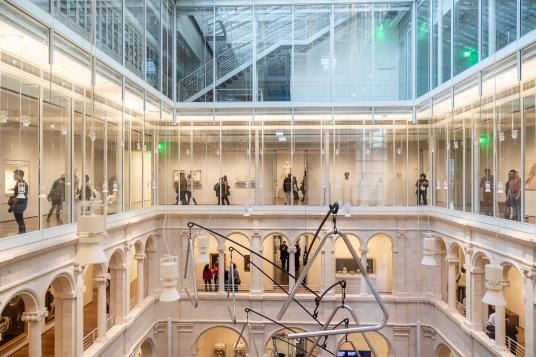
The physical presence of the Harvard Art Museums is shaped by the hand of Renzo Piano. His design for the renovated building at 32 Quincy Street united the three museums into a single facility. This structural integration increased the available gallery space by 40%. The architecture seeks to illuminate the past through contemporary innovation, creating a seamless transition between historical reverence and modern form.
The most striking element of this structural work is the truncated pyramidal roof. This glass-clad crown appears to float above the courtyard. As sunlight filters through the structure, it bathes the interior galleries in a soft, natural light. This transparency creates a living connection between the art within and the world outside, making the act of viewing art feel like a communal experience with nature itself.
The Fogg Museum Collection
As the cornerstone of the complex, the Fogg Museum holds a legacy that traces its roots back to 1873. The collection is celebrated globally for its holdings of Western painting, offering a space where the weight of history is felt through the presence of original works. One finds the divine proportions of the Italian Renaissance within these walls, specifically in the works of Botticelli and Raphael. These paintings exist as physical entities that command the viewer's attention through their composition and historical gravity.
Beyond the large-scale canvases, the museum maintains a significant collection of drawings and photography. These works offer a more intimate encounter with the artist's hand and the evolution of visual perception. The precision of a line or the subtle gradation of a photographic print provides a quiet counterpoint to the larger paintings. The following works are among those held in the collection:
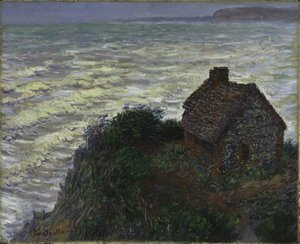
- House of the Customs Officer, Varengeville, about 1870 - Claude Monet
- Le Stryge, 1853 - Charles Meryon
- Untitled, 1960 - Hedda Sterne
The depth of the collection allows for a study of how light and form have been interpreted across centuries. To stand before these objects is to witness the development of Western art through its most fundamental elements.
The Arthur M. Sackler Museum
The Arthur M. Sackler Museum provides a window into the artistic traditions of Asia, the Islamic world, and the ancient Near East. Within this space, the focus shifts toward the delicate precision of Chinese calligraphy and the quiet presence of Japanese prints. These objects exist as physical traces of long-standing aesthetic practices, offering a direct encounter with the hand of the maker across different eras and geographies.
The scope of the collection extends into the ancient Near East, where the material remains of past civilizations are held in quiet repose. As part of a larger repository containing approximately 250,000 objects in all media, this museum allows for a study of how form and function have evolved through diverse cultural lenses. The presence of these works invites a slow observation of the subtle variations in line and material that define these traditions.
Masterpieces of the Art Collection
The presence of a work like Claude Monet’s House of the Customs Officer, Varengeville offers a specific encounter with the light of the French coast. Nearby, the atmosphere shifts toward the psychological weight of Charles Meryon’s Le Stryge, created in 1853. These works exist as physical anchors within the galleries, demanding a quiet attention to the way pigment meets the surface.
The collection holds significant examples of Japanese and East Asian traditions that invite a slower pace of observation. Suzuki Kiitsu’s Mount Fuji and Mount Tsukuba from 1835 and his Cranes from 1820 demonstrate a precise command of form. These sit alongside the delicate compositions of Hishikawa Moronobu’s Early Evening at a Yoshiwara Inn, dating to about 1600, and the seasonal clarity found in Tawaraya Sorai’s Autumn Maple Trees from 1700. There is a specific stillness in these pieces that persists through the centuries.
Other works demand a focus on movement and the natural world. Soga Shohaku’s Race at Uji River, dating to 1764, captures a sense of momentum, while Kamisaka Sekka’s Momoyogusa (Flowers of a Hundred Worlds from 1909 provides a study in botanical detail. To stand before these objects is to witness the specificities of different eras and the varied ways artists have translated the world onto a plane.
Research and Scientific Wonder
The institution functions as a center for rigorous inquiry, housing four distinct research centers that support its vast collections. The Straus Center for Conservation and Technical Studies, established in 1928, focuses on the preservation and scientific analysis of objects. This commitment to technical understanding is furthered by the Center for the Technical Study of Modern Art, founded in 2002, and the Archaeological Exploration of Sardis, which has been active since 1958.
At the intersection of art and natural history, the legendary Glass Flowers exist as a singular presence. These botanical models, meticulously crafted by the Blaschka family, offer a precise study of plant life through glass. They represent a rare moment where scientific accuracy and artistic skill converge, providing a physical record of botanical forms that remains constant through the decades.
Visiting the Harvard Art Museums
Located at 32 Quincy Street in Cambridge, Massachusetts, the institution welcomes visitors from Tuesday through Sunday. Admission is free to all. The main building encompasses 204,000 square feet of space, which accommodates public exhibitions, classrooms, and research labs, alongside conservation and other essential functions. Within this structure, approximately 43,000 square feet are dedicated specifically to exhibitions.
The physical presence of the museum allows for a quiet encounter with works that have been preserved through centuries of scholarly care. One might find themselves standing before the delicate precision of Japanese prints or the textured brushstrokes of Impressionist canvases. The scale of the facility provides ample room to move between the different collections housed within the complex.
- Mount Fuji, about 1802 - Tani Bunchō
- Cranes, 1820 - Suzuki Kiitsu
- Autumn Maple Trees, 1700 - Tawaraya Sorai