
Introduction
The 1940s in the United States marked a profound seismic shift in the global art landscape, as the center of creative gravity began to migrate from Europe to American shores. This decade was defined by a tension between the deeply personal and the intensely social, capturing a nation navigating the complexities of World War II and the subsequent dawn of a new, modern era. The artworks of this period reflect a diverse spectrum of human experience, from the intimate, haunting realism of rural life to the explosive, spontaneous energy of emerging abstract movements.
As the world underwent massive geopolitical transformations, American painters sought new visual languages to express the era's anxieties and aspirations. We see this through the meticulous storytelling of illustrators capturing the American spirit, the rhythmic, soulful compositions of the Harlem Renaissance, and the radical departure from traditional form seen in the rise of Abstract Expressionism. These artists did not merely document their time; they redefined the very boundaries of what a canvas could represent, moving from the figurative and narrative toward the purely gestural and emotional.
Today, these works remain vital because they embody the birth of modernism in the Western Hemisphere. They represent the moment when art became a vehicle for raw, individual subconsciousness and a tool for profound social commentary. The following selection highlights ten significant works from this transformative decade, showcasing the mastery of artists who shaped the visual identity of a nation in transition.
Christina's World - Andrew Wyeth
 Christina's World - Andrew Wyeth
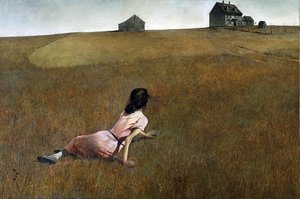
Created in 1948, Christina's World stands as a profound masterpiece of American Realism, capturing a moment of quiet introspection that defines the era's preoccupation with the human condition. The work depicts Anna Christina Olson, a woman who navigated the rugged terrain of Cushing, Maine, by crawling through the fields. Rather than focusing on physical struggle, the composition emphasizes her indomitable spirit and her profound connection to the vast, undulating landscape.
The technical execution is a testament to the meticulous precision characteristic of 1940s American Regionalism. Utilizing oil paints on canvas, the artist employs a textured, layered application to achieve a tactile sense of the dry, golden-brown grasses. The palette is dominated by earthy tones—shades of ochre, beige, and espresso—which harmonize with the muted, hazy sky to evoke a nostalgic and melancholic atmosphere. The composition is defined by strong horizontal lines, from the expanse of the field to the distant farmhouse, creating a sense of isolation and yearning. Through this flattened perspective and diffused lighting, the painting transcends mere landscape, becoming a powerful meditation on loneliness and the quiet strength found within the American rural experience.
Freedom of Speech - Norman Rockwell
 Freedom of Speech - Norman Rockwell
In this evocative oil on canvas, the viewer's eye is immediately drawn to a central figure standing before an attentive assembly. He is captured in a moment of profound communication, holding a book as he addresses a diverse crowd. The composition is anchored by the shared focus of the listeners, several of whom also hold books, reinforcing a powerful narrative of literacy and the dissemination of ideas. Subtle details, such as the presence of ties on either side of the frame, ground the scene in a sense of formal, public importance.
Created in 1943, this work is a quintessential example of American art from the 1940s. As part of Norman Rockwell's iconic Four Freedoms series, it was originally commissioned for The Saturday Evening Post to translate complex political ideals into the visual language of American life during a period of global upheaval. By depicting the fundamental right to speak and read, the painting serves as a poignant symbol of the democratic values that defined the era's cultural and social consciousness.
Freedom to Worship - Norman Rockwell
 Freedom to Worship - Norman Rockwell
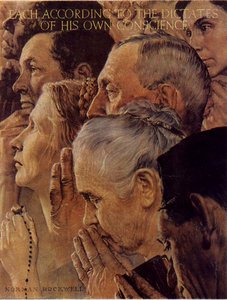
Created in 1943, Freedom to Worship stands as a quintessential example of American narrative realism from the 1940s. As part of the American Scene Painting movement, Norman Rockwell utilizes this composition to explore the spiritual and communal dimensions of the era. The work captures a profound moment of collective devotion within the architectural embrace of an old church, where a diverse assembly of men and women is gathered in a shared act of faith.
The scene is rich with the quiet solemnity of a religious service. Within the wooden pews, individuals are depicted in various states of prayer; some are bowed in quiet contemplation, while others lift their gaze toward the vaulted ceiling. Many congregants hold religious texts or hymnals, emphasizing the ritualistic nature of the gathering. Through his meticulous attention to detail—from the varied attire of the community to the interplay of light within the sanctuary—Rockwell transforms a simple moment of worship into a powerful study of social cohesion and individual reflection during a transformative decade in United States history.
Scene at the Signing of the Constitution of the United States - Howard Chandler Christy
 Scene at the Signing of the Constitution of the United States - Howard Chandler Christy
Completed in 1940, this monumental oil on canvas by Howard Chandler Christy serves as a profound example of American Scene Painting from the 1940s. Commissioned to commemorate the sesquicentennial of the Constitution, the work captures the gravity of the 1787 Philadelphia assembly with theatrical, dramatic lighting. Christy utilizes a chiaroscuro effect, where light emanates from large windows to illuminate the faces and hands of the delegates, casting the periphery into deep, meaningful shadows. This technique creates a palpable sense of three-dimensional space within the neoclassical hall.
The palette is anchored in warm, earthy tones—rich golds, deep browns, and creams—which are punctuated by the symbolic reds, whites, and blues of the American flags. Such a sophisticated use of color and Academic Realism highlights the intricate textures of silk, velvet, and wool worn by the figures. Through an expansive, wide-angle composition, Christy depicts a crowded gathering of delegates, including Benjamin Franklin and Alexander Hamilton, frozen in a moment of intense dialogue and solemnity. The painting stands as a masterwork of historical storytelling, bridging the eighteenth-century political foundation with the mid-twentieth-century American aesthetic.
Alchemy - Jackson Pollock
 Alchemy - Jackson Pollock
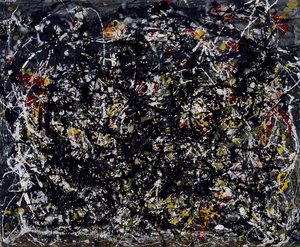
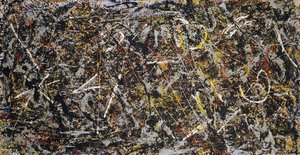
Upon first encounter, the eye is met by a dense, rhythmic web of interlacing lines and splatters that seem to vibrate with kinetic energy. Layers of black, white, yellow, red, and blue enamel create a complex, non-hierarchical composition where no single focal point dominates. This intricate network of drips and pours produces a profound sense of depth and texture, as the glossy finish of the enamel catches the light, emphasizing the physical presence of the medium.
Created in 1947, Alchemy stands as a definitive example of American art from the 1940s, marking the era when the center of the art world shifted toward the revolutionary spirit of Abstract Expressionism. By eschewing the easel to work directly on the floor, Jackson Pollock transformed the act of painting into a physical, performative dance. This work captures the decade's departure from traditional representation, replacing structured forms with a visceral, spontaneous language of pure movement and material transformation. It remains a monumental testament to the era's pursuit of raw, subjective truth through the radical innovation of the drip technique.
There Were Seven in Eight - Jackson Pollock
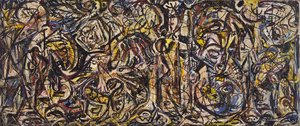 There Were Seven in Eight - Jackson Pollock
Created in 1945, "There Were Seven in Eight" stands as a visceral gateway into the turbulent heart of Abstract Expressionism, a movement that defined the American avant-garde during this decade. This masterpiece by Jackson Pollock represents a moment where the boundaries of traditional painting dissolved, replaced by a raw, unbridled energy. As a quintessential work of the 1940s, it captures the era's shift toward exploring the subconscious through physical, gestural action.
Pollock’s revolutionary approach transformed painting into a rhythmic performance. Eschewing the easel, he utilized his signature drip painting method, manipulating layers of enamel, casein, and oil to create a complex interplay of textures. The composition lacks a central focal point, employing an "all-over" technique that draws the eye into a labyrinth of dark blues, blacks, and reds. Amidst this controlled chaos, sudden flashes of yellow and white emerge like light breaking through a storm. Influenced by Jungian psychoanalytic theories, the work serves as a profound exploration of psychological landscapes, where thick splatters and translucent veils collide in a dance of gravity and intention.
Hunting for water - Grandma Moses
 Hunting for water - Grandma Moses
Created in 1948, Hunting for water represents a fascinating departure from the nostalgic, vibrant rural landscapes typically associated with Grandma Moses. While her folk art often celebrates the idyllic simplicity of farm life, this work serves as a stark, documentary-style exploration of human labor and the physical restructuring of the earth during the mid-20th century. As a piece dating from the 1940s, it captures the era's focus on infrastructure and the industrial push toward modernization.
The composition utilizes a high-angle perspective, looking down into a deep, excavated trench that dominates the frame. The scene is characterized by a complex arrangement of textures, from the uneven mounds of churned dirt to the rigid, geometric lines of wooden scaffolding and brickwork. Key visual elements include:
- Long, diagonal pipes that act as leading lines, pulling the gaze into the depth of the excavation.
- A central brick structure, providing a focal point of order amidst the surrounding chaos.
- The presence of several men positioned at different levels, which provides a sense of scale and human purpose to the manual toil.
The lighting is natural and diffused, lending a journalistic quality to the work that emphasizes realism over romanticism.
Winter Fields - Andrew Wyeth
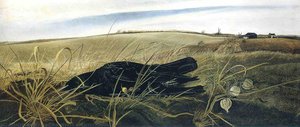 Winter Fields - Andrew Wyeth
Upon first glance, the viewer is met with a stark and melancholic scene: a single dead crow resting amidst the tall, desiccated grasses of a desolate field. The composition is defined by strong horizontal lines and a muted, earthy palette of browns, tans, and subtle blues, all under a soft, diffused light that suggests an overcast winter day. This sense of quiet desolation is heightened by the meticulous rendering of textures, where the scratchy, brittle quality of the dry vegetation feels almost tactile against the stillness of the fallen bird.
As a quintessential work from the 1940s, this piece reflects the profound psychological landscape of the era. Created in 1942, Winter Fields captures the somber mood of a world gripped by the anxieties of the Second World War. Through this minimalist yet powerful depiction of mortality and the harshness of nature, Wyeth utilizes the precision of American Realism to transform a simple rural scene into a meditative study of loss and isolation. The work stands as a significant example of how mid-century American artists navigated the tension between the natural world and the heavy emotional currents of their time.
Onement I - Barnett Newman
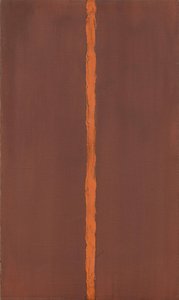 Onement I - Barnett Newman
Completed in 1948, Onement I stands as a foundational pillar of the Color Field movement and a profound emblem of Abstract Expressionism. This work represents a pivotal moment in the evolution of American art during the 1940s, as artists like Barnett Newman moved away from surrealist influences to seek a visual language capable of articulating the existential anxieties of the post-war era. Through this piece, Newman transitioned toward an exploration of pure perception, crafting a meditative space where color and form converge to touch the sublime.
The composition is a masterclass in radical simplification, utilizing oil on linen to establish a striking, dualistic atmosphere. The artist employed meticulous masking techniques to delineate two distinct zones: a deep, resonant maroon that anchors the lower portion, and a vibrant, radiating orange-red emerging from the upper section. This horizontal division establishes spatial relationships that transcend traditional perspective. The tension created where these colors meet—highlighted by a singular, striking red line against a walnut-toned background—invites a contemplative experience, marking a departure from representation toward the monumental power of color and scale.
Migration Series No.11: Food had doubled in price because of the war - Jacob Lawrence
 Migration Series No.11: Food had doubled in price because of the war - Jacob Lawrence
Jacob Lawrence’s Migration Series No.11: Food had doubled in price because of the war is a profound testament to the social shifts defining American life in the 1940s. As part of his monumental sixty-part cycle documenting the Great Migration, this work captures the quiet, heavy tension of wartime scarcity. The piece belongs to this decade's American canon through its urgent, narrative-driven approach to the African-American experience during a period of massive demographic movement.
The composition utilizes a sophisticated, flattened perspective, a hallmark of Lawrence’s dynamic cubist style. A central female figure leans over a dark green table, her silhouette defined by bold, graphic shapes. Beside her, a small child watches, adding a layer of domestic vulnerability to the scene. The palette is dominated by deep teals, earthy browns, and muted reds, which are sharply punctuated by bright yellow stripes on a cloth and the singular, atmospheric glow of a small candle flame. Executed in tempera on hardboard, the work possesses a matte, opaque quality where color functions as a structural element, emphasizing the rhythmic patterns and emotional weight of the struggle for survival.
Conclusion
The American art of the 1940s represents a profound cultural pivot, capturing a nation caught between the nostalgic intimacy of regionalism and the explosive, chaotic energy of the burgeoning abstract expressionist movement. From the quiet, psychological landscapes that define the American spirit to the bold, rhythmic compositions that signaled a new era of modernism, these works collectively mapped the complexity of a decade in transition. Whether through the meticulous storytelling of portraiture or the raw, visceral application of paint, these artists redefined the visual language of the United States.
At Mus3ums.com, we invite you to bring this transformative era into your own space. Our master artists specialize in creating museum-quality, hand-painted oil reproductions that preserve the authentic texture and soul of these mid-century masterpieces. You can explore the breadth of this era by browsing our full collection and find the perfect piece to live with your collection for generations.


