Introduction
The 1980s in the United States marked a period of profound cultural friction and explosive creativity, where the boundaries between high art and popular culture began to dissolve. As the nation navigated a decade of intense consumerism, urban transformation, and shifting social identities, the art produced during this era became a vibrant, often provocative mirror of a changing society. From the neon-soaked energy of Pop Art's evolution to the raw, gestural urgency of Neo-Expressionism, the decade was defined by a restless desire to redefine what an image could represent.
This era saw a fascinating tension between the polished, mass-produced aesthetics of commercial media and the gritty, deeply personal narratives of identity and street culture. Artists moved between the meticulous, graphic precision of comic-inspired motifs and the spontaneous, layered textures of neo-expressionist canvases. It was a time when the canvas became a site for social commentary, exploring themes of race, celebrity, and the very nature of the image in an increasingly media-saturated world.
Today, these works remain vital because they captured the pulse of a turning point in modern history. They represent the moment when the visual language of the street met the institutional prestige of the gallery, creating a legacy that continues to influence contemporary painters and digital creators alike. The following selection highlights ten significant works from this decade, showcasing the diverse voices of American masters who transformed the canvas into a battlefield of color, symbol, and profound cultural meaning.
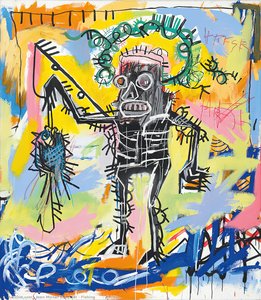
Fishing Fish - Jean Michel Basquiat
Created in 1981, Fishing Fish serves as a quintessential example of the raw, frenetic energy that defined American Neo-Expressionism during the 1980s. In this composition, a central figure stands upon a shoreline, gripping a large fish in one hand and a pair of heavy scissors in the other. The man’s face is obscured by thick layers of paint, creating a detached, mask-like expression that heightens the work's dramatic tension. Scattered throughout the coastal scene, several birds are positioned in various states of flight or rest, adding a sense of movement to the static posture of the subject.
The technique is characterized by a tactile, layered approach, utilizing scratching, dripping, and collage-like applications to build a complex surface. This method results in a palette of direct, distinct pigments that define the anatomy of the fish and the sharp edges of the scissors against a putty-toned background. The blurred boundaries between the sand, sea, and sky reflect the decade's departure from polished technical perfection, favoring instead a chaotic, symbolic language that blends street-inspired graffiti with profound social commentary and anatomical interest.
Bird on Money - Jean Michel Basquiat
 Bird on Money - Jean Michel Basquiat
Created in 1981, Bird on Money serves as a profound testament to the Neo-Expressionist movement that defined the visual landscape of the United States in the 1980s. This work functions as a visceral tribute to the legendary jazz musician Charlie Parker, whose nickname "Bird" is central to the piece's identity. Basquiat, who frequently utilized jazz as a rhythmic foundation for his practice, translates the improvisational spirit of bebop into a frenetic, layered visual language.
The composition is anchored by a sharply outlined bird, rendered in a stark palette of black and white with striking red accents and a prominent, watchful eye. This central figure appears to float within a chaotic, energetic field of yellow, blue, and red splashes. The artist employs a raw, improvisational technique using acrylic and oil on canvas, integrating textual elements such as "PARIS" and "MONEY" alongside numbers like "9" and "10." These scribbles and markings create a sense of movement and social layering, reflecting the complex intersection of street-inspired graffiti and high-art symbolism characteristic of this era.
Self-Portrait (Camouflage) - Andy Warhol
 Self-Portrait (Camouflage) - Andy Warhol
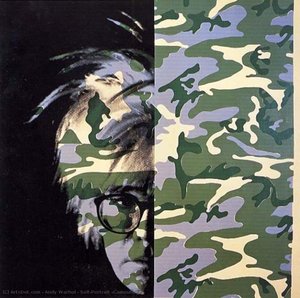
Created in 1986, Self-Portrait (Camouflage) stands as a definitive example of American Pop Art from the 1980s. This striking diptych utilizes the silkscreen printing technique to juxtapose the highly recognizable visage of Andy Warhol with a complex military camouflage pattern. By overlaying his iconic features and signature glasses against shades of green and blue, Warhol explores the tension between celebrity visibility and the concept of concealment. This work perfectly captures the decade's fascination with the intersection of mass media, identity, and the blurring lines between high art and popular culture.
The composition is divided into two distinct halves, utilizing the flat, graphic repetition characteristic of Warhol's mechanical reproduction methods. While the left side presents a stylized portrait, the right side dissolves into an abstract pattern, suggesting a persona that is simultaneously hyper-visible and shrouded in mystery. This duality reflects the broader artistic shifts of the 1980s, where artists increasingly interrogated the nature of fame and the artificiality of the image in an era dominated by rapid media consumption.
Gothe - Andy Warhol
 Gothe - Andy Warhol
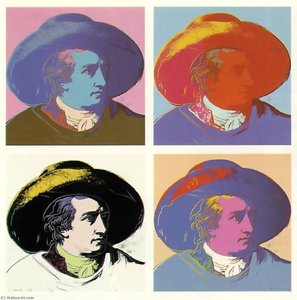
In 1982, Andy Warhol expanded the boundaries of Pop Art by turning his gaze toward the masters of the past. His work Gothe serves as a quintessential example of American art from the 1980s, a decade where the intersection of high culture and mass media became a central theme. This screenprint is a bold reinterpretation of Johann Heinrich Tischbein’s 1787 portrait of the German literary icon Johann Wolfgang von Goethe.
Warhol’s approach is defined by a dramatic, modern cropping that strips away the original Romantic landscape of Roman ruins, focusing instead on the subject's head and shoulders. By presenting the portrait in a 2x2 grid of four distinct color variations, Warhol utilizes a mechanical, graphic technique that mirrors the aesthetics of celebrity mugshots or promotional imagery. The palette relies on flat blocks of vibrant, contrasting colors and bold lines, eschewing traditional shading to achieve a sense of intentional flatness. This stylistic choice highlights the 1980s fascination with multiplicity and the transformation of historical figures into contemporary icons through the lens of industrial-inspired silk-screen printing.
Lovers - Andrew Wyeth
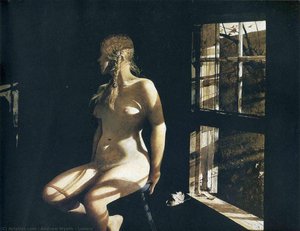 Lovers - Andrew Wyeth
Upon viewing Lovers, the eye is immediately drawn to the dramatic chiaroscuro effect created by a sharp beam of sunlight streaming through a window. This intense illumination strikes the luminous skin of a nude woman, casting her in stark contrast against the deep, shadowed recesses of a quiet domestic interior. The composition utilizes a muted palette of earthy browns, tans, and creams, where the organic curves of the human form are framed by the rigid, rectangular geometry of the window and architectural elements.
Executed in 1981, this work is a quintessential example of American artworks of the 1980s, showcasing the enduring mastery of Andrew Wyeth during this decade. As a leading figure in American realism, Wyeth utilizes this period to explore themes of vulnerability and introspection. The painting captures a profound sense of stillness and melancholy, characteristic of his late-career studies of light and the human figure. Through meticulous tonal gradations and a focus on texture, Wyeth transforms a private, intimate moment into a powerful meditation on solitude and light.
Forest scene - Roy Lichtenstein
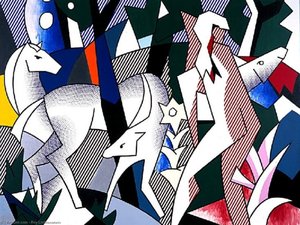 Forest scene - Roy Lichtenstein
Created in 1980, Forest Scene stands as a definitive example of American Pop Art during the 1980s, a decade where the boundaries between high art and commercial media continued to dissolve. In this work, Roy Lichtenstein reimagines the organic majesty of a woodland through a highly stylized, industrial lens. Rather than employing traditional chiaroscuro to create depth, the artist utilizes his signature visual language: bold black outlines and a palette dominated by primary reds, blues, and whites. This approach flattens the perspective, transforming a natural landscape into a graphic, cinematic composition.
The scene features horses and human figures moving through a landscape of trees and bushes, all rendered with the precision of a comic book panel. By employing techniques reminiscent of Ben-Day dots, Lichtenstein replaces nuanced shading with flat planes of color and rhythmic patterns. This method captures the energetic spirit of the era, reflecting a modern, media-saturated world where even the most primal elements of nature—the forest and its inhabitants—are filtered through the vibrant, structured aesthetics of mass communication.
Coast Village - Roy Lichtenstein
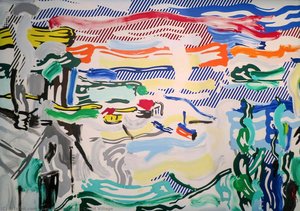 Coast Village - Roy Lichtenstein
Created in 1987, Coast Village stands as a definitive example of American Pop Art from the 1980s, showcasing Roy Lichtenstein’s mastery over graphic simplification. This work exemplifies the decade's continued fascination with the intersection of high art and mass media, reimagining a serene seaside vista through a highly stylized, monumental lens. The composition captures a tranquil beach scene, where boats float upon a body of water and figures dot the shoreline, yet it avoids the traditional textures of landscape painting.
Lichtenstein’s signature technique is on full display here, utilizing bold outlines and a structured color palette to transform a coastal landscape into a rhythmic, graphic arrangement. By employing his iconic approach to Ben-Day dots, he creates an illusion of shading and depth while maintaining a deliberate flatness that challenges classical perspective. This piece represents a significant moment in his career, where the spontaneous energy of a beach environment is distilled into a precise, controlled visual language. It remains a quintessential representation of the 1980s American aesthetic, blending the calmness of a maritime subject with the striking, high-contrast impact of the Pop Art movement.
Camas para Sueños - Carmen Lomas Garza
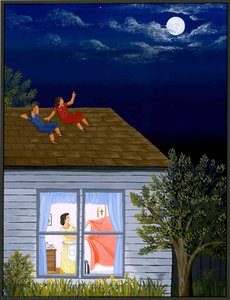 Camas para Sueños - Carmen Lomas Garza
Created in 1985, Camas para Sueños is a poignant example of how American artists of the 1980s utilized folk-inspired aesthetics to explore cultural identity. Through the medium of gouache on paper, Carmen Lomas Garza captures a quiet, nostalgic moment in South Texas, blending the domestic sphere with celestial aspiration. The composition employs a flattened perspective, a hallmark of her style that brings the viewer into an immediate, intimate connection with the subjects.
The palette is dominated by deep Prussian Blue, which defines the expansive night sky where two sisters rest upon the roof, dreaming under the moon and stars. This celestial realm contrasts with the warm, grounded interior where a woman sits near a window, tending to the rhythms of the home. Through her signature monitos—simplified, expressive figures—Garza documents the intersection of Mexican-American heritage and everyday life. The work serves as a visual bridge between the earthly realities of family tradition and the boundless potential of the next generation, making it a significant representative of the decade's focus on personal and cultural narratives.
Genesis Creation Sermon V: And God Created All the Fowls of the Air and Fishes of the Seas - Jacob Lawrence
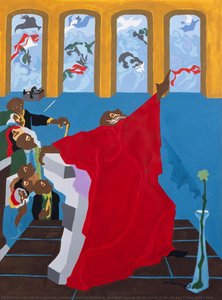 Genesis Creation Sermon V: And God Created All the Fowls of the Air and Fishes of the Seas - Jacob Lawrence
Created in 1989, this work serves as a profound example of American art from the 1980s, showcasing how late-century masters continued to weave complex social narratives into spiritual themes. In this panel from the Genesis Creation Sermon series, Jacob Lawrence utilizes a dynamic, expressionistic approach to translate biblical scripture into a visual symphony of movement. The composition is anchored by a central preacher in striking red robes, whose raised arms project a sense of divine revelation and communal energy.
Lawrence’s signature style—characterized by vibrant, simplified shapes and a rhythmic, almost jazz-like cadence—is on full display here. The palette is punctuated by the deep tones of the scene, contrasted against the lively presence of birds in flight and fish navigating the waters. By integrating these elements, Lawrence moves beyond mere illustration to create a monumental cultural document. The work captures the essence of the 1980s through its bold, graphic energy, reflecting a sophisticated intersection of religious fervor and the historical chronicles of the African-American experience.
Genesis Creation Sermon IV: And God Created the Day and the Night and God Creatied and Put Stars in the Skies - Jacob Lawrence
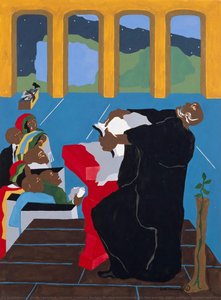 Genesis Creation Sermon IV: And God Created the Day and the Night and God Creatied and Put Stars in the Skies - Jacob Lawrence
In this 1989 masterpiece, Jacob Lawrence captures a profound intersection between the divine and the communal, a hallmark of his late-career mastery. As a seminal figure in American modernism, Lawrence utilizes a vibrant, simplified geometry to translate the cosmic scale of the Book of Genesis into an intimate, rhythmic experience. The composition is anchored by a monumental preacher figure whose expressive, theatrical gestures echo the powerful oral traditions of Harlem’s religious sermons, grounding the celestial narrative in the lived experience of Black America.
The artwork’s spiritual resonance is heightened by the juxtaposition of deep, nocturnal tones and luminous hues. Through arched windows, the viewer glimpses a sky transformed by the emergence of stars and the duality of day and night, mirroring the cosmic drama within the room. Surrounding the central figure, a community of individuals is gathered in collective awe, their presence creating a sense of togetherness. Through this sophisticated use of color and form, Lawrence transforms a biblical event into a visceral symphony of light and shadow, reflecting the profound spiritual depth characteristic of significant American works from the 1980s.
Conclusion
The American art scene of the 1980s was a vibrant collision of high culture and street energy, where the boundaries between fine art and popular iconography were perpetually challenged. From the neon-soaked pop sensibilities of Warhol and Lichtenstein to the raw, rhythmic neo-expressionism of Basquiat, these works captured a decade of profound social and aesthetic transformation. Whether through the intimate, haunting realism of Wyeth or the bold, narrative storytelling of Lawrence and Garza, this era redefined how identity and modern life could be translated onto canvas. Each piece serves as a vital pulse of a decade that refused to be quiet, leaving behind a legacy of visual complexity and stylistic rebellion.
At Mus3ums.com, we invite you to bring this transformative era into your own space. You can explore our full collection to find the perfect piece for your home or gallery. Our master artists specialize in creating museum-quality, hand-painted oil reproductions that capture the authentic texture, brushwork, and soul of these iconic 1980s masterpieces, allowing you to live with the energy of American art history every day.