
Introduction
The final decade of the nineteenth century in the United States marked a profound era of artistic transition, where the rigid boundaries of traditional academicism began to dissolve into the vibrant textures of modernism. As the nation underwent rapid industrialization and urban expansion, American painters sought new ways to capture the shifting light of a changing landscape and the intimate, psychological nuances of private life. This period was defined by a tension between the old world and the new, as artists moved away from purely historical subjects toward the immediate, sensory experiences of the present moment.
During the 1890s, the American aesthetic was shaped by a diverse array of movements, from the delicate, light-filled compositions of Impressionism to the rugged, dramatic realism of maritime and frontier scenes. Artists like Mary Cassatt and Winslow Homer were instrumental in this evolution, bringing a sophisticated understanding of color and human emotion to the forefront of the national consciousness. Whether exploring the quiet domesticity of a parlor or the untamed power of the Atlantic coast, these works reflect a culture grappling with its own identity at the dawn of a new century.
Today, these paintings remain vital because they capture the very essence of a transformative era. They serve as visual chronicles of a society in motion, offering a timeless connection to the textures, fashions, and landscapes of a bygone age. The following selection highlights ten significant works from this decade, showcasing the mastery and stylistic diversity that defined American art during this pivotal decade.
The Child's Bath - Mary Cassatt
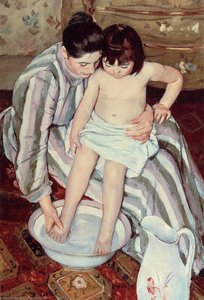 The Child's Bath - Mary Cassatt
Painted in 1893, this captivating work by Mary Cassatt serves as a profound testament to the American contribution to the Impressionist movement during the 1890s. The scene captures a tender, private moment of domesticity, where a woman gently washes the feet of a young child in a porcelain bowl. Cassatt moves away from grand historical narratives to elevate the quiet, nurturing bonds of motherhood into the realm of high art.
The composition is defined by a sophisticated use of flattened perspectives and organic, flowing lines, reflecting the influence of Japanese ukiyo-e prints. Through a harmonious palette of soft tones and warm, diffused light, Cassatt emphasizes the textures of draped fabrics and smooth skin. Her brushwork is confident and layered, creating a sense of immediacy and grace. Rather than focusing on vast spatial depth, the artist utilizes a shallow perspective to draw the viewer into the intimate, serene interaction between mother and child. This masterpiece exemplifies the decade's shift toward observing the beauty of the everyday, transforming a simple household ritual into a timeless exploration of maternal care and innocence.
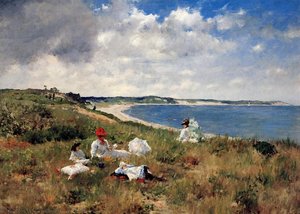
Idle Hours - William Merritt Chase
Completed in 1894, Idle Hours serves as a quintessential example of the American Impressionist movement that flourished during the 1890s. Painted by William Merritt Chase, this oil-on-canvas work captures a serene moment of leisure on the shores of eastern Long Island. The composition is masterfully balanced, leading the viewer from a foreground of textured, grassy dunes toward a tranquil beach where figures are engaged in quiet relaxation. The expansive sky, filled with billowing clouds, dominates the upper canvas, creating a sense of atmospheric depth through a flattened, Impressionistic perspective.
Chase utilizes a technique characterized by loose, broken brushstrokes that prioritize the fleeting effects of light and movement over rigid detail. The palette is a sophisticated blend of earthy greens and browns in the vegetation, contrasted against the soft blues and whites of the sea and sky. This emphasis on capturing subjective perception and the tactile qualities of nature is a defining hallmark of United States artworks from the 1890s, marking a period where American painters moved toward a more spontaneous and light-drenched aesthetic.
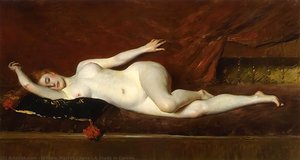
A Study in Curves - William Merritt Chase
Created in 1890, A Study in Curves stands as a captivating testament to the mastery of William Merritt Chase, a leading figure in the American Impressionist movement. This work exemplifies the artistic evolution of United States art during the 1890s, showcasing a sophisticated command over form, light, and the expressive potential of oil paint. The composition is dominated by a reclining nude female figure, whose body stretches diagonally across the canvas in a dynamic, almost unsettling pose. This arrangement creates a sense of movement and tension, drawing the viewer’s eye along the fluid, organic lines of her silhouette.
Chase utilizes a dramatic chiaroscuro effect, employing strong lighting and deep shadows to accentuate the three-dimensionality of the figure. The background remains dark and indistinct, focusing all attention on the rich, layered textures of the subject. Through thick impasto strokes and careful tonal variations, the artist captures a sense of languor and introspection. The piece balances academic precision with an Impressionist sensibility, emphasizing the tactile materiality of the paint to evoke themes of beauty and the human condition.
An Indian Hunting Party - Edwin Lord Weeks
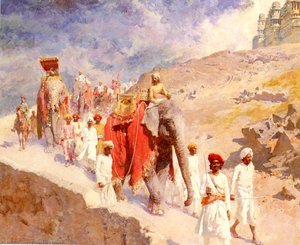 An Indian Hunting Party - Edwin Lord Weeks
Created in 1899, An Indian Hunting Party serves as a masterful example of how American artists of the 1890s expanded their horizons through the lens of Orientalism. Edwin Lord Weeks, an American painter who traveled extensively through Asia, captures a ceremonial procession that transports the viewer to a historical South Asian landscape. This work exemplifies the decade's fascination with exoticism and the meticulous documentation of distant cultures through a Western perspective.
The composition is anchored by a majestic elephant, its presence signifying status and authority as it carries a prominent figure through the terrain. Surrounding this central focus, a procession of men in vibrant red and white attire moves through a landscape of rocky paths and distant, hazy fortresses. Weeks employs a technique characterized by loose, impressionistic brushwork and a rich, textured surface that prioritizes atmosphere and light over rigid detail. The color palette is deeply evocative, utilizing warm earthy tones, striking reds, and luminous golds to create a sense of movement and ritualistic grandeur. Through this layered application of oil on canvas, Weeks achieves a dreamlike, atmospheric quality that defines the era's approach to grand-scale storytelling.
A Wall, Nassau - Winslow Homer
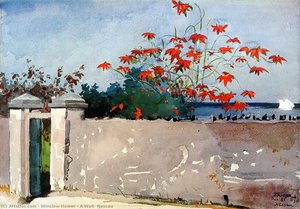 A Wall, Nassau - Winslow Homer
Created in 1898 during his second visit to the Bahamas, A Wall, Nassau stands as a testament to Winslow Homer's mastery of the watercolor medium. This piece is a quintessential example of American art from the 1890s, showcasing the artist's ability to transition from powerful maritime realism to the more ethereal, atmospheric qualities of Impressionism. The composition is defined by a weathered, textured wall that serves as a structural anchor, dividing the scene into horizontal bands of sky, architecture, and the distant sea.
Homer utilizes a sophisticated interplay of light and shadow to evoke a serene yet slightly melancholic mood. The palette is dominated by muted, earthy tones and rosy browns, which are punctuated by the vibrant, organic shapes of red flowers blooming against deep green foliage. Through fluid, expressive brushstrokes and wet-on-wet washes, the artist captures the essence of the coastal landscape, prioritizing the fleeting quality of light and the passage of time over rigid detail. The result is a captivating study of how man-made structures harmonize with the lush, untamed beauty of the tropics.
Gloucester Harbor - Willard Metcalf
 Gloucester Harbor - Willard Metcalf
Willard Metcalf’s 1895 work, Gloucester Harbor, serves as a quintessential example of American Impressionism emerging from the United States during the 1890s. This oil on canvas captures a panoramic view of the Massachusetts port, utilizing an elevated perspective to balance the rugged, lush greenery of the foreground with the expansive maritime activity of the shoreline. The composition is defined by a rhythmic interplay of horizontal lines—the docks, rooftops, and water—interrupted by the vertical masts of sailboats and a distant church steeple.
Metcalf’s technique emphasizes the sensory experience of light and atmosphere over rigid anatomical precision. He employs short, broken brushstrokes that allow colors to blend optically, a hallmark of the Impressionist movement. The palette is dominated by cool blues and greens that reflect the shimmering water, punctuated by warmer tones on the building facades. This approach creates a sense of tranquil, diffused light, suggesting the soft atmosphere of an overcast morning. By prioritizing the fleeting qualities of light and the organic shapes of the New England coast, Metcalf’s work exemplifies the shift toward capturing immediate, atmospheric impressions that defined American landscape painting in this decade.
The fox hunt pensylvania academy of the fine arts - Winslow Homer
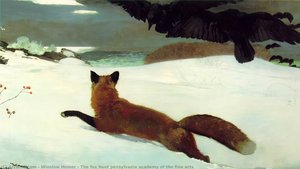 The fox hunt pensylvania academy of the fine arts - Winslow Homer
Created in 1893, The Fox Hunt stands as a powerful testament to Winslow Homer’s mastery of American Realism, a movement that defined much of the artistic output from the United States in the 1890s. This large-scale oil painting captures a moment of intense natural drama, centering on a fox caught in mid-leap. The composition is defined by tension and movement, as the fox’s dynamic form is contrasted by the presence of a large raven hovering overhead, evoking the primal themes of survival and the raw force of the natural world.
Homer utilizes a sophisticated, painterly approach, employing loose brushstrokes that prioritize expressive energy over rigid detail. The color palette is dominated by a cold, stark arrangement of blues, grays, and whites, which heightens the wintry atmosphere. This cool environment is punctuated by warm, organic accents—specifically the red of the fox—which draws the eye immediately to the central action. Through a flattened perspective and a focus on atmospheric light, Homer transforms a scene of wildlife into a profound reflection on the harshness and beauty of the wilderness.
Front door to the Henry O. Havemeyer house, New York - Louis Comfort Tiffany
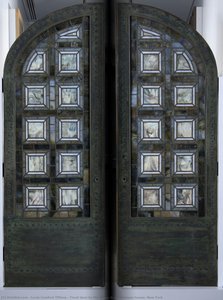 Front door to the Henry O. Havemeyer house, New York - Louis Comfort Tiffany
Created in 1891, this masterpiece by Louis Comfort Tiffany serves as a definitive example of American decorative arts from the 1890s. Designed for the Henry O. Havemeyer house in New York, these ornate doors represent a transformative threshold where architectural restraint meets the exuberant fluidity of the Art Nouveau movement. While the building's exterior favored Richardsonian austerity, Tiffany’s work introduced a luminous, ethereal dimension to the entrance.
The composition is a sophisticated symphony of curvilinear lines and organic motifs, featuring intricate floral and foliage patterns that appear to unfurl within the glass. Utilizing his revolutionary approach to stained glass, Tiffany achieved a remarkable depth of color and texture. The interplay between the rigid, geometric metal framework and the shimmering, iridescent glass creates a sense of balanced harmony. This work exemplifies the decade's shift toward integrating fine art into functional architecture, turning a mere entryway into a breathtaking display of light and color.
The Broncho Buster - Frederic Remington
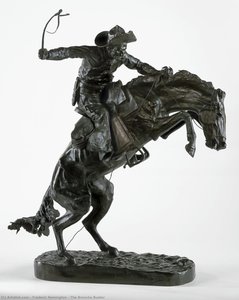 The Broncho Buster - Frederic Remington
Created in 1895, The Broncho Buster stands as a definitive example of American Realism from the 1890s. This bronze sculpture by Frederic Remington captures a high-stakes moment of rodeo action, portraying a cowboy in the midst of roping a bucking horse. The work exemplifies the decade's fascination with the rugged spirit of the American West, moving away from romanticized myth-making toward a more visceral, photographic intensity.
Remington’s mastery is evident in the intricate textures achieved through the bronze casting process. The sculpture utilizes a palette of deep browns and blacks, which emphasizes the anatomical precision of the horse's musculature and the strained sinews of the rider. The interplay of light across the dark metal creates dramatic highlights and shadows, simulating the grit of kicked-up dust and the coarse texture of leather and fur. Through this dynamic composition, Remington transforms a fleeting struggle into a permanent study of movement, embodying the tension between human skill and the untamed energy of the frontier.
The Charge of the Rough Riders - Frederic Remington
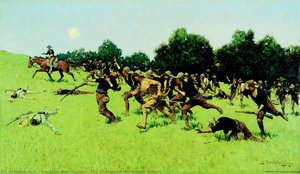 The Charge of the Rough Riders - Frederic Remington
Painted in 1898, The Charge of the Rough Riders stands as a monumental vision of frontier valor, serving as a quintessential example of American art from the 1890s. Frederic Remington, a preeminent realist of the Old West, captures the raw energy of Theodore Roosevelt’s expedition to Cuba during the Spanish-American War. This work transcends mere military documentation, utilizing an impressionistic realism to prioritize the visceral atmosphere of the cavalry charge over static photographic accuracy.
The composition is defined by a sense of urgent dynamism. Remington employs energetic, thick brushstrokes to depict at least thirteen horses and riders galloping toward the viewer, their forms caught in various stages of intense action. The men, some brandishing firearms, emerge from a landscape characterized by muted tones and dramatic movement. By blending the grit of combat with a powerful, emotive narrative, Remington captures the determination of the Rough Riders. This piece exemplifies the era's fascination with national identity and the heroic spirit, cementing its place among the significant American works produced during this transformative decade.
Conclusion
The American art of the 1890s represents a profound era of transition, where the intimate domesticity of Mary Cassatt met the rugged, sweeping landscapes of Winslow Homer and the atmospheric light of Edwin Lord Weeks. These works collectively capture a nation in flux, moving between the quietude of private moments and the grand, expanding vistas of a new century. Whether through the delicate textures of Impressionism or the bold, narrative strength of American Realism, this decade left an indelible mark on the visual language of the United States.
At Mus3ums.com, we invite you to bring this transformative era into your own space. Our master artists specialize in creating museum-quality, hand-painted oil reproductions that preserve the soul, texture, and vibrant brushstrokes of these historical masterpieces. You can explore the breadth of this era by browsing our full collection and find the perfect piece to live with your collection for generations.


