


Introduction
The 20th century marked a profound metamorphosis for the visual language of Greece, as artists navigated the complex tension between a deep-rooted classical heritage and the radical avant-garde movements emerging from Western Europe. This era saw a generation of creators moving beyond traditional academicism to explore the essence of light, the geometry of form, and the psychological depths of the Mediterranean landscape. From the surrealist echoes of the early century to the abstract and conceptual shifts of the later decades, these painters redefined what it meant to be a Greek artist in a rapidly modernizing world.
What unites this diverse group is a shared dialogue with their environment—the stark sunlight of the Aegean, the structural rhythm of urban life, and the weight of historical memory. Whether through the lyrical abstraction of Nikos Hadjikyriakos-Ghikas or the profound, often melancholic compositions of Yannis Tsarouchis, the movement was characterized by a constant negotiation between the local and the universal. They did not merely paint scenes; they translated the spirit of a nation undergoing intense social and political transformation into a modern aesthetic vocabulary.
Today, these masters remain vital as they provide a bridge between the ancient past and the contemporary gaze, offering a visual history of how tradition can be dismantled and rebuilt through modernism. Their influence persists in the way we perceive color, space, and identity in the Mediterranean. The following selection highlights ten pivotal figures whose work defines this transformative century, ranging from the pioneers of surrealism to the architects of modern Greek expressionism.
Giorgio de Chirico
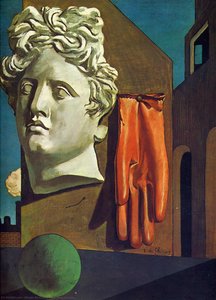 The Song of Love - Giorgio de Chirico
Born in Volos, Greece, in 1888, Giorgio de Chirico occupies a singular position among 20th century Greek painters. Although his career is deeply intertwined with the Italian avant-garde, his formative years in Greece provided a foundational connection to the Mediterranean classical atmosphere that would define his aesthetic. His early training at the Athens Polytechnic allowed him to master the precise representation of form, a discipline that he later subverted to create the haunting, dreamlike landscapes of the Metaphysical art movement.
His 1914 masterpiece, The Song of Love, serves as a profound example of this stylistic evolution. In this work, de Chirico juxtaposes classical-style busts with unexpected, symbolic objects, creating a sense of profound mystery. The composition utilizes soft, diffused lighting and deep shadows to transform everyday architectural elements into a stage for the subconscious. By blending the tangible reality of his Greek and Italian heritage with a sense of melancholic stillness, de Chirico moved beyond mere representation, influencing generations of Surrealists through his ability to evoke the enigmatic and the irrational.
Yannis Kounellis
 Untitled (Athena) - Yannis Kounellis
Born in Piraeus in 1936, Yannis Kounellis emerged as a transformative figure within the landscape of 20th century Greek painters. His artistic evolution was deeply shaped by the socio-political upheavals of the Greek Civil War, an experience that instilled in him a lifelong preoccupation with societal fracture and human resilience. After moving to Rome in 1956, he moved beyond the traditional confines of the Accademia di Belle Arti, transitioning from the gestural language of Abstract Expressionism toward the radical tenets of Arte Povera.
Kounellis became renowned for disrupting the boundaries of fine art by incorporating raw, found materials—such as street signs, newspapers, and even live animals—into his compositions. His work sought to capture the chaotic pulse of modern existence rather than merely depicting it. A profound example of this dialogue between history and the present is his 1979 work, Untitled (Athena). In this site-specific installation, Kounellis traced ancient geometric patterns onto a vertical surface and paired a plaster cast of the Apollo Belvedere with fresh flowers. This juxtaposition serves as a powerful meditation on myth, treating classical beauty as a living, breathing memory of nature and culture.
Sergeant Theodore P. Hios Usmc
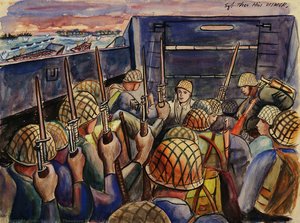 Landing Party - Sergeant Theodore P. Hios Usmc
Born in Greece in 1908, Sergeant Theodore P. Hios USMC represents a profound intersection of Greek heritage and the dramatic experiences of the 20th century. His life was defined by a transition from the battlefield to the studio, moving from the front lines of World War II to the prestigious Art Students League in New York. As a combat photographer for the 4th Marine Division, Hios earned a Bronze Star for his documentation of the Pacific Theater, a background that fundamentally shaped his artistic vision.
A viewer can recognize a work by Hios through its intense, documentary-style realism blended with a painterly fluidity. His compositions often possess a heavy, atmospheric weight, utilizing a sophisticated play of light and shadow to render the textures of military equipment and weathered uniforms. In his representative work, Landing Party (1943), this technique is masterfully applied to capture the grit and anticipation of soldiers on a shoreline. The brushwork carries a sense of urgency, mirroring the chaotic, visceral reality of the combat environments he witnessed in Saipan and Iwo Jima. His legacy remains a powerful testament to how the trauma and camaraderie of war can be transformed into evocative, high-stakes fine art.
Voúla Papaïoánnou
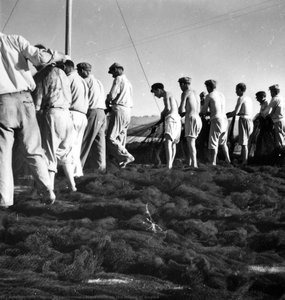 Fishermen on the island of Aegina - Voúla Papaïoánnou
Voúla Papaïoánnou (1898–1990) stands as a vital figure among 20th century Greek painters and visual artists, bridging the gap between technical precision and profound social realism. Born in Lamia and trained at Athens Polytechnic University, her early work focused on the structural elegance of Greek landscapes and architectural monuments. However, her legacy is most deeply defined by her transition into documentary photography during the German occupation of Greece. She moved beyond static aesthetics to capture the raw, pulsing heartbeat of a nation in crisis, documenting the resilience of the Greek spirit through a humanist lens.
In her 1950 work, Fishermen on the island of Aegina, Papaïoánnou demonstrates her mastery of capturing the rhythmic stability of daily labor. This piece, held in the Benaki Museum of Greek Civilization, showcases her ability to find dignity in communal activity. Through a monochromatic intensity, she renders the textures of the sand and the presence of the sea, turning a simple moment of coastal life into a reflective study of human presence. Her work remains an essential social record of the 20th century, immortalizing the quiet strength of the Greek people amidst a period of immense historical transition.
Nikos Hadjikyriakos-Ghikas
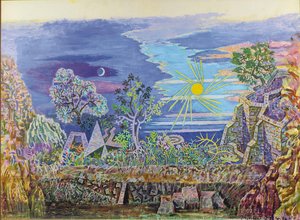
A central figure in the landscape of 20th century Greek painters, Nikos Hadjikyriakos-Ghikas (1906–1994) achieved a rare synthesis of European avant-garde rigor and Mediterranean soul. His journey through the modern era was marked by a profound connection to Paris, where his studies at Académie Ranson and his presence in the French art scene—notably earning the attention of Picasso—helped shape a unique visual language. This international perspective allowed him to bring the structural discipline of Cubism back to his homeland, influencing the Athenian art world through his teaching at the National Technical University of Athens and his involvement with the influential "Armos" group.
His 1942 masterpiece, Kifissia, serves as a luminous testament to this stylistic fusion. In this work, the artist transforms the lush, organic sprawl of the Greek landscape into a rhythmic, geometric dance. Rather than mere depiction, the foliage is sculpted through layers of light and color, creating a sanctuary of structured nature. By blending the architectural stillness of suburban life with a vibrant, pulsating vitality, Hadjikyriakos-Ghikas captured the essence of the Greek spirit during a period of global upheaval, securing his legacy as a pioneer of modern Greek art.
Stylianos Antoniou
 The Light - Stylianos Antoniou
Born in 1926 in Agios Nikolaos, Stylianos Antoniou—widely recognized by his professional name Stephen Antonakos—represents a transformative chapter in the history of 20th century Greek painters and sculptors. His journey began with a foundation in painting during the 1950s, where he engaged with the currents of Abstract Expressionism. However, his artistic evolution was marked by a profound desire to transcend the two-dimensional canvas, seeking instead to manipulate the very essence of space and atmosphere.
The pivotal turning point in his career occurred in 1962, following a chance encounter with the luminous glow of a neon sign. This revelation shifted his focus from traditional pigments to the sculptural poetry of light. By utilizing neon, he was able to define space through pure energy rather than solid mass, creating ethereal lines that interacted directly with their environment. His work, such as the evocative The Light (1997), exemplifies this mastery of the medium, utilizing vibrant hues like cobalt violet to transform architectural voids into immersive experiences. Through this radical shift from canvas to light, Antoniou bridged his Greek heritage with American minimalism, leaving an indelible mark on the mid-to-late 20th-century avant-garde.
Yannis Tsarouchis
 Asleep beneath the fig-tree and a chimney - Yannis Tsarouchis
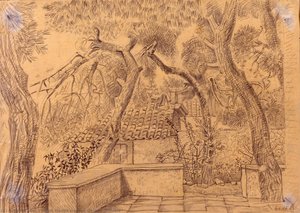
A central figure in the mid-century Athenian art scene, Yannis Tsarouchis (1910–1989) represents the profound evolution of 20th century Greek painters through his unique synthesis of modernism and tradition. After studying at the Athens School of Fine Arts, where he absorbed the nuances of Impressionism and Symbolism, he underwent a transformative shift toward Surrealism in the mid-1930s. This evolution was deeply influenced by the contemplative avant-garde approaches of artists like Giorgio Morandi and Fernand Léger, allowing him to develop a visual language that was both deeply personal and culturally resonant.
His oeuvre is characterized by a dreamlike quality, often populating fantastical landscapes with stylized, enigmatic figures that evoke themes of spirituality and heroism. In his 1965 work, Asleep beneath the fig-tree and a chimney, one can observe his ability to blend reality with the subconscious, inspired by the ethereal clouds and landscapes encountered during his travels. By layering oil paint with watercolor and utilizing rich impasto textures, Tsarouchis created a tactile, psychological depth that remains a hallmark of his contribution to the Greek modernist movement.
Polygnotus Of Thasos
 Cocktail ensemble - Polygnotus Of Thasos
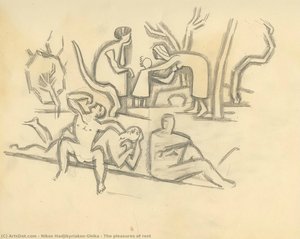
While his origins lie in the classical era, the legacy of Polygnotus of Thasos remains a foundational pillar for the 20th century Greek painters who sought to bridge the gap between ancient narrative and modern expression. Born on the island of Thasos and trained by his father, Aglaophon, Polygnotus revolutionized mural art by moving beyond mere decoration toward a profound, character-driven storytelling. His monumental frescoes, such as the Iliupersis (The Sack of Troy) and the Nekyia (Odysseus’ Descent into Hades), introduced a sense of moral weight and psychological depth that transformed the Greek visual language.
His inclusion in this study of 20th century Greek painters is essential because his "primitive" yet highly sophisticated approach to composition and human emotion served as a spiritual precursor to the modernists of the 1900s. Even when viewed through the lens of a contemporary study like the Cocktail ensemble, one perceives a continuity of form and structural elegance that traces back to his mastery of the human silhouette. He remains the "Homer of painters," a figure whose influence on the Greek aesthetic identity persists through the centuries.
Giorgos Rorris
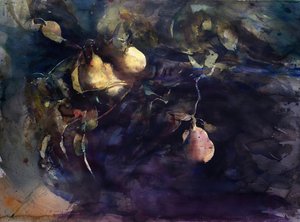 Pears - Giorgos Rorris
Born in the village of Kosmas of Kynouria, Giorgos Rorris represents the evolution of the Greek figurative tradition into the contemporary era. His artistic journey, which began with rigorous training at the Athens School of Fine Arts under masters such as Panagictis Tetsis and Yiannis Valavanides, places him firmly within the lineage of 20th-century Greek painters who bridged classical academic foundations with modern sensibilities. His development reached a pivotal stage in Paris, where he refined his vision at the École Nationale Supérieure des Beaux-Arts, absorbing a sophisticated approach to light and form.
Rorris’s work is characterized by a profound fascination with how the observer internalizes the appearance of the world. Rather than pursuing abstract philosophy, he seeks a sincere revelation of the soul through the physical presence of his subjects. In his representative work, Pears, this is achieved through a masterful command of light and shadow. Using the fluid properties of watercolor, he captures the organic shapes and weight of the fruit, transforming a quiet observation of nature into a tangible sensory experience. His ability to blend technical brilliance with a striking chromatic sensibility allows him to turn simple, everyday objects into windows of deep emotional resonance.
Panagiotis Kalantzis
 Electricity Lighting Contract of Kalavryta Front page - Panagiotis Kalantzis
Representing the contemporary evolution of the 20th-century Greek tradition, Panagiotis Kalantzis brings a unique, multidisciplinary perspective to the nation's artistic landscape. Born in Sparta in 1970, his work emerges from a life defined by the intersection of scientific precision and creative empathy. As a contemporary figure within this century's lineage, Kalantzis bridges the gap between the analytical rigor of medicine and the evocative power of fine art.
His profound understanding of human anatomy, cultivated through extensive medical studies at the University of Athens and Kapodistrian University, as well as a career in orthopedic surgery, informs a visual language deeply rooted in the structure and fragility of the human form. This dual expertise allows him to approach portraiture and landscape with a rare, structural depth. His connection to the Greek identity is further evidenced by his historical ties to the region, as seen in the document Electricity Lighting Contract of Kalavryta Front page, which highlights his family's presence in the administrative and social fabric of Kalavryta during the early 20th century.
Through his evocative explorations of human connection and the Greek landscape, Kalantzis continues to expand the expressive boundaries established by his predecessors in the 20th-century Greek canon.
Conclusion
The evolution of 20th-century Greek art represents a profound dialogue between ancient heritage and the radical shifts of modernism. From the surrealist echoes of Giorgio de Chirico to the lyrical abstractions of Nikos Hadjikyriakos-Ghikas and the soulful compositions of Yannis Tsarouchis, these artists collectively redefined the visual language of their nation. Whether through the structural precision of the Generation of the '30s or the experimental textures of contemporary masters, each painter contributed a unique layer to a rich, multifaceted aesthetic identity that continues to resonate globally.
At Mus3ums.com, we invite you to bring this legacy of Mediterranean light and modern expression into your own living space. Our artisans specialize in creating museum-quality, hand-painted oil reproductions that capture the authentic brushwork and emotional depth of these masters. You can explore our full collection to find the perfect piece and experience the timeless beauty of Greek art through a bespoke, handmade masterpiece.


