A Legacy Carved in Stone
Ange Jacques Gabriel was not a painter, but an architect whose life was shaped by the very stones of France. Born in Paris in 1698, he belonged to a long line of builders, a family dynasty that traced its roots back to Jules Hardouin Mansart. His early years were spent observing the practicalities of construction, learning through the execution of his father’s designs for Parisian townhouses. This education was grounded in the reality of how buildings functioned and how they occupied space within a growing city.
His professional path was often intertwined with personal milestones. Upon marrying Catherine de la Motte, he received the position of controller of the king's buildings as a wedding gift from his father. This role placed him at the heart of royal administration. By 1742, following his father's death, he became the first architect, a title he held until 1775. He lived within the Orangerie of the Tuileries Palace, physically residing among the structures he helped shape.
The Evolution of Form
The work of Gabriel reflects a significant shift in French taste. During his career, the ornate and asymmetrical curves of the Rococo period began to fade, replaced by a preference for Greek simplicity and Neo-Classicism. His style moved toward a purification of cubic mass, where he sought to minimize decorative accessories in favor of noble simplicity. He mastered the use of proportional relationships and the control of dynamic expression inherited from ancient Rome.
This transition is visible when comparing his earlier, more heavy-set works to his later, lighter designs. His block pavilions at the entrance gates of the École Militaire in Paris show a certain weight, yet his work on the Petit Trianon at Versailles displays an elegant sobriety. In these structures, he used the right angle to create a sense of order and clarity. He had a particular talent for making disparate parts of a building complex feel like a single, cohesive whole.
A Career of Royal Commissions
Much of Gabriel's activity was centered around the existing palaces of the French monarchy. While financial constraints often limited his ability to build entirely new structures from scratch, he transformed the interiors and courtyards of the most important sites in France. His hands were present in many locations:
- The forecourt of the château at Fontainebleau
- The restoration of the Louvre in Paris
- Internal adjustments for the small apartments at Versailles
- The Grand Pavillon at Fontainebleau
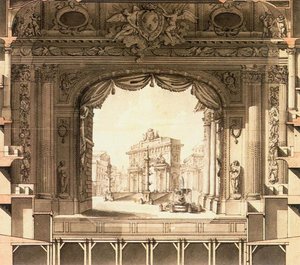
- The Salle de l'Opéra at Versailles
- The Place Louis XV, now known as Place de la Concorde, in Paris
Despite facing professional difficulties, such as the enmity of the Marquis de Marigny and a lack of royal funds, his influence on the landscape of France remained profound. From the Place Royale in Bordeaux to the colonnaded bays at Versailles, his buildings were defined by a sense of correctness and a careful arrangement of architectural forms.
Q&A
Ange Jacques Gabriel 작가의 국적은 어디인가요?
Ange Jacques Gabriel은(는) France 출신입니다.
Ange Jacques Gabriel의 출생지와 출생 연도는 어떻게 되나요?
Ange Jacques Gabriel은(는) 1698년 Paris에서 태어났습니다.
Ange Jacques Gabriel의 출생 도시와 국가는 어디인가요?
Ange Jacques Gabriel은(는) France Paris에서 태어났습니다.