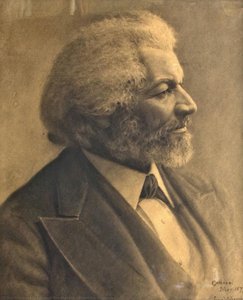
A Legacy Captured in Portraiture
Born in the vibrant atmosphere of New York City, United States of America, Eva Amarantha Webster emerged as a painter capable of capturing profound human dignity through her brushwork. Her life, spanning from 1854 to 1945, saw her navigate an era of immense social and historical transformation. While much of her personal history remains veiled in the quietude of the past, her artistic contribution is anchored by her ability to render subjects with a sense of permanence and respect.
The essence of Webster's talent is perhaps most notably reflected in her 1887 work, Frederick Douglass. In this piece, she engaged with one of the most significant figures of the nineteenth century, translating his powerful presence onto canvas. This specific work, which can be found at the Frederick Douglass National Historic Site in Washington, D.C., serves as a testament to her skill in portraiture and her ability to connect with the gravity of her subjects' legacies.
Artistic Presence and Historical Context
Webster’s work exists as a window into a period where the art of portraiture served not only as a means of documentation but as an emotional bridge between the subject and the viewer. Through her meticulous approach, she was able to contribute to the visual history of her time, ensuring that the likenesses of influential figures were preserved with care. Her ability to capture the spirit of her subjects remains her most enduring achievement, leaving behind a legacy that continues to be studied by those interested in the intersection of art and historical identity.
Q&A
Eva Amarantha Webster의 다른 이름이나 별칭에는 무엇이 있나요?
Eva Amarantha Webster은(는) Eva Webster라는 이름으로도 활동하고 있습니다.
Eva Amarantha Webster의 출생 도시와 국가는 어디인가요?
Eva Amarantha Webster은(는) United States of America New York City에서 태어났습니다.
Eva Amarantha Webster은(는) 어느 시대의 작품을 남겼나요?
Eva Amarantha Webster은(는) 19th Century 시대에 활동했습니다. 이 시기는 역사적 맥락 속에서 작가의 예술적 위치를 보여줍니다.