Early Life, Family and Training
Frans Hogerwaard entered the world on November 10, 1882, in Weltevreden, Java. His early years were shaped by a dual focus on discipline and visual form. Before committing fully to the canvas, he studied the cello, a pursuit that required a precision often mirrored in the technical demands of printmaking and painting. This musical foundation provided a rhythmic structure to his later artistic sensibilities.
His formal training began at the School voor Kunst en Kunstnijverheid in Haarlem. This period established the technical groundwork necessary for a professional career in the arts. He moved from this foundational instruction to the Rijksacademie in Amsterdam, where he studied from 1904 to 1906. Under the guidance of Allebé, Hogerwaard refined his draftsmanship and composition, moving beyond mere imitation toward a more deliberate command of his medium.
Travels and Artistic Development
Hogerwaard’s trajectory shifted decisively in 1907 when he moved to Paris alongside Piet van der Hem. This period in France provided the necessary friction for his development, resulting in the etching Het huisje van Berlioz. By 1908, he had returned to Holland, but his momentum was only truly validated in 1910. That year, he secured the Prix de Rome, a distinction earned through his work Mozes en de strijd tegen de Amalekieten. This achievement dictated the geography of his subsequent years.
The prize necessitated an extended period of residency across several major European and North African hubs. He spent significant time navigating the visual landscapes of Rome, Florence, Venice, Madrid, and Algiers. These travels were not mere excursions; they were the practical requirements of his professional standing. His connection to France remained a recurring theme in his life. He returned to Paris in 1913, eventually settling in St. Cloud, before his final return to Holland in early 1914.
Later Years and Death
The final decade of Hogerwaard's life was marked by a restless movement between the urban centers of the Netherlands and the quietude of the countryside. After his time spent in the Mediterranean and Paris, he returned to the Netherlands in 1914. He spent a period working in Heeze alongside Gerdes before moving into a studio located in the Joh. van Campenstraat in Amsterdam. This period represented a shift from the expansive travels of his youth toward a more settled, though still nomadic, professional existence.
Personal life and professional output intersected in 1918 when he married Marie Constance Françoise de Bruijn Kops on April 15. His movements remained frequent; he spent a few months working in Oosterbeek before eventually settling in Den Haag. This final chapter of his life was cut short. He died in Den Haag, Nederland, on June 15, 1921, leaving behind a body of work that reflects the tension between his formal training and the impulse to move beyond established boundaries.
Technique and Key Works
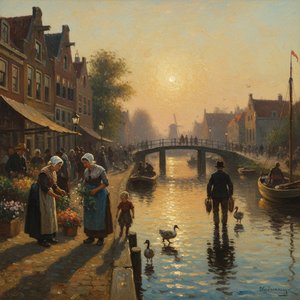
Hogerwaard’s output reflects the core tenets of Impressionism, applied through the disciplined application of both etching and painting. His technical range allowed him to move between the precise, linear demands of printmaking and the more fluid requirements of canvas. This versatility is evident in his ability to translate complex compositions into different media, maintaining a consistent focus on form and light regardless of the surface.
His time in Paris proved decisive for his development as a printmaker. It was during this period that he produced the etching Het huisje van Berlioz, a work that demonstrates his command over the medium. This piece highlights a capacity for capturing specific, localized subjects through the sharp, deliberate lines characteristic of high-quality etching. His work in this medium was not merely a secondary pursuit but a fundamental part of his visual language.
In his paintings, Hogerwaard demonstrated a willingness to engage with established visual traditions through reinterpretation. A notable example is his painting The Holy Genoveva, which was created after a work by P. Puvis de Chavannes. By taking on such a subject, he engaged with the formal structures of his predecessors while applying his own Impressionist sensibilities. His work remains a concrete example of how an artist navigates the tension between classical composition and modern technique.
Q&A
Frans Hogerwaard은(는) 어느 시대의 작품을 남겼나요?
Frans Hogerwaard은(는) Modern 시대에 활동했습니다. 이 시기는 역사적 맥락 속에서 작가의 예술적 위치를 보여줍니다.
Frans Hogerwaard의 출생 도시와 국가는 어디인가요?
Frans Hogerwaard은(는) Dutch East Indies Batavia에서 태어났습니다.
Frans Hogerwaard 작가의 국적은 어디인가요?
Frans Hogerwaard은(는) Dutch East Indies 출신입니다.