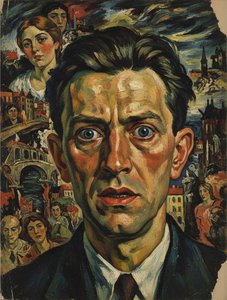
The Devotion of a Nazarene
To understand Johann Gebhard Flatz, one must look past the simple label of an Austrian painter and see the grit required to survive the nineteenth century. Born in Wolfurt as the eleventh child of a baker, his early life was defined by poverty rather than privilege. He did not arrive at the Academy of Fine Arts in Vienna through ease; he arrived through a grueling apprenticeship completed by age fifteen and years spent working as a waiter and a house painter to fund his studies. This struggle shaped a technical discipline that would later define his religious output.
His work belongs firmly to the Nazarene movement, a group that sought to revive spiritual sincerity in art. Flatz found his footing in Rome, where he integrated into this circle of artists dedicated to Christian themes. His career was not a steady ascent but a series of shifts between Rome and Innsbruck, driven by both artistic connection and financial necessity. He eventually settled in Vorarlberg following the Capture of Rome in 1870, spending his final years near the parish church of Bregenz.
A Life Marked by Loss and Faith
The emotional weight behind Flatz’s religious compositions is impossible to ignore when examining his personal history. In 1838, he married Marie Felicitas Freiin von Foullon-Norbeck, but the period following their union was marked by profound tragedy. The death of both of his children shortly after birth, followed by the death of his wife in 1840, left a visible mark on his productivity. He did not pick up his brush with any regularity for a full year after these losses.
Despite this, he maintained a presence within the religious community, becoming a member of the Campo Santo Teutonico. His reputation as "the Catholic painter of his time" was earned through a consistent focus on sacred subjects. His output included:
- Portraits, including over 150 produced in 1829.
- Religious works such as Madonna with Child and John the Baptist as a boy.
- Devotional pieces like The Ecstasy of Saint Francis.
- Studies including the Verkündigung an Maria.
Technical Precision and Recognition
Flatz utilized a range of methods to convey his religious narratives, from pencil drawings like Der Heilige Georg to steel engravings. His ability to navigate both the delicate requirements of portraiture and the heavy demands of large-scale religious painting secured his place in the Austrian art scene. He was not merely a painter of sentiment; he was a technician capable of handling diverse media.
His contributions were recognized by the state toward the end of his life. In 1879, he received the Order of Franz Joseph, an honor that acknowledged his long-standing service to the visual culture of his region. He died in Bregenz in 1881, leaving behind a body of work that remains a specific, unyielding record of the Nazarene commitment to sacred imagery.
Q&A
Gebhard Flatz의 출생지와 출생 연도는 어떻게 되나요?
Gebhard Flatz은(는) 1800년 Rickenbach에서 태어났습니다.
Gebhard Flatz의 다른 이름이나 별칭에는 무엇이 있나요?
Gebhard Flatz은(는) Johann Gebhard Flatz, Joh. Gebhard Flatz라는 이름으로도 활동하고 있습니다.
Gebhard Flatz은(는) 어느 시대의 작품을 남겼나요?
Gebhard Flatz은(는) 19th Century 시대에 활동했습니다. 이 시기는 역사적 맥락 속에서 작가의 예술적 위치를 보여줍니다.