The Legacy of a Master of History and War
Isidore Alexandre Augustin Pils was a distinguished French academic painter whose brush captured the profound intersections of religious devotion, military grandeur, and nationalistic fervor. Born in Paris as the son of a soldier, François Pils, his early life was steeped in a lineage of service that would later manifest in his fascination with the heroic and the martial. His artistic journey began in earnest at the age of twelve under the guidance of Guillaume Guillon-Lethière, eventually leading him to the prestigious École des Beaux-Arts. It was here, studying under François-Édouard Picot, that Pils honed the meticulous technique required to navigate the demanding world of academic painting.
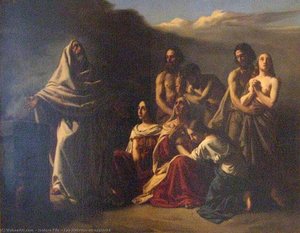
His ascent within the French art world was marked by significant early triumphs, most notably winning the Prix de Rome in 1838. This prestigious achievement allowed him to spend three years at the French Academy in Rome at the Villa Medici, an experience that enriched his understanding of classical beauty and historical narrative. During his time in Italy, he traversed the cultural landscapes of Naples, Venice, and Florence, absorbing the light and legacy of the masters. While his earliest works often explored religious themes—such as his award-winning St. Peter Healing a Lame Man at the Door of the Temple—his artistic focus underwent a transformative shift following his travels with French troops through the Crimea.
From Sacred Themes to Military Grandeur
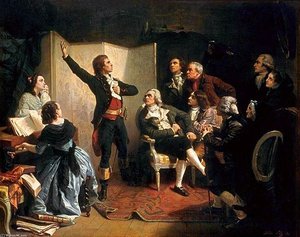
The evolution of Pils’s oeuvre reflects the turbulent political landscape of mid-19th-century Europe. As he moved away from purely religious subjects, his work began to pulse with the energy of contemporary military and nationalistic themes. He became a foremost painter of military subjects, capable of blending the emotional depth of Romanticism with a precise, academic realism. This transition was perhaps most vividly realized in his famous 1849 work, Rouget de L'Isle Singing La Marseillaise, which remains a powerful emblem of French identity.
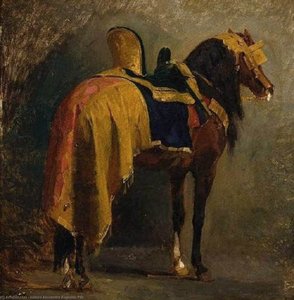
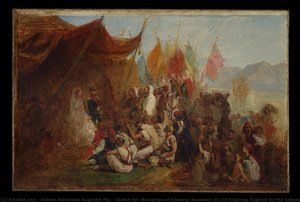
His ability to capture the weight of history and the solemnity of war is evident in works such as Horse Caparisoned. In this piece, Pils demonstrates his mastery of texture and symbolism, using a riderless horse draped in rich fabrics to evoke a sense of mourning and noble grace. His talent for large-scale historical commemoration was also highly sought after; he executed significant compositional sketches for massive canvases intended to celebrate imperial visits, such as the reception of Napoleon III in Algeria. Even during the darkest moments of the Franco-Prussian War and the siege of Paris, Pils continued to document the era through his military scenes, cementing his role as a visual chronicler of his nation's struggles.
Academic Eminence and Final Contributions
Beyond his individual canvases, Pils left an indelible mark on the institution of art education. In 1863, he was appointed professor of painting at the École des Beaux-Arts, sharing his rigorous training with a new generation of artists including Adrien Moreau and Paul Adolphe Rajon. His prestige was further solidified in 1868 when he was elected to seat #14 of the Académie des Beaux-Arts.
In the twilight of his life, Pils contributed to some of the most iconic architectural spaces in Paris. He worked on the grand staircase of the Palais Garnier, painting panels that depicted celestial and harmonious themes, such as The Gods of Olympus and Apotheosis of the Opera. These works, completed in the year of his death, stand as a testament to his enduring ability to marry the monumental with the exquisite. Though he passed away in Douarnenez, his legacy remains woven into the fabric of French academic tradition, preserved through works that continue to evoke the dignity, tragedy, and glory of a bygone era.
Q&A
이시도르 필스의 출생지와 출생 연도는 어떻게 되나요?
이시도르 필스은(는) 1815년 옛 파리 10구에서 태어났습니다.
이시도르 필스은(는) 어느 시대의 작품을 남겼나요?
이시도르 필스은(는) 19세기 미술 시대에 활동했습니다. 이 시기는 역사적 맥락 속에서 작가의 예술적 위치를 보여줍니다.