A Life Dedicated to Serene Observation: Ivan Khrutsky and the Intimacy of Russian Realism
Ivan Aleksandrovich Khrutsky (1810-1885) occupies a unique, often understated position within the landscape of 19th-century Russian art. While not as widely celebrated as his contemporaries like Aivazovsky or Repin, Khrutsky’s contribution lies in his quiet dedication to capturing the beauty of everyday life – the stillness of interiors, the delicate arrangement of still lifes, and the contemplative presence of monastic figures. Born into a family with Polish roots in the village of Ulka, Vitebsk Gubernia (modern-day Belarus), Khrutsky's artistic journey began with formal training at the Imperial Academy of Arts in St. Petersburg in 1830. This foundational education instilled in him a mastery of academic technique, which would become a hallmark of his style, even as he moved towards a more personal and nuanced expression. His early works, dating back to 1832, quickly garnered attention for their meticulous detail and emerging artistic sensibility.From Academy Training to the Intimacy of Domestic Life
Khrutsky’s initial success wasn't limited to painting; he also found favor as an interior designer, a profession that deeply informed his artistic vision. This practical experience honed his understanding of light, space, and composition – elements that would become central to his depictions of domestic interiors. He excelled in creating scenes imbued with a sense of warmth and tranquility, often featuring wealthy homeowners and their surroundings. In 1836, he was awarded the Major Silver medal by the Academy for his still lifes, signaling a growing recognition of his talent within the established art world. This period also saw him produce genre paintings and portraits, demonstrating a versatility that further solidified his reputation. However, it was after his father’s death in 1840 that Khrutsky made a pivotal decision: he retreated from the bustling artistic life of St. Petersburg to settle permanently on his family estate in Zakharevichi, Polotsk region. This move marked a shift in focus towards religious commissions and portraiture for local patrons, but it also allowed him to cultivate a deeply personal style rooted in observation and contemplation.The Monastic World and the Still Life Genre
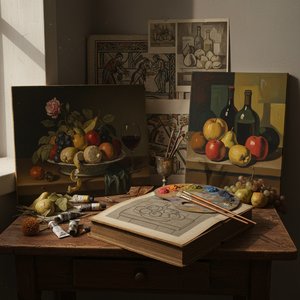
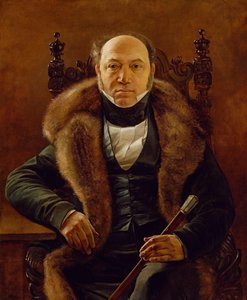
The years spent on his estate were characterized by a steady stream of commissioned work, primarily religious art for churches throughout Lithuania. Yet, even within these devotional pieces, Khrutsky’s distinctive touch is evident – a quiet dignity and emotional depth that transcends mere technical proficiency. Alongside these sacred commissions, he continued to paint portraits, capturing the likenesses of prominent figures like I.I. Glazunov and Joseph Semashko with sensitivity and skill. However, it's perhaps in his still lifes that Khrutsky’s artistic voice shines most brightly. These are not merely representations of objects; they are meditations on beauty, transience, and the simple pleasures of life. He arranged fruits, flowers, and everyday items with a deliberate artistry, using light and shadow to create compositions that are both visually appealing and emotionally resonant. His paintings evoke a sense of peaceful abundance, inviting viewers to pause and appreciate the quiet moments of existence.Influences and Artistic Legacy
Khrutsky’s work reflects the influence of Academic Art, particularly in his precise technique and attention to detail. However, he also demonstrates an affinity for Realism, evident in his honest depictions of everyday life and his rejection of idealized forms. Vasily Petrovich Verkhoff is noted as one of the artists who influenced Khrutsky's development. While not a revolutionary figure, Khrutsky played a significant role in shaping the aesthetic landscape of 19th-century Russian art. His paintings offer a glimpse into the lives of both the wealthy elite and the religious communities of his time, providing valuable insights into the social and cultural context of the period. Today, Ivan Khrutsky’s works are appreciated for their serene beauty, technical mastery, and enduring emotional power – a testament to a life dedicated to observing and celebrating the quiet moments that make up the fabric of human existence. His legacy continues to inspire artists and art lovers alike with its understated elegance and profound sense of peace.Q&A
Ivan Khrutsky의 출생 도시와 국가는 어디인가요?
Ivan Khrutsky은(는) Belarus Uła에서 태어났습니다.
Ivan Khrutsky은(는) 어느 시대의 작품을 남겼나요?
Ivan Khrutsky은(는) 19th Century 시대에 활동했습니다. 이 시기는 역사적 맥락 속에서 작가의 예술적 위치를 보여줍니다.
Ivan Khrutsky 작가의 다른 활동명이나 알려진 이름이 있나요?
Ivan Khrutsky은(는) Jan Chrucki, Ivan Fomich Khrutsky, Ivanas Chruckis, Ivan Chrucki, Ivan Khroutski라는 이름으로도 활동하고 있습니다.