Early Life, Family and Training
Jean Duncan was born in Edinburgh in 1933. Her early years were shaped by her time at the Edinburgh College of Art, where she studied from 1951 to 1955. During these formative years in the studio, she met her husband, Roderick. The two would go on to make a significant impact on the art scene in every place they settled. Their lives were closely intertwined with their creative pursuits, and they shared a life that spanned over six decades.
Following her time at the college, she spent a year at the Moray House School of Education. This period of study preceded a life that would see her move between different landscapes, eventually settling in Northern Ireland. As her career progressed, her personal life expanded as well; she had children over the following seven years. These years of building a family and a practice occurred alongside her growing presence in the local art communities.
Artistic Training and Workshop Foundations
After settling in Belfast, Duncan focused her attention on the technical nuances of printmaking. In 1980, she pursued a post-graduate diploma at the Ulster Polytechnic. This period of study led to a significant professional partnership when she co-founded the Seacourt Print Workshop in Bangor, County Down. The workshop became a central part of her practice, a place where the physical demands of the medium met her interest in collaborative creation.
Her work often moved between the visual and the auditory. She collaborated with composers Piers Hellawell and Deirdre McKay, translating their musical compositions into imagery. These projects were not merely illustrations but were works created in response to the sound itself. This habit of working alongside musicians became a recurring thread in her career, linking the silence of the studio to the movement of a score.
By 1994, her standing within the local art community was recognized when she was elected a member of the Royal Ulster Academy. This period marked a steady integration into the professional structures of Northern Ireland's art scene, moving from the hands-on environment of the workshop to formal recognition within the academy.
Technique and Artistic Style
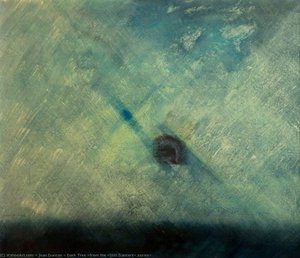
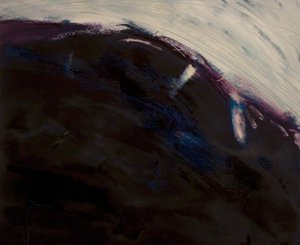
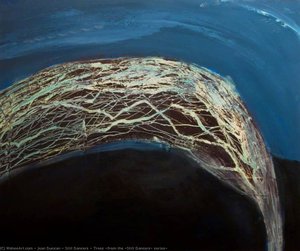
Her practice moved between painting, printmaking, and video art. Much of her visual language was drawn from the landscapes of the West of Ireland, translating the physical terrain into layered compositions. She often worked with the rhythms of sound, creating series of etchings that responded to specific musical structures. This included a series of etchings inspired by the music of John Taverner, specifically his work The Protecting Veil. She also produced images that responded to the compositions of Piers Hellawell and Deirdre McKay, turning auditory patterns into visual forms.
The work often carries a sense of movement through its varied textures. In her prints, she explored how light and shadow interact with the landscape, sometimes using the medium to capture atmospheric shifts. Her approach to printmaking allowed for a physical depth that mirrored the complexity of the music she studied. Whether working in etching or through video, the focus remained on how a specific sound or a specific place could be distilled into a mark on a surface.
Exhibitions and International Presence
Her work moved through several spaces in Belfast and Manchester, finding a place in the local art scene through various solo shows. In 1986, she presented a solo exhibition titled Sense and Symbols at the Octagon Gallery in Belfast. This was followed by another solo show at One Oxford Street in Belfast in 1993. These exhibitions allowed her to present her prints and paintings to a wider audience within the United Kingdom.
Beyond these regional shows, her presence extended to international exhibitions. She was part of the 2001 International Biennial in Portugal. Later, in 2005, she participated in the Tokyo International mini-print Triennial. These appearances placed her printmaking work in a global context, reaching collectors and viewers far from her base in Northern Ireland.
Where to See the Works Today
Her prints and paintings have found their way into several permanent collections across the British Isles. In Ireland, you can find her work held by the Arts Council of Northern Ireland. The Bank of Ireland and AIB Bank also keep pieces of her output in their collections. These works remain part of the visual landscape in various public and private spaces.
Other examples of her practice are held at University College Dublin. In Scotland, Dundee Contemporary Arts maintains pieces from her career. These locations offer a way to see how her focus on rhythm and texture settled into the institutional records of the regions where she lived and worked.
Q&A
Jean Duncan 작가의 다른 활동명이나 알려진 이름이 있나요?
Jean Duncan은(는) Jean Fraser, Jean Isobel Duncan(으)로도 알려져 있습니다.