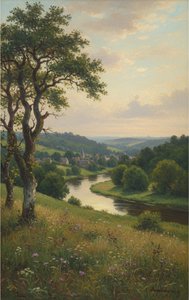
A Life in Color and Light
Jeanne Rongier was born in 1852 in Mâcon, France. Her early years were shaped by the quiet landscapes of her birthplace, where she first began to understand the language of light and shadow. She sought out guidance from Henri Senart, a teacher who helped her find her footing in the delicate art of painting. As her talent grew, she moved toward more complex studies, learning from Henri Joseph Harpignies and Evariste Vital Luminais. These mentors helped her develop a style that felt deeply connected to the natural world, often finding inspiration in the dense, quiet woods of the Fontainebleau forest.
Her work often looked back to the old masters, finding a sense of purpose in the genre scenes of artists like Frans Hals and Jacob Duck. She had a way of capturing historical moments and quiet, domestic scenes with a sense of lived-in reality. By the time she began exhibiting at the Salon de Paris in 1869, she had established herself as a painter with a distinct and steady hand.
Recognition and Artistic Milestones
Throughout her career, Rongier achieved several honors that reflected her skill and the respect of her peers. Her ability to translate history and nature onto canvas led to several significant moments in her professional life:
- She was admitted as a member of the Société des artistes français in 1883.
- She received an honorable mention at the Universal Exhibition in 1884 and again in 1900.
- She was awarded a third-class medal in 1887.
Her presence in the art world was felt far beyond the borders of France. In 1893, her work was featured at the World's Columbian Exposition in Chicago, appearing in the Pennsylvania Building, the Palace of Fine Arts, and The Woman's Building. This international exposure brought her vision to a much wider audience, placing her work alongside the most significant creative efforts of her era.
The Legacy of the Canvas
The paintings she left behind continue to reside in various collections, offering a glimpse into the technical precision of her era. One of her notable works, Séance de portrait sous le Directoire, is held in the Musée des beaux-arts de Vannes. This piece, an oil on canvas, measures 130x195 cm and serves as a quiet window into the social textures of the past. Other works have found their way into the museums of Clamecy, Rouen, and Mâcon, ensuring her contribution to French painting remains part of the public record.
Rongier passed away in Paris in 1929. She lived through a period of immense change in the art world, yet she remained true to the traditions of her training, maintaining a style that was closely aligned with the Barbizon school. Her life was one of steady dedication to the craft of painting, leaving behind a body of work that captures the stillness of a moment and the weight of history.
Q&A
Jeanne Rongier 작가의 다른 활동명이나 알려진 이름이 있나요?
Jeanne Rongier은(는) ジャンヌ・ロンジェ, 让娜·龙吉耶(으)로도 알려져 있습니다.
Jeanne Rongier은(는) 어느 시대의 작품을 남겼나요?
Jeanne Rongier은(는) 19th Century 시대에 활동했습니다. 이 시기는 역사적 맥락 속에서 작가의 예술적 위치를 보여줍니다.
Jeanne Rongier의 출생 도시와 국가는 어디인가요?
Jeanne Rongier은(는) France Mâcon에서 태어났습니다.