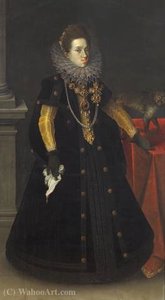
A Legacy of Light and Venetian Splendor
The story of Joseph Heintz the Younger is one of profound movement and cultural synthesis, tracing a path from the heart of Germany to the shimmering canals of Italy. Born in Augsburg, Germany, he was the son of the esteemed Joseph Heintz the Elder, inheriting a lineage steeped in artistic tradition. His early years were shaped by a rigorous apprenticeship under his stepfather, Matthiana Gundelach, between 1617 and 1621. This formative period in Augsburg laid the technical foundation for a career that would eventually transcend borders, as his burgeoning talent led him to seek new horizons beyond his birthplace.
In 1625, a pivotal journey took him to Italy, where he found his true artistic home in Venice. This relocation was more than a mere change of scenery; it was a spiritual and professional metamorphosis. His conversion to Catholicism became a defining element of his life, providing the theological impetus for much of his religious output. Settling within the vibrant Venetian atmosphere, he began to master the art of capturing both the divine and the terrestrial, often drawing inspiration from his father's legacy through meticulous copies that helped establish his reputation in the local artistic community.
Mastery of the Baroque Canvas
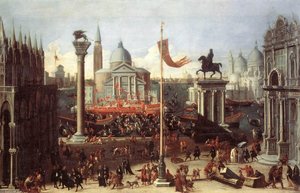
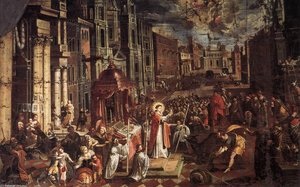
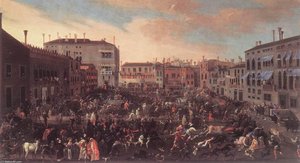
As a painter of the Baroque era, Heintz possessed a remarkable ability to weave complex narratives through light, shadow, and architectural grandeur. His work often oscillated between the sacred and the spectacular. In his religious compositions, such as the profound Christ in Limbo, one can witness the emotional depth and dramatic tension characteristic of the period. Yet, it was perhaps in his depictions of Venetian life that he truly left an indelible mark on the history of art. He became a celebrated chronicler of the city's festivities and state ceremonies, populating his canvases with vast, lively crowds and intricate architectural details.
His talent for large-scale, atmospheric scenes is exemplified in works like The Bull Hunt in Campo San Polo and Imaginary Scene with Venetian Buildings. In these masterpieces, the artist demonstrates an extraordinary command over composition, using ornate domes, towers, and canals to create a sense of immersive depth. His ability to render the bustling energy of the streets—filled with figures in historical attire and the rhythmic movement of gondolas—positions him as a vital precursor to later masters of the Venetian veduta style, such as Canaletto. Through his brush, the ephemeral moments of Venetian celebration were transformed into enduring monuments of oil and canvas.
Artistic Significance and Enduring Influence
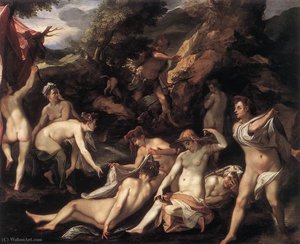
The significance of Joseph Heintz the Younger lies in his unique position as a bridge between German training and Italian splendor. While he was capable of profound mythological and allegorical storytelling, his true contribution to the Venetian school was his ability to capture the very soul of the city through its architecture and public rituals. His work served the needs of the Counter-Reformation, providing churches with powerful visual tools for devotion, while simultaneously enriching the secular tradition of landscape and cityscape painting.
Throughout his long career, which saw him honored as a Knight of the Order of the Golden Spur by Pope Urban VIII, he remained a steadfast observer of the world around him. Whether through the intimate detail of a genre painting or the sweeping grandeur of an imaginary cityscape, his oeuvre remains a testament to the transformative power of the Baroque spirit. He left behind a legacy that continues to invite viewers into a lost world of Venetian majesty and dramatic grace.
질의응답
Joseph The Younger Heintz의 다른 이름이나 별칭에는 무엇이 있나요?
Joseph The Younger Heintz은(는) Joseph Heintz The Younger, Joseph Heintz (Ii)(으)로도 알려져 있습니다.
Joseph The Younger Heintz은(는) 어느 시대에 활동했나요?
Joseph The Younger Heintz은(는) Early Modern 시대에 활동했습니다. 이 시기는 역사적 맥락에서 작가의 활동 위치를 보여줍니다.
Joseph The Younger Heintz의 출생지와 출생 연도는 언제인가요?
Joseph The Younger Heintz은(는) 1600년 Augsburg에서 태어났습니다.