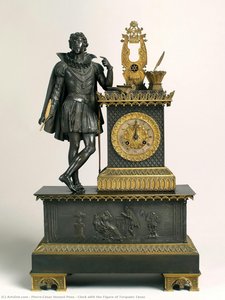
The Master of Time: The Life of Pierre-César Honoré Pons
Pierre-César Honoré Pons was not a visual artist in the traditional sense of painting or sculpture, but rather an extraordinary horologist whose mastery over mechanical precision shaped the very rhythm of the nineteenth century. Born in Paris, France, his early life was marked by a profound fascination with the science of time measurement. His education began under the guidance of the Jesuits in the rue Mouffetard, a foundation that likely nurtured the disciplined mind required for the intricate world of clockmaking. This intellectual rigor prepared him for an apprenticeship with the legendary Antide Janvier, one of the most brilliant horologists of his era. Although the political turbulence of the French Revolution disrupted his formal training, the seeds of technical excellence had already been sown.A Legacy of Precision and Innovation
The trajectory of Pons's career was defined by a relentless pursuit of perfection in the mechanics of time. Following his early studies, he entered the prestigious workshop of Lepaute in 1798, where he refined his skills within one of the most esteemed environments of the period. By 1803, his ambition led him to establish his own workshop in the rue de la Huchette, situated near the Place Saint-Michel. This location placed him at the heart of a community of distinguished makers, including luminaries such as Berthoud, Breguet, and Lépine. While he operated his own business, Pons also served as a vital supplier to these masters, contributing high-quality mechanisms that fueled the golden age of French horology. His contributions extended far beyond mere assembly; he was an inventor whose intellect pushed the boundaries of what a machine could achieve. His obsessive quest for accuracy led to the creation of several new escapements and specialized machinery designed for the precise cutting of gear teeth and the polishing of pinion leaves. In 1804, his scientific prowess was recognized by the Academy of Sciences when he presented his observations on free escapements, supported by the esteemed Ferdinand Berthoud.Artistry in Bronze and Brass
While his primary focus was the internal movement, the works associated with Pons's name are celebrated for their breathtaking aesthetic harmony. The mantel clocks produced under his direction often featured a sophisticated combination of patinated and gilded bronze, a technique that allowed Parisian artists to achieve unparalleled depth and luster. These pieces frequently blended the grandeur of the Neoclassical tradition with elements from the Gothic repertoire, creating a balanced composition that appealed to the Romantic sensibilities of the era. The significance of his work is immortalized in the exquisite details of his clocks, which often depicted historical figures and literary heroes. His craftsmanship was so highly regarded that he received numerous gold and silver medals, and his technical excellence was even noted by Napoleon’s Interior Minister. Through his mechanical genius and his ability to marry scientific precision with decorative elegance, Pierre-César Honoré Pons left an indelible mark on the history of horology, ensuring that his name remains synonymous with the pinnacle of nineteenth-century French clockmaking.Q&A
피에르 세자르 오노레 퐁의 출생 도시와 국가는 어디인가요?
피에르 세자르 오노레 퐁은(는) France Paris에서 태어났습니다.
피에르 세자르 오노레 퐁의 출생지와 출생 연도는 어떻게 되나요?
피에르 세자르 오노레 퐁은(는) 1773년 Paris에서 태어났습니다.
피에르 세자르 오노레 퐁 작가의 국적은 어디인가요?
피에르 세자르 오노레 퐁은(는) France 출신입니다.