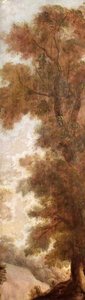
The Alchemist of Canvas and Chemistry
In the grand tapestry of twentieth-century intellectual history, few figures loom as uniquely as Sir Robert Robinson. To the scientific community, he was a titan of organic chemistry, a Nobel laureate whose mastery over molecular structures redefined our understanding of life's very building blocks. Yet, beneath the rigorous precision of the laboratory bench beat the heart of a visionary painter, an artist capable of translating the complexities of the natural world into evocative, dreamlike landscapes. This rare duality—the marriage of scientific exactitude and artistic imagination—allowed Robinson to approach the canvas with a singular perspective, where the structural logic of chemistry met the fluid beauty of the sublime.
Born on September 13th, 1886, at Rufford House Farm near Chesterfield, Derbyshire, Robinson’s early life was steeped in an environment that nurtured both inquiry and observation. The son of James Bradbury Robinson, a skilled maker of surgical dressings, he was raised amidst the scents and certainties of science. His academic journey through Chesterfield Grammar School and the University of Manchester provided the foundational discipline that would later characterize his groundbreaking research into alkaloids and plant dyestuffs. However, it was this very foundation of structural analysis that perhaps most profoundly influenced his artistic eye; he did not merely see a landscape, but understood the intricate, interconnected systems that composed it.
A Visionary Synthesis of Style and Subject
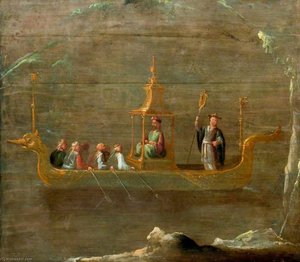
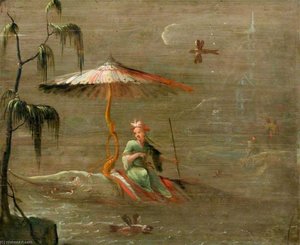
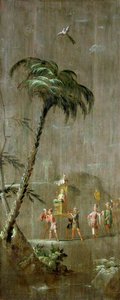
As his scientific career ascended—marked by prestigious appointments at the University of Sydney, Liverpool, and ultimately Oxford—Robinson’s artistic voice began to emerge with increasing distinctiveness. His work often transcends the boundaries of traditional landscape painting, venturing into realms that blend Orientalist influences with a profound sense of fantasy. One might encounter his canvases and find themselves lost in scenes such as "A Chinese Dignitary Riding a Fish," where the boundaries between reality and myth dissolve into vibrant, symbolic detail. This ability to weave classical Chinese motifs with a Western painterly technique creates a tension that is both captivating and deeply unsettling in its beauty.
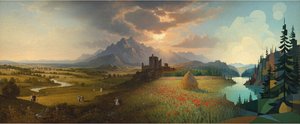
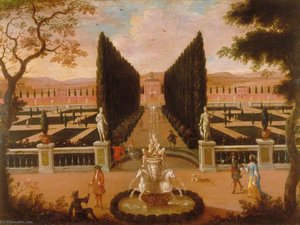
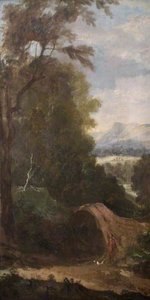
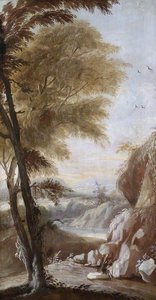
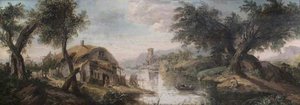
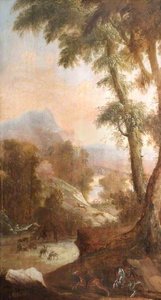
His landscapes are rarely mere topographical records; instead, they serve as windows into an imagined topography. In works like "Travellers Resting in a Mountainous Landscape," Robinson utilizes a style reminiscent of the Baroque and Romantic traditions to evoke a sense of atmospheric depth and human connection. He possesses a remarkable talent for capturing the quietude of nature—the stillness of a river valley or the heavy mist clinging to a peak—while simultaneously imbuing these scenes with an underlying sense of wonder. His brushwork often balances a meticulous attention to texture and light with a more fluid, imaginative embellishment that suggests a world governed by different, perhaps more magical, physical laws.
Legacy of a Dual Master
The historical significance of Robert Robinson lies in his refusal to be confined by the boundaries of a single discipline. While his invention of the curly arrow notation revolutionized how chemists visualize electron movement, his paintings revolutionized how we might perceive the intersection of the real and the imagined. He proved that the analytical mind does not preclude the poetic soul; rather, they can exist in a symbiotic state, where the study of a molecule and the study of a sunset are both quests for fundamental truth.
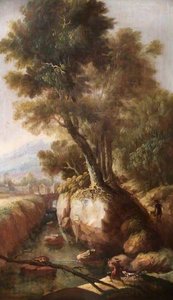
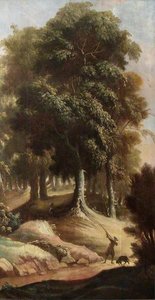
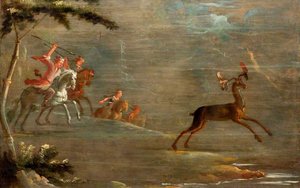
Today, his body of work stands as a testament to a life lived in pursuit of discovery. Whether examining the molecular architecture of morphine or painting the lush greenery of "Hunting by the River," Robinson remained eternally attuned to the intricate patterns of existence. His legacy is found not only in the textbooks of organic chemistry but in the enduring, evocative power of his canvases, which continue to invite viewers into a world where science and art are one.
질의응답
Robert Robinson은(는) 어느 시대에 활동했나요?
Robert Robinson은(는) Modern 시대에 활동했습니다. 이 시기는 역사적 맥락에서 작가의 활동 위치를 보여줍니다.