A Life Painted in Travel: The World of Willem Schellinks
Willem Schellinks, born in Amsterdam in 1623, was a Dutch artist whose life unfolded as a remarkable journey—both geographically and creatively. Unlike many of his contemporaries rooted firmly in the artistic centers of the Netherlands, Schellinks distinguished himself by an insatiable wanderlust that profoundly shaped his vision. Coming from a family with artistic leanings – his brother Daniël also pursued painting as an amateur – Willem initially trained under Karel Dujardin, absorbing the foundations of Italianate landscape and genre scenes. However, it was not within the confines of the studio that Schellinks truly blossomed, but rather on the open road, sketchbook in hand. His early travels with Lambert Doomer through France hinted at his future path, yet it was the extensive Grand Tour undertaken between 1661 and 1665, accompanying young Jakob Thierry de Jong, that irrevocably altered his artistic trajectory. This odyssey took him across England, France, Italy, Sicily, Malta, Germany, and Switzerland, a meticulous documentation of observations transforming into drawings, notes, and sketches – the very lifeblood of his art.The Italianate Embrace and Atmospheric Innovations
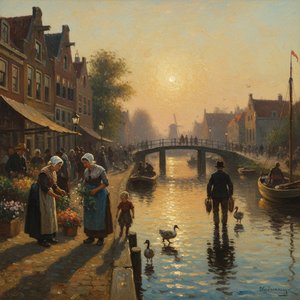
Schellinks’ artistic style is best understood as a synthesis of keen observation, imaginative interpretation, and technical prowess. His exposure to the landscapes of Italy proved pivotal, leading him to embrace the *Italianate* aesthetic – characterized by classical ruins bathed in dramatic light, expansive vistas that stretched the imagination, and a sense of romantic melancholy. He wasn’t merely copying what he saw; rather, he was absorbing an atmosphere, a sensibility. This influence is palpable in his depictions of Dutch and Italian views, river scenes, harbor settings, and particularly, his evocative winter landscapes. He found particular inspiration in the work of Jan Asselyn, a master of atmospheric effects and compositional restraint. Asselyn’s ability to distill a scene down to its essential elements, emphasizing mood over meticulous detail, resonated deeply with Schellinks. This is evident in Schellinks' own winter scenes, where stillness and serenity are captured not through bustling activity but through subtle gradations of light and shadow, the quiet hush of falling snow. He wasn’t simply painting a landscape; he was conveying a feeling, an emotional resonance with the natural world.Naval History and Collaborative Visions
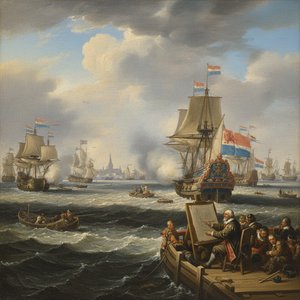
While celebrated for his landscapes, Schellinks also demonstrated a remarkable ability to portray dramatic historical events. His depictions of naval battles, most notably *Burning of the English Fleet near Chatham* (1667-1678) and *Battle of Medway* (c. 1668), are powerful testaments to his skill in capturing both accuracy and intensity. These works aren’t simply records of conflict; they are visceral experiences, conveying the chaos, destruction, and human drama inherent in warfare. The raid on Chatham during the Second Anglo-Dutch War provided Schellinks with a subject that allowed him to combine his landscape skills with a narrative drive, resulting in paintings that were both visually compelling and historically significant. Beyond his individual endeavors, Schellinks frequently engaged in collaborative work, often painting landscapes into which other artists would add figures or intricate details. He partnered with Herman Nauwincx and Adriaen van de Velde on various projects, demonstrating a willingness to share his vision and enhance the overall impact of the artwork through combined expertise.A Legacy Rediscovered: Historical Significance
Though not widely recognized during his lifetime, Willem Schellinks’ work has gained increasing appreciation for its historical importance and artistic merit. His detailed observations offer invaluable insights into 17th-century Dutch society, travel practices, and naval history. His journals, meticulously preserved in the Royal Library of Copenhagen, stand as a remarkable source of information about European landscapes and culture during this period – a testament to his dedication to documenting the world around him. The fact that he may have been commissioned by the Dutch government to create sketches for intelligence purposes adds another layer of intrigue to his story. His paintings, while sometimes overshadowed by more famous contemporaries, reveal a unique artistic vision—one informed by extensive travel, a deep appreciation for atmosphere, and a willingness to experiment with both subject matter and technique. Schellinks’ unusual interest in Mughal miniatures, as evidenced in some of his works, further underscores his open-mindedness and willingness to draw inspiration from diverse cultural traditions. Today, Willem Schellinks is remembered not just as a painter, but as a chronicler of his time—an artist whose work continues to resonate with scholars and art enthusiasts alike, offering a captivating glimpse into a world long past.Q&A
Willem Schellinks의 출생 도시와 국가는 어디인가요?
Willem Schellinks은(는) Netherlands Amsterdam에서 태어났습니다.
Willem Schellinks 작가의 다른 활동명이나 알려진 이름이 있나요?
Willem Schellinks은(는) Willem Schellinger, Willem Scherinks, Willem Schellinck, Willem Schellings, Willem Schellingen(으)로도 알려져 있습니다.
Willem Schellinks은(는) 어느 시대의 작품을 남겼나요?
Willem Schellinks은(는) Early Modern 시대에 활동했습니다. 이 시기는 역사적 맥락 속에서 작가의 예술적 위치를 보여줍니다.